

Is it possible to repair scratches or blemishes on powder coated aluminium surfaces?
Minor scratches or blemishes on powder coated aluminium can often be retouched, provided the damaged area is clean, dry and free from loose coating. Deeper damage, exposed metal or a visibly mismatched repair may require professional preparation and recoating to restore a consistent finish.
Powder coated aluminium can be repaired, but the suitable method depends on the size, depth and position of the defect, as well as the required appearance and service conditions. A small surface mark may be treated locally, whereas widespread damage or coating failure usually calls for the affected component to be professionally prepared and recoated.
Minor surface damage
Small scuffs, pinholes and light scratches that have not compromised the underlying aluminium can sometimes be corrected with a compatible touch-up product. The repair should be colour-matched as closely as possible to the original powder coating, including its gloss level and texture. A colour match alone is not always sufficient: a smooth repair can remain visible against a textured finish, while differences in gloss can make an otherwise accurate colour appear inconsistent.
Before applying any repair material, the area should be washed with a suitable mild cleaner and allowed to dry fully. Contamination such as grease, polish, dust or salts can prevent adhesion. Any unstable coating around the mark should be removed, and the edge of the damaged area should be gently blended rather than leaving a sharp step between the original finish and the repair.
Damage that reaches the aluminium
Where a scratch has cut through the coating, the exposed aluminium needs particular care. Aluminium forms an oxide layer naturally, and surface contamination or corrosion products can reduce the adhesion of a new coating. The substrate should therefore be cleaned and mechanically prepared before a suitable primer or repair system is applied. The repair product must be compatible with aluminium and with the existing powder-coated surface; using an unsuitable paint can lead to poor adhesion, peeling or a visibly different finish.
A local repair may protect the exposed area, but it may still be noticeable when viewed at close range. This is more likely on large, flat profiles, dark colours, high-gloss finishes and textured coatings, where differences in application or sheen are easier to see.
When recoating is the better option
Professional recoating is generally more appropriate when:
- the coating is peeling, flaking or lifting beyond the original impact;
- there are several scratches or blemishes across the same component;
- the aluminium has been exposed over a substantial area;
- the finish has been damaged by chemicals, abrasion or unsuitable cleaning;
- the component must present a consistent appearance from end to end; or
- the coating provides a protective function in a demanding industrial environment.
The component is normally assessed first to determine whether the existing coating can be prepared successfully or whether it should be removed. Preparation may involve degreasing, controlled abrasion, removal of loose material and treatment of any corrosion or surface contamination. The chosen coating system is then applied under controlled conditions, with attention paid to film coverage, edge definition and the required colour, texture and gloss.
For a localised defect, blending may be possible, although the repair boundary can remain visible. For a high-visibility component or a finish that must be uniform, recoating the complete frame, tube or aluminium part is often preferable to creating several isolated touch-up areas. If multiple parts are being repaired, treating them as a batch can also help maintain a consistent appearance, particularly where they will be installed together.
Assessing whether a repair is successful
A repair should be checked for more than colour. The repaired area should have sound adhesion, an even surface and no lifting at the perimeter. It should also be inspected for differences in texture, gloss, coverage and edge visibility. Components exposed outdoors or to industrial contaminants need a repair system that is suitable for those conditions; an indoor decorative touch-up may not provide equivalent protection.
It is useful to identify the original powder coating specification, colour reference and finish type before selecting a repair material. If that information is unavailable, a coating specialist can assess a retained sample or an undamaged section, although an exact match may not always be possible because the existing finish may have weathered or changed with use.
For valuable, safety-critical or highly visible aluminium components, improvised sanding and painting can make the defect harder to correct. A coating specialist can advise whether a local treatment is technically adequate or whether full preparation and recoating will provide the more consistent result.
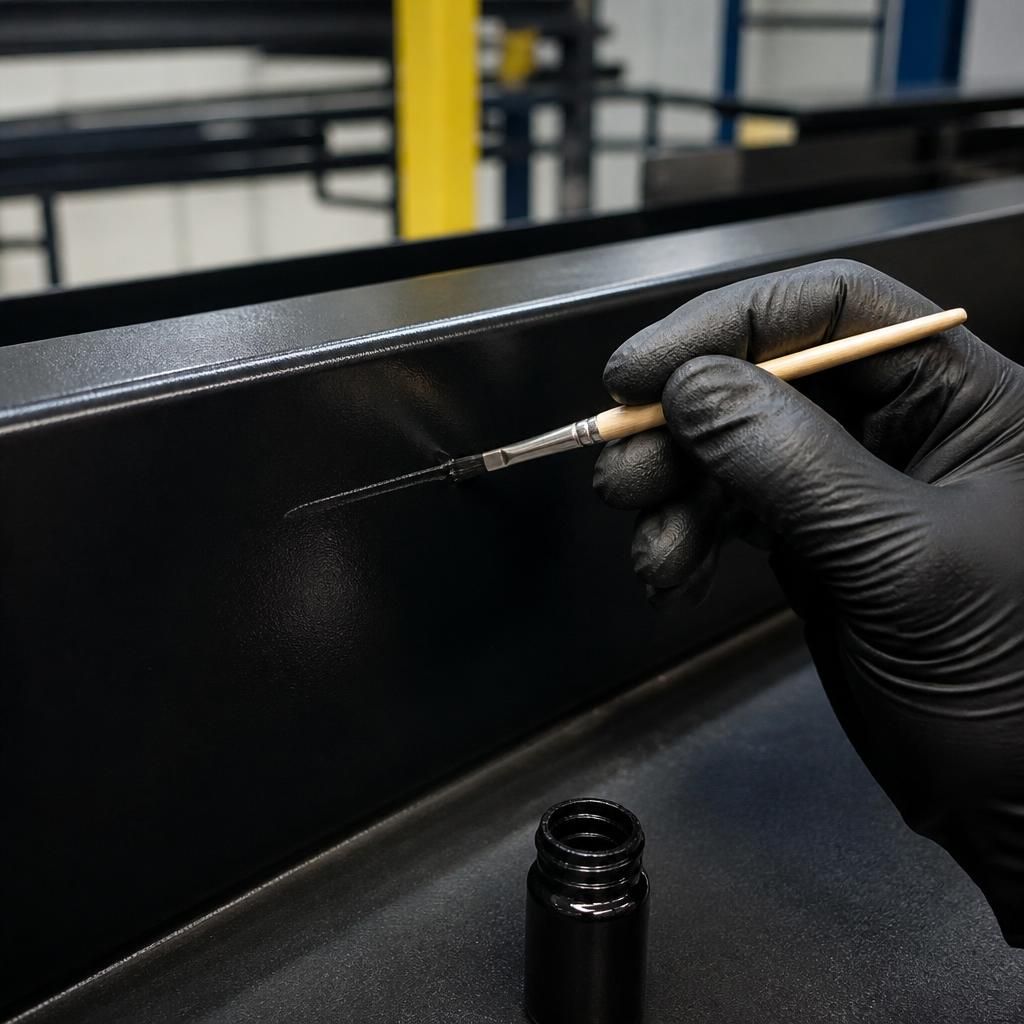
Powder coating is a cured finish, so a scratch cannot be removed by melting or reflowing the surrounding coating. Polishing may reduce the appearance of a very light surface mark, but aggressive polishing can alter the gloss and texture of the finish, creating a larger visible patch. Where the coating has been cut or worn away, the practical solution is to add a compatible repair layer rather than attempt to restore the original film by polishing alone.