

What are the benefits of using corrosion-resistant coatings for rust repair on powder-coated metals?
Corrosion-resistant coatings help protect repaired powder-coated metal from moisture, salts and other corrosive agents that can cause rust to return. Applied over suitably prepared areas, they reinforce the protective system, help preserve the metal substrate and can extend the useful life of the component.
Corrosion-resistant coatings provide a controlled protective layer over a repaired area, helping the repair perform as part of the wider powder-coating system rather than leaving exposed or weakly protected metal. Their main benefit is to reduce the conditions that allow corrosion to develop beneath the finish, particularly around repaired edges, welds, joints, fixings and areas where the original coating has been damaged.
Key benefits include:
- Improved protection at vulnerable areas: Rust often starts where the coating has been chipped, cut, abraded or penetrated. A suitable corrosion-resistant repair coating can cover these transitions and reduce the likelihood of corrosion spreading from the defect.
- Better resistance to underfilm corrosion: If corrosion progresses beneath an apparently intact coating, it can cause blistering, lifting and further loss of adhesion. A correctly selected repair system helps limit the conditions needed for this type of failure.
- Greater durability in demanding environments: Components exposed to industrial contaminants, road salts, condensation, cleaning chemicals or frequent handling may need more than a standard decorative touch-up. A corrosion-resistant formulation can provide a more appropriate level of protection for the component’s operating conditions.
- More reliable adhesion: Specialist repair coatings are selected to bond to the prepared substrate and, where compatible, to the surrounding powder coat. This helps reduce premature flaking or separation at the boundary between the repaired and original areas.
- Protection of repaired edges and complex geometry: Corners, folds, drilled holes, recesses and weld zones can be difficult to coat evenly. A suitable product and application method can improve coverage in these locations, where water and contaminants may otherwise collect.
- Preservation of the underlying metal: Limiting further corrosion helps retain the component’s original dimensions and surface condition. This is particularly important where corrosion could affect fits, fasteners, moving parts or the alignment of assembled components.
- Reduced need for repeated local repairs: A repair designed around the exposure conditions and the existing coating is less likely to fail simply because an unsuitable touch-up material was used. This can make future inspection and maintenance more manageable, although no coating removes the need for routine checks.
- Improved appearance after repair: Where the repair is properly prepared and the finish is matched as closely as practicable, the transition between the repaired section and the original powder coating can be made less noticeable. Appearance should be considered alongside protection, not used as a substitute for sound corrosion treatment.
The coating is only as effective as the preparation beneath it. Loose powder coating, rust, mill scale, grease, salts and other contamination must be removed, and any corrosion-related pitting may require additional treatment. If rust remains under the repair, the new coating can conceal an active problem rather than resolve it. The surrounding powder coat should also be checked for lifting or loss of adhesion, because applying a protective layer over unstable material does not create a sound repair.
Selection should take account of the metal, the remaining powder-coating system, the level of corrosion, the component’s environment and the required finish. A product intended for sheltered interior use may not be suitable for external, coastal, wet or chemically exposed service. Compatibility matters as well: some coatings require a particular primer, preparation standard or curing method, and not every repair product can be applied directly over existing powder coating.
For components with extensive section loss, deep pitting, cracked welds or corrosion affecting structural integrity, a coating alone is not a complete repair. The metal may need assessment, fabrication or replacement before recoating. Corrosion-resistant coatings are most effective when used as part of a complete repair system comprising inspection, preparation, appropriate coating selection, controlled application and checks on the finished surface.
In practice, their value is therefore not limited to covering a visible rust mark. They help restore continuity to the protective finish, support adhesion at the repair boundary and make the recoated component more suitable for its intended service conditions. A specialist powder-coating provider can assess whether local preparation and recoating are appropriate or whether the component needs more extensive remedial work first.
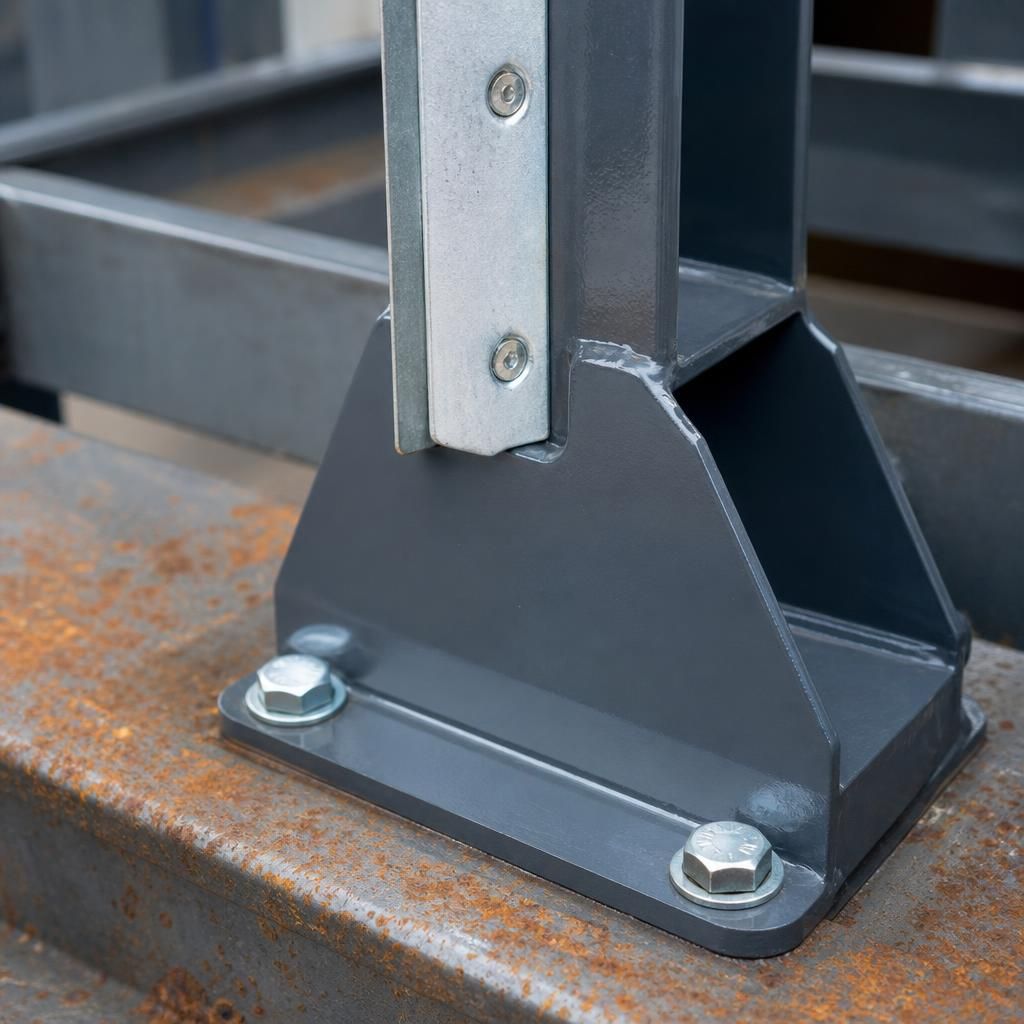
One additional benefit of a corrosion-resistant coating is that it can help reduce galvanic corrosion where a repaired powder-coated component comes into contact with a dissimilar metal. By creating a continuous barrier, the coating can limit the contact between the metals and moisture that enables this electrochemical reaction.
This is particularly relevant around brackets, fixings, frames and assembled interfaces where steel, aluminium or plated components meet. The repair specification should still consider fastener materials, contact points, drainage and any required electrical bonding, because a coating cannot compensate for unsuitable assembly details or trapped moisture. Correctly applied, it forms part of a broader corrosion-control strategy rather than serving only as a visual covering for the repaired area.
Discuss corrosion-resistant coating options for rust repair
If you need to establish whether a rust-affected powder-coated component is suitable for repair, request an assessment of its condition, existing coating and service environment. A specialist can then advise whether preparation and corrosion-resistant recoating are appropriate or whether further remedial work is required.