

How does high temp powder coating impact environmental sustainability in industrial applications?
High temp powder coating can support environmental sustainability by producing durable finishes with limited solvent emissions and less coating waste than many liquid-coating processes. Its environmental benefit must be assessed alongside the energy required for high-temperature curing, with efficient application, appropriate powder selection and long service life helping to improve the overall balance.
High temperature powder coating can support industrial sustainability when its full lifecycle is considered, from powder selection and surface preparation through curing, service life and eventual refurbishment. The environmental result is not determined by the coating name alone: formulation, application efficiency, oven operation, component design and the frequency of recoating all influence the overall impact.
Powder formulation and operating conditions are important starting points. A coating intended for elevated service temperatures must remain stable under the component’s actual thermal, chemical and mechanical conditions. Selecting a system that is suited to those conditions can reduce premature breakdown, flaking or corrosion-related replacement. However, a coating specified beyond the component’s genuine requirements may involve unnecessary processing demands. The appropriate choice is therefore the lowest-impact system that meets the required temperature resistance, chemical exposure, appearance and performance criteria.
Environmental assessment should also include the preparation stages. Degreasing, abrasive cleaning, conversion treatments and rinsing can involve water, energy and chemical inputs. Their impact depends on the metal substrate, the condition of the parts and the required finish. Good process control helps prevent excessive chemical use and reduces the risk of failed adhesion, which would otherwise lead to additional preparation and recoating. Fabricators should provide accurate information about oils, scale, weld contamination and previous finishes so that the preparation process can be matched to the actual parts.
Application efficiency affects resource use in several ways. Correct earthing, gun settings, film-thickness control and part positioning help place powder on the intended surface rather than on the booth, fixtures or surrounding equipment. Overspray can often be collected within a suitable reclaim system, although reclaimed material must be managed carefully because contamination or mixing between powder types can affect finish consistency. Where reclaim is unsuitable, controlled collection and responsible waste handling are preferable to allowing powder residues to enter general waste streams.
Curing is a significant energy consideration. The relevant assessment should examine the complete oven process rather than focusing only on its set temperature. Oven insulation, airflow, burner or heating-system efficiency, loading pattern, part mass and dwell time all affect energy demand. Thin or lightly loaded components may require a different process approach from heavy assemblies, while under-cured coatings can create rework and over-curing can waste energy or damage the finish. Process validation is therefore important: the coating should reach the required cure throughout the part without adding avoidable heating time.
The service life of the coated component is another major part of the sustainability calculation. A finish that protects metal against the relevant combination of heat, moisture, chemicals and abrasion can help retain the component in service for longer. This may reduce the environmental burden associated with manufacturing replacement parts, transporting them and disposing of failed components. The benefit is application-specific, so it should be assessed against the real exposure conditions rather than assumed from a general coating specification.
Repair and refurbishment can improve the lifecycle position further. Components should be inspected for corrosion, impact damage, loss of adhesion and changes caused by repeated heating and cooling. In some applications, local repair or complete refurbishment may be possible; in others, stripping and recoating will be necessary. The most sustainable route depends on the substrate condition, coating compatibility and whether the repaired finish can meet the original performance requirements.
End-of-life considerations also matter. Powder coating is bonded to the metal, so separation may be required before certain recycling or remanufacturing routes. The exact approach depends on the substrate, coating chemistry and recycler’s process. Designing components for disassembly, avoiding unnecessary mixed materials and keeping coating information with the part can make future treatment easier. For B2B projects, it is useful to record the powder type, cure specification and any pretreatment used so that later refurbishment decisions are based on known information.
A practical sustainability review for a high temperature powder coating project should consider:
- whether the coating’s temperature and chemical resistance match the real operating environment;
- the powder quantity applied, overspray controls and arrangements for unavoidable waste;
- the chemicals, water and energy used during preparation and rinsing;
- oven loading, insulation, airflow, cure schedule and the mass of the components;
- the likelihood of defects, rework, stripping or premature replacement;
- whether the coated parts can be repaired, refurbished or recycled at the end of their service life.
For industrial buyers, sustainability is therefore best evaluated as a process and lifecycle question rather than as a simple comparison between coating labels. A suitable high temperature powder, applied with controlled preparation and curing, can reduce avoidable material use and support longer component service. The strongest assessment combines technical performance data with information about energy use, waste handling, refurbishment options and the eventual treatment of the coated metal.
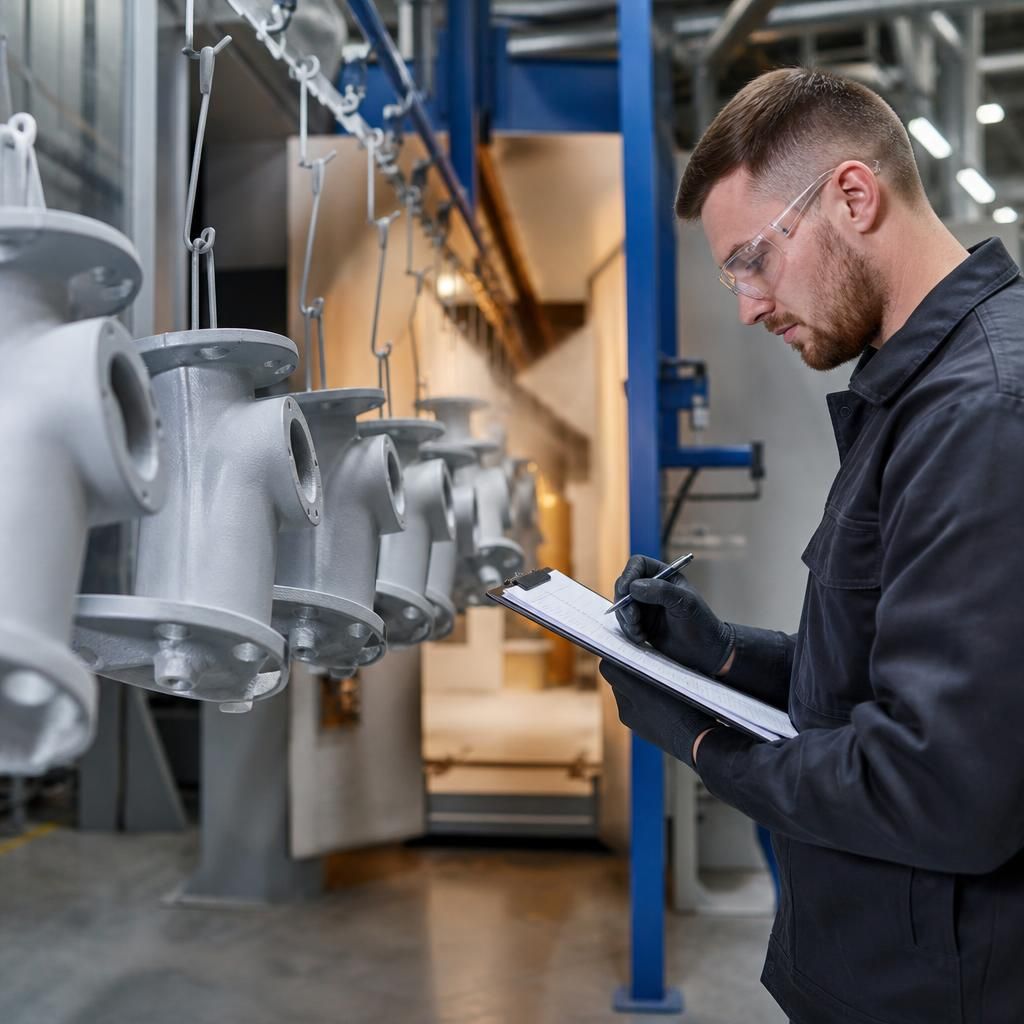
Environmental claims about high temp powder coating are most useful when they are supported by project-specific evidence rather than by the coating category alone. For a fair comparison, assess systems against the same component, service temperature, finish requirement and expected durability. This avoids treating a lower-emission application method as automatically more sustainable when it may require a different preparation or curing process.
Industrial buyers can ask for the powder’s technical and safety documentation, the proposed cure specification and details of how process residues are handled. Recording these requirements in the job specification also makes future environmental reviews more consistent, particularly when comparing coating options for repeat production or different component designs.
Discuss Sustainability for Your High Temp Powder Coating Project
Discuss your high temperature powder coating project with the team, providing details of the component, operating conditions and finish requirements so the coating process can be assessed for its environmental and technical suitability.