

What preparation is needed before applying powder coating to steel and aluminium frames?
Before powder coating, steel and aluminium frames must be inspected, thoroughly cleaned and free from oil, rust, scale, paint residue and other contaminants. Any surface damage should be repaired, suitable areas masked or plugged, and the prepared frames kept dry and protected from further contamination before coating.
Preparation before powder coating steel and aluminium frames is primarily a matter of confirming the substrate, making the frame suitable for hanging and oven curing, and ensuring that its design will accept the required coating without affecting fit or function. Good preparation also involves agreeing the finish specification, identifying areas that must remain coating-free and checking that the assembled frame can be processed safely and consistently.
Confirm the material and coating history
The coater should know whether each frame is mild steel, galvanised steel, stainless steel or aluminium, as these substrates require different pre-treatment and powder-coating systems. Mixed-material assemblies should be identified before processing because steel and aluminium may need separate treatment routes. Details of any previous coating, chemical treatment, galvanising or fabrication process are also relevant, particularly where residues or porous materials could affect adhesion or produce defects during curing.
Where the frame is being specified for a particular environment, the required powder type and pre-treatment should be agreed at this stage. Internal, external, high-humidity, coastal or chemically exposed applications may have different performance requirements. The selected system should be compatible with the base metal and with the intended curing temperature.
Make the frame suitable for processing
Frames need suitable points from which they can be suspended or supported during coating. These points should be positioned where a small contact mark will not affect appearance, sealing or installation. The frame must also fit within the available spray and curing equipment without touching other components or restricting the operator’s access to recessed areas.
Assemblies should normally be supplied in a condition that allows all required faces to be reached. Hinges, handles, seals, glazing, bearings, electrical parts and other heat-sensitive or removable components should be removed unless the process has been specifically designed to accommodate them. Separating components can also prevent powder bridging between moving parts and avoids adding coating to surfaces that must retain precise movement or electrical contact.
Drainage and venting are important for hollow sections and enclosed fabrications. Any liquid used during pre-treatment needs a route to drain, while enclosed cavities may require suitable venting to prevent pressure build-up during heating. Trapped moisture, treatment fluid or air can lead to blistering, staining or other defects. Vent and drain provisions should be incorporated into the design where possible, rather than added after fabrication without considering structural or visual requirements.
Review fabrication quality and geometry
Welds should be continuous where the design requires a sealed joint, with excessive spatter and abrupt projections avoided. Sharp corners, deep recesses, narrow gaps and overlapping components can affect powder coverage and may create areas that are difficult to cure consistently. The frame design should therefore allow reasonable access for spraying and avoid unnecessary crevices where contaminants or moisture could remain.
Edges and transitions should be formed consistently. Very sharp edges can receive a thinner coating than adjacent faces, while deep internal corners can produce uneven coverage. Where appearance and corrosion protection are important, the fabrication specification should address edge treatment, weld finishing and the relationship between adjoining parts before the frame reaches the coating stage.
Protect critical dimensions and interfaces
Powder coating adds a measurable layer to the prepared surface, so dimensional requirements must be identified in advance. Particular attention is needed around press fits, sliding faces, threaded holes, hinge bores, bearing seats, grounding points, assembly joints and areas that must make electrical contact. The required coating-free zones and acceptable contact marks should be shown on a drawing or clearly agreed with the coater.
Where frames are part of a larger manufactured product, provide the relevant drawings, tolerances and assembly information. This helps distinguish cosmetic surfaces from functional surfaces and reduces the risk of coating being applied where it would interfere with installation or operation. Components that will be assembled after coating should also be checked for potential abrasion during handling and assembly.
Allow for aluminium and porous components
Cast aluminium, some die-cast parts and porous weld areas can retain air, oils or moisture within the metal. During oven heating, these substances may migrate through the powder film and cause pinholes, bubbles or surface defects. Such components may require a suitable outgassing treatment or a coating system selected to reduce the effect. The risk should be considered before production, especially when a smooth decorative finish is required.
Agree inspection and handling requirements
Before processing, the parties should agree the required colour, gloss level, texture, coating zones, acceptable contact marks and any sample or reference standard. Frames should be identified so that components are not mixed between different specifications or installation locations. They should then be transported and stored using clean supports and suitable protection, avoiding contact with substances or packaging that could transfer contamination to the prepared metal.
A final pre-production review is valuable for complex or repeat batches. It should confirm the substrate, coating system, curing requirements, hanging method, drainage and venting, critical dimensions and inspection criteria. Resolving these points before coating is more effective than attempting to correct a defect or dimensional issue after the finish has been applied.
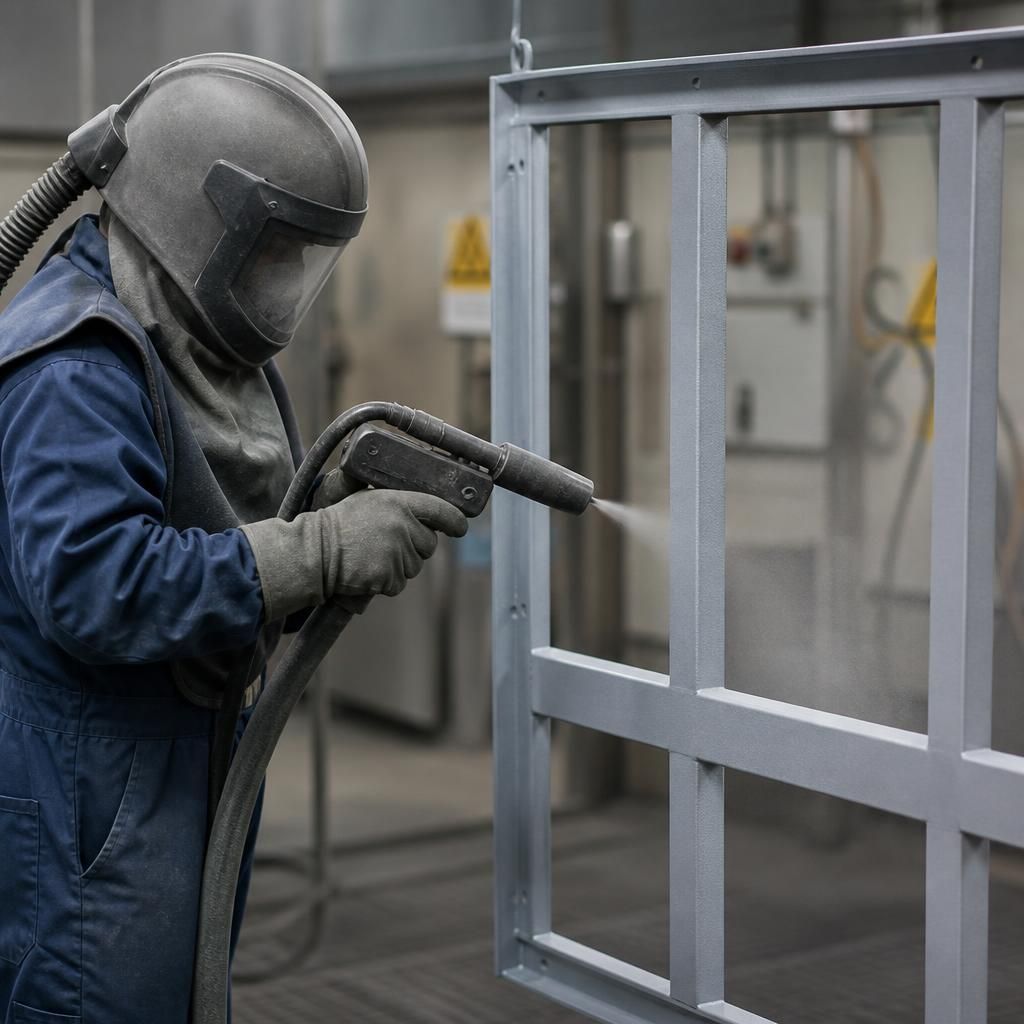
Where abrasive blasting is part of the preparation, the method must be matched to the frame’s material, thickness and visible surfaces. On steel, blasting can remove mill scale, rust and firmly bonded residues while creating a surface profile for the pre-treatment and powder system. Aluminium generally requires more controlled treatment because aggressive blasting can mark the surface, alter fine details or affect thin sections. The chosen media, pressure and masking arrangements should therefore be agreed before processing, particularly for architectural faces and close-tolerance components.
After preparation, the surface should be checked for remaining residues, excessive roughness and damage caused during handling. This review is separate from the coating inspection: it confirms that the metal is genuinely ready to receive powder rather than relying on the coating to conceal preparation defects.