

How do different metals respond to high temp powder coating oven conditions?
Different metals respond to high temperature powder coating ovens according to their thermal conductivity, heat capacity, mass, alloy composition and thermal expansion. These differences affect how quickly the substrate reaches curing temperature, how evenly heat is distributed and whether the finished coating develops defects such as poor flow, distortion or loss of adhesion.
Different metals can produce different powder coating results in the same high temperature oven. The main practical differences are how each substrate absorbs and transfers heat, how its surface has been prepared, and whether it releases gases or contaminants during heating. The oven temperature should therefore be selected alongside the metal, component design, coating specification and required cure schedule, rather than treated as a universal setting.
Mild and carbon steel are generally the most predictable substrates for high temperature powder coating. They tolerate industrial oven conditions well when they have been correctly degreased, blasted or chemically pre-treated. However, heavy fabrications, folded sections and boxed components may require a longer dwell to allow the coldest areas to reach the coating manufacturer’s specified metal temperature. If the surface has retained oil, moisture, mill scale or abrasive residue, heating can expose the problem through pinholes, blistering or poor adhesion.
Stainless steel requires particular attention to surface preparation. Its passive oxide layer can make adhesion more difficult than on clean mild steel, especially where the surface is smooth or contaminated. Suitable abrasion or pre-treatment may be needed, followed by careful removal of grease, salts and embedded particles. Stainless components should also be kept separate from carbon-steel contamination during preparation, as iron residue can affect the appearance and corrosion performance of the finished surface.
Aluminium commonly reaches the required surface condition quickly because many aluminium components are relatively light, but its surface chemistry makes preparation important. Oxides form readily, and residues from machining, cutting fluids or handling can interfere with adhesion. Excessive heat exposure can also affect thin sections, close-tolerance parts, decorative profiles and assemblies containing temperature-sensitive inserts. Masking, racking and dimensional checks are consequently important where the coated component must assemble accurately after curing.
Galvanised and zinc-coated steel can release trapped air, moisture or other volatile material when heated. This may cause pinholing, cratering or bubbles in the powder film. The zinc surface should be cleaned without unnecessarily damaging the protective coating, and the powder system and preparation method should be suitable for galvanised work. Vent holes may be needed in enclosed sections so that expanding air does not disrupt the coating or create a pressure hazard. A controlled pre-treatment or outgassing stage may also be considered for components known to contain absorbed moisture or process residues.
Cast iron presents a different challenge because its porous structure can retain oil, water and contaminants. These materials may emerge during the oven cycle and create surface defects even when the powder has been applied correctly. Castings often benefit from thorough cleaning and a suitable pre-bake or outgassing procedure, followed by inspection before coating. Edges, recesses and rough cast surfaces may also need additional preparation to achieve consistent coverage and avoid weak areas in the film.
Copper and copper alloys conduct heat efficiently and can have a surface oxide or tarnish that affects bonding and colour consistency. Their surfaces should be cleaned and prepared according to the coating system, with particular care taken around joints, soldered areas and embedded materials. Components made from brass or bronze may also contain machining residues that become visible during curing. The coating specification should confirm that the selected powder is suitable for the alloy and intended service conditions.
Mixed-metal assemblies need more assessment than single-metal parts. A steel bracket fixed to aluminium, a component with brass inserts, or a fabrication containing rubber, plastic or adhesive elements may not have one uniform thermal response. One part can reach the target metal temperature before another, while non-metallic components may distort, release gases or lose their properties. Where possible, parts should be coated separately. If that is not practical, the assembly should be reviewed for masking, venting, contact points, galvanic considerations and the lowest temperature limit of every material.
Metal thickness and geometry remain important within the same material group. A thin aluminium panel, a dense steel plate and a hollow welded frame may all be placed in the same oven, yet they may not require identical treatment. The oven air reading does not prove that every part has reached the required cure temperature. Temperature profiling with suitable probes can identify cold spots, overheating and differences between exposed faces, internal sections and densely loaded racks.
When assessing a metal for high temperature powder coating, the process should normally consider:
- the alloy or surface coating and its compatibility with the powder system;
- the cleanliness, roughness and chemical condition of the surface;
- the thickness, enclosed sections, welds, recesses and overall geometry;
- the possibility of trapped oil, moisture, air or other volatile material;
- the dimensional tolerances of the finished component;
- the temperature limits of inserts, fasteners, seals and attached materials; and
- the actual metal temperature and dwell time required by the powder manufacturer’s technical data.
The correct approach is to validate the complete cure cycle on the actual substrate and component design. A setting that produces an acceptable finish on a simple mild-steel part may give a different result on stainless steel, aluminium, galvanised material or a porous casting. Trial pieces, adhesion checks, visual inspection and temperature profiling help establish whether the issue is preparation, heating, powder selection or handling rather than the nominal oven setting alone.
For manufacturers and fabricators processing varied metalwork, recording the substrate, preparation method, rack position, oven profile and inspection result provides a useful basis for repeatable production. This is particularly important for batch coating, where changes in load density or component mix can alter the way heat reaches individual parts.
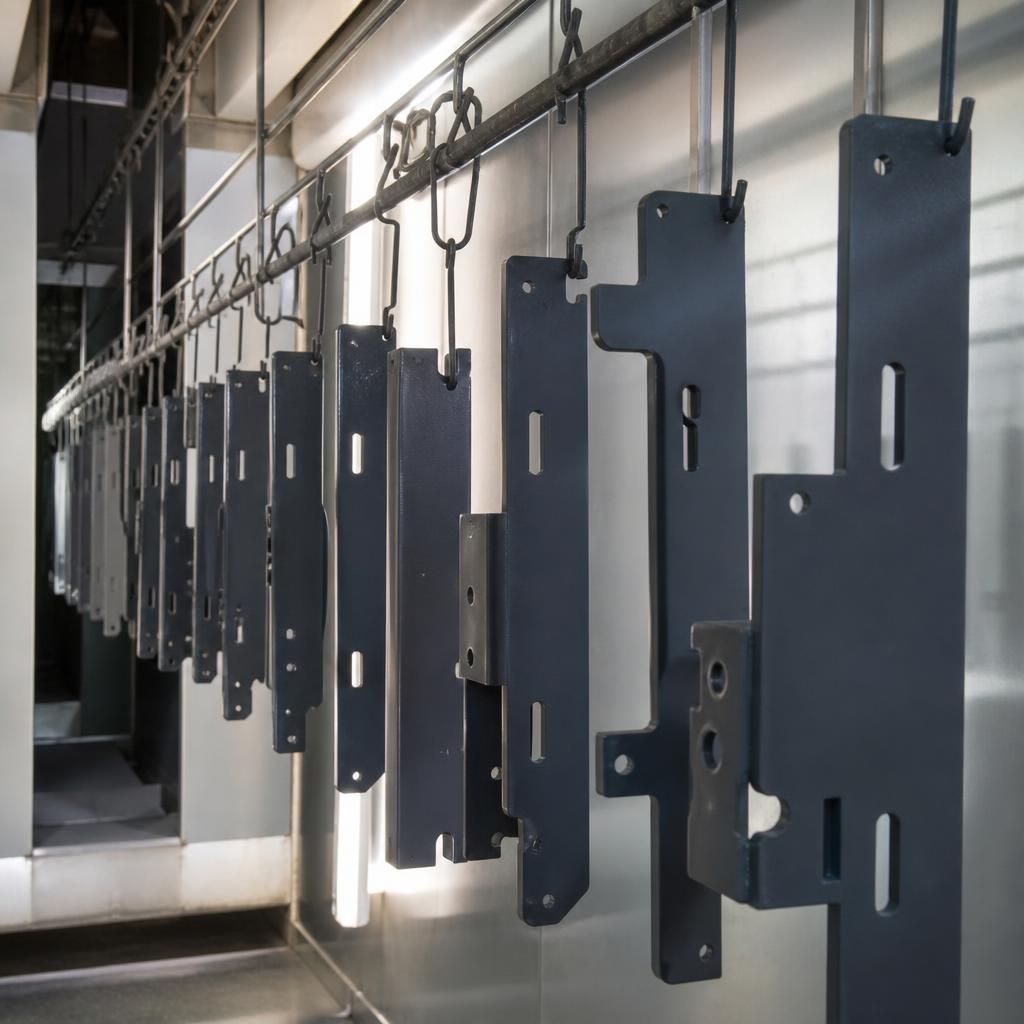
Racking can influence how a metal component responds in the oven. Hooks, bars and support points form direct contact with the part, so they may create small areas with reduced powder coverage or leave marks in the finished film. They can also act as local heat paths, particularly where a thin component is supported by a substantial metal fixture.
For repeatable results, components should be supported at robust, non-critical locations while preserving airflow around the surfaces that require a consistent finish. Contact points should be considered during inspection, especially on parts with visible faces, tight assembly tolerances or corrosion-sensitive areas. Racks and hooks should also be kept clean, since accumulated coating can alter the contact position and affect reliable electrical grounding during powder application.