

What environmental factors should be considered when applying high temperature powder coating to ensure optimal performance?
Environmental factors such as humidity, ambient temperature, airborne contamination and ventilation can affect powder flow, film formation, adhesion and curing when applying high temperature powder coating. Control the application area, keep parts and powder dry and clean, and verify that the oven provides consistent, correctly monitored heat to achieve a durable, uniform finish.
Optimal performance from a high temperature powder coating depends on controlling the application environment and assessing the conditions the finished component will face in service. The maximum operating temperature is only one consideration; thermal cycling, part geometry, heat distribution, electrical conditions, chemical exposure and storage or transport can all affect film integrity and adhesion.
Control heat transfer through the part, not just the oven setting. Components with heavy sections, enclosed areas, folded edges or large differences in thickness heat at different rates. If the coating reaches its required cure condition before the metal has heated evenly, some areas may be under-cured while others receive excessive heat exposure. Arrange parts to allow heat to reach recessed and shielded surfaces, avoid placing heavy components against one another and use a temperature profile across representative areas of the load. This is particularly important for fabrications with welds, thick plates, brackets and mixed-gauge assemblies.
Part orientation can also influence the finish. Horizontal faces may collect more powder than vertical faces, while sharp edges, recesses and Faraday cage areas can receive a different film build during electrostatic application. Earth the workpiece effectively and check that hooks, racks and contact points provide a reliable electrical path. Poor grounding can reduce transfer efficiency and create uneven deposition, especially on parts with complex geometry.
Consider the component’s thermal behaviour. A coating exposed to repeated heating and cooling may experience more stress than one held at a stable temperature. Expansion and contraction of the metal, coating and any attached materials can eventually produce cracking, loss of adhesion or edge breakdown if they have substantially different thermal expansion characteristics. Review:
- the normal operating temperature and the highest credible excursion;
- how frequently the component heats and cools;
- the rate of temperature change;
- whether hot spots occur around welds, burners, exhaust paths or electrical contacts; and
- whether the coating must tolerate vibration while hot.
Where a component moves between hot and cool conditions, testing should reproduce the expected thermal cycle rather than relying only on a single elevated-temperature exposure. Inspect test panels or representative parts for blistering, cracking, colour change, adhesion loss and changes in gloss.
Assess the environment after application. A high temperature coating may also need to withstand moisture, condensation, salt-laden air, industrial chemicals, oils, solvents, cleaning agents or abrasive dust. These exposures can become more aggressive at elevated temperature because heat may accelerate chemical reactions or soften deposits on the surface. The correct system therefore depends on the complete combination of heat and exposure, not simply a stated heat-resistance level.
For example, a component operating near a furnace may face radiant heat and scale, whereas an automotive or plant component may combine heat with oils, road salts, vibration and stone impact. Components used outdoors may additionally require resistance to ultraviolet exposure and weathering. Identify the likely contaminants, their concentration or severity, contact duration and cleaning method before selecting the coating formulation. A coating that performs well against dry heat may not provide the same protection when exposed to hot chemicals or repeated washing.
Protect coated parts during storage and handling. Environmental performance can be compromised before installation if parts are stacked while warm, packed before the finish has stabilised or exposed to abrasive contact at edges and fixing points. Use separators or suitable packaging for finished surfaces, prevent metal-to-metal rubbing and avoid trapping contaminants against the coating. During transport, consider condensation, impact and contact with incompatible packaging materials. These controls do not change the coating chemistry, but they help prevent early damage that could be mistaken for coating failure.
Application records should link the environmental assessment to the actual production conditions. Record the coating specification, substrate, part configuration, load arrangement, cure profile, film thickness checks and any unusual exposure expected in service. For critical components, retain representative samples or carry out testing on the actual substrate and geometry. This can reveal problems caused by heat sinks, masking, weld areas or difficult-to-coat recesses that a flat test panel will not show.
Finally, separate cosmetic changes from loss of protection. Some high temperature systems may change colour or gloss during service without immediately losing adhesion, while blistering, flaking, cracking or corrosion at damaged areas indicates a more serious performance issue. Define the acceptable appearance and functional limits before production, then inspect components at suitable stages of their service life. A controlled application environment, representative thermal testing and a realistic assessment of chemical and mechanical exposure provide the most reliable basis for achieving durable results.
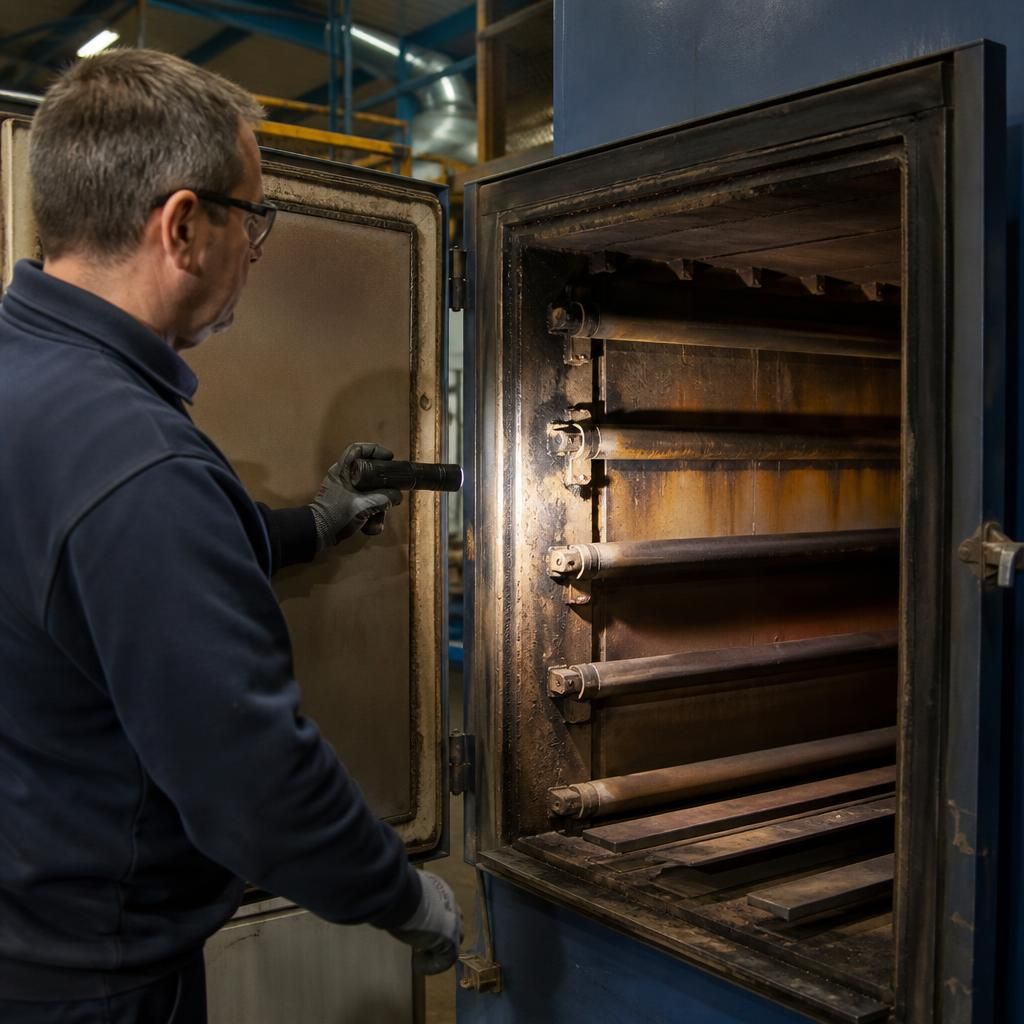
The curing oven environment is a separate environmental factor because residues, vapours and combustion products can affect the coating while it is forming its final film. Oil, silicone, plastic vapour, dust or fuel-related contamination may cause discolouration, surface defects or reduced adhesion, even when the metal and powder were prepared correctly.
Keep the oven clean and inspect its burners, exhaust routes, filters and internal surfaces as part of process control. Direct-fired systems require particular attention to combustion quality and exhaust balance so that contaminants do not enter the coating zone. After maintenance, a change of fuel or an alteration to ventilation, check the oven using representative coated samples before returning it to routine production. This helps distinguish an oven-atmosphere problem from a powder, substrate or application fault.