

How do powder coating systems ensure coating durability and quality in large-scale industrial applications?
Powder coating systems ensure durability and quality in large-scale industrial applications through consistent surface preparation, controlled powder application and accurate oven curing. Integrated process controls and inspection help produce an even, well-adhered finish across batches of metal components.
Powder coating systems ensure durability and quality in large-scale industrial applications by matching the coating material and process settings to the component, then controlling the variables that affect film performance from batch to batch. A durable finish is not determined by powder alone; it depends on coating chemistry, film build, component geometry, handling, process records and inspection criteria working together.
Coating selection is the first control point. Different powders provide different balances of hardness, flexibility, chemical resistance, weathering performance and appearance. Polyester-based systems are commonly selected where exterior durability and colour retention are important, while epoxy and hybrid formulations may suit components used mainly indoors or where chemical resistance is a priority. Nylon and other specialist protective coatings can be appropriate where abrasion, impact, low friction or enhanced corrosion protection is required. The correct choice depends on the substrate, operating environment, required appearance and expected service conditions.
Large components and production batches also require a defined coating specification. This normally records the approved powder type, colour, gloss level, target film thickness, masking requirements, coverage limits and acceptance criteria. Establishing these requirements before production reduces variation between operators, production runs and component sizes. It also gives inspection teams an objective basis for deciding whether a finished part meets the intended standard.
Consistent film thickness is essential to both performance and appearance. A film that is too thin may provide inadequate coverage or reduced protection, while excessive build can affect edges, recesses, fit, flexibility and surface appearance. Component geometry can make uniform coverage difficult: corners, deep recesses, narrow sections and enclosed areas behave differently from broad, open faces. Racking and part orientation therefore need to support even access and prevent contact marks, trapped powder or shadowing.
Electrostatic application is affected by the shape and electrical characteristics of the workpiece. Complex components can create Faraday cage effects, in which powder is less readily deposited in recessed areas. A suitable system setup, appropriate gun movement and a considered rack arrangement help reduce these inconsistencies. For repeat production, storing proven settings for particular component families can make changeovers more predictable without treating every part as if it has the same coating requirements.
Quality assurance combines measurement with visual assessment. Typical checks may include dry film thickness, colour, gloss, coverage, adhesion and the presence of defects such as pinholes, craters, runs, contamination, impact damage or incomplete coverage. Where the application demands it, additional testing can assess resistance to abrasion, chemicals, humidity or corrosion. The relevant tests should reflect the component’s intended use rather than being selected simply because they are easy to perform.
Reliable large-scale output also depends on controlling material handling and equipment condition. Powder should be stored and handled in accordance with its technical requirements, with reclaimed material managed consistently where it is used. Guns, hoses, nozzles, booths, filters, racks and contact points can all influence transfer efficiency and finish quality. Build-up, contamination or poor earthing can introduce defects and create differences between otherwise similar batches.
Traceability makes quality problems easier to investigate. Recording the powder identification, production batch, component reference, process settings, inspection results and any deviations helps identify whether a variation arose from the material, the component, the equipment or the operating method. This is particularly valuable for manufacturers and fabricators supplying repeat parts, because corrective action can be based on evidence rather than visual judgement alone.
Durability is also protected after coating. Components should be handled in a way that avoids scratching or impact, with suitable separation during storage and transport. Edges, threaded areas, machined interfaces and masked sections may need particular attention because damage in these locations can affect assembly or expose the underlying metal. Clear packaging and handling requirements form part of maintaining the finish achieved by the coating system.
For an industrial powder coating project, the most dependable approach is to define the service conditions and acceptance standard first, select a compatible powder system, validate the requirements on representative components and then maintain documented controls throughout production. This combination of material knowledge, repeatable equipment settings and proportionate inspection is what allows large batches and specialist components to achieve a durable, consistent finish.
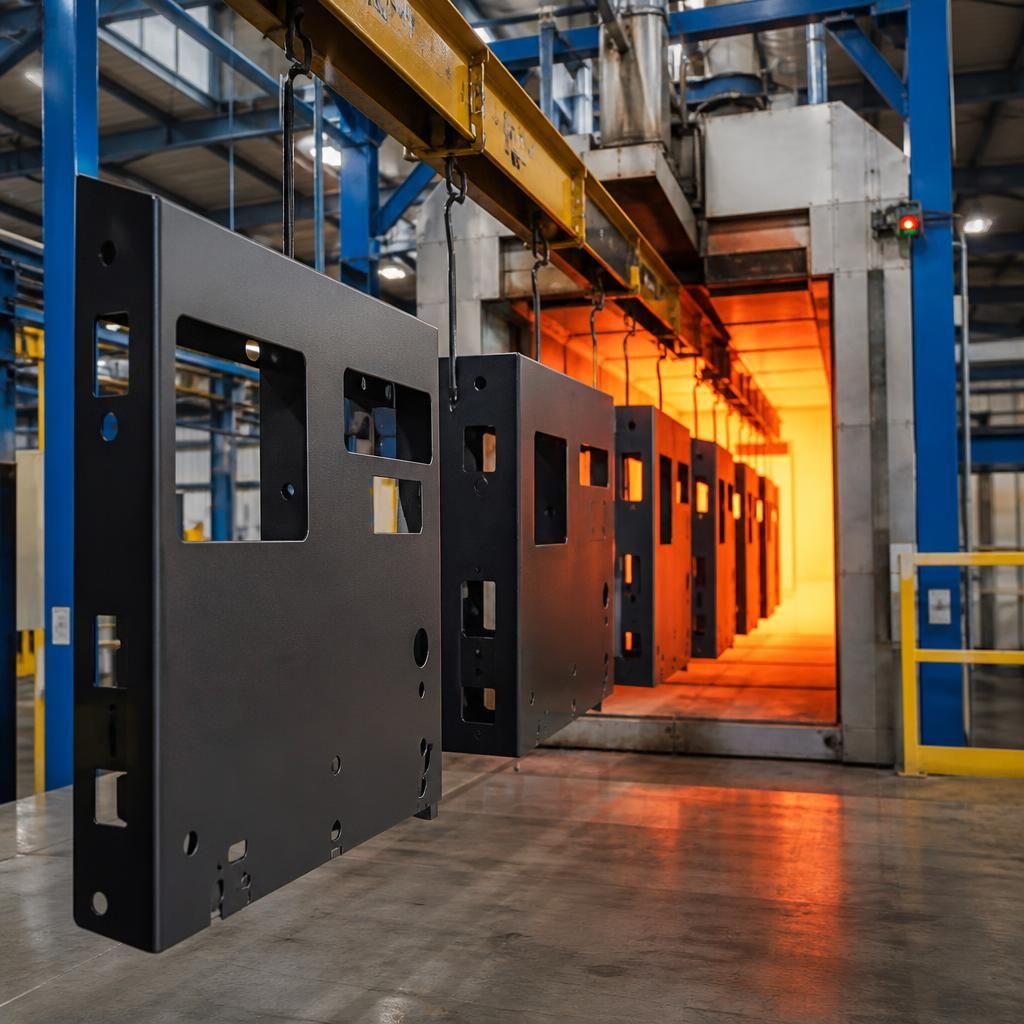
Oven curing converts the applied powder into a continuous, bonded coating, so the part must reach the specified cure condition rather than simply pass through a heated oven. Component thickness, material and loading pattern affect how quickly the metal reaches temperature; a heavy assembly may require a different process profile from a light bracket. Monitoring the part temperature helps distinguish adequate curing from relying only on oven air temperature or conveyor settings.
For large-scale production, cure validation should be carried out on representative components and repeated after significant changes to loading, line speed, powder formulation or equipment. This confirms that the coating develops the required hardness, adhesion and resistance without over-curing, which can affect colour or finish. Maintaining a verified cure profile helps keep quality consistent across different component sizes and production batches.