

What is the significance of sandblasting in the epoxy powder coating process?
Sandblasting is a key pre-treatment stage in the epoxy powder coating process because it removes rust, mill scale, old coatings and other contaminants from the metal surface. It also creates a controlled surface profile, giving the epoxy powder a suitable key for adhesion and helping produce a more consistent, durable finish.
Sandblasting is significant in epoxy powder coating because it prepares the metal in a controlled, measurable way before powder is applied. Its role is not limited to cleaning: the treatment can expose the true condition of the substrate, remove weak surface layers and establish the physical conditions needed for the coating system to perform consistently.
It removes incompatible surface layers. Steel components may have mill scale, corrosion products, fabrication residue, paint, grease or handling contamination. If these remain beneath the coating, they can form a weak boundary between the metal and epoxy film. Sandblasting provides a more uniform starting surface than relying on chemical cleaning or manual abrasion alone, particularly on fabricated parts with welds, edges and irregular profiles.
The abrasive treatment also reveals defects that may need attention before coating. Pitting, laminations, sharp weld spatter, pinholes and damaged edges can become more apparent once loose material and scale have been removed. These issues should be assessed before powder coating, as an epoxy finish follows the underlying shape rather than correcting significant metal defects. Welds may require dressing, and edges may need suitable preparation where coating coverage and electrical insulation are important.
The result depends on how the blasting is specified and controlled. Important variables include the abrasive medium, particle size, air pressure, nozzle distance, angle of impact and exposure time. An excessively aggressive treatment can unnecessarily roughen the surface, alter fine features or remove material from vulnerable areas. Insufficient treatment may leave unstable residues or an uneven surface. The objective is therefore a consistent surface condition suited to the component, the epoxy powder and the required service environment.
Part geometry must be considered during blasting. Recesses, internal corners, holes and narrow sections may receive less direct abrasive action than exposed faces. Conversely, edges and projecting features can receive greater impact. Components should be positioned and inspected so that less accessible areas are not overlooked. Any blast media trapped in cavities or threaded features must be removed before coating, since residue can interfere with assembly or become incorporated into the finish.
Cleanliness after blasting is equally important. The prepared surface should be protected from moisture, dust, oil and further handling contamination before powder application. On steel, delay or exposure in humid conditions can allow surface oxidation to develop again. The coating team therefore considers the condition of the part immediately before application, rather than treating blasting as an isolated operation whose result remains unchanged indefinitely.
Surface profile is selected rather than maximised. A profile that is too shallow may provide limited mechanical anchoring, while an unnecessarily coarse profile can increase powder consumption, affect the visual texture and make it more difficult to achieve complete coverage at peaks and recesses. The appropriate profile depends on the substrate, the epoxy system, the specified film thickness and the component’s end use. Profile assessment and visual inspection help confirm that preparation is consistent across the batch.
Blasting can also influence the appearance of the finished coating. Variations in preparation may show through as differences in texture, gloss or edge coverage, especially on large panels and components viewed from several angles. Consistent preparation is therefore relevant to both functional performance and appearance, even though the blasting stage itself is hidden beneath the cured epoxy layer.
Not every metal should be treated identically. Steel, aluminium and other substrates differ in hardness, oxide behaviour and susceptibility to distortion or excessive abrasion. The abrasive and method must be compatible with the metal and must not introduce unwanted contamination. Where a component combines different metals or includes machined, threaded or precision surfaces, those areas may require separate protection or a more controlled treatment approach.
Masking and pre-treatment planning should take place before blasting begins. Threads, bearing seats, machined faces, electrical contact points and identification surfaces may need protection where coating would affect fit, conductivity or function. After blasting, the component is normally checked for remaining contamination, damage, accessible coverage and the required surface condition before it proceeds to powder application.
For industrial work, the significance of sandblasting is therefore its contribution to process control. It establishes a known substrate condition, supports repeatable coating application and helps identify preparation or fabrication issues before they are concealed by the epoxy finish. When matched to the metal, component geometry and specification, it forms an important link between fabrication, powder application and the long-term performance expected from the coated part.
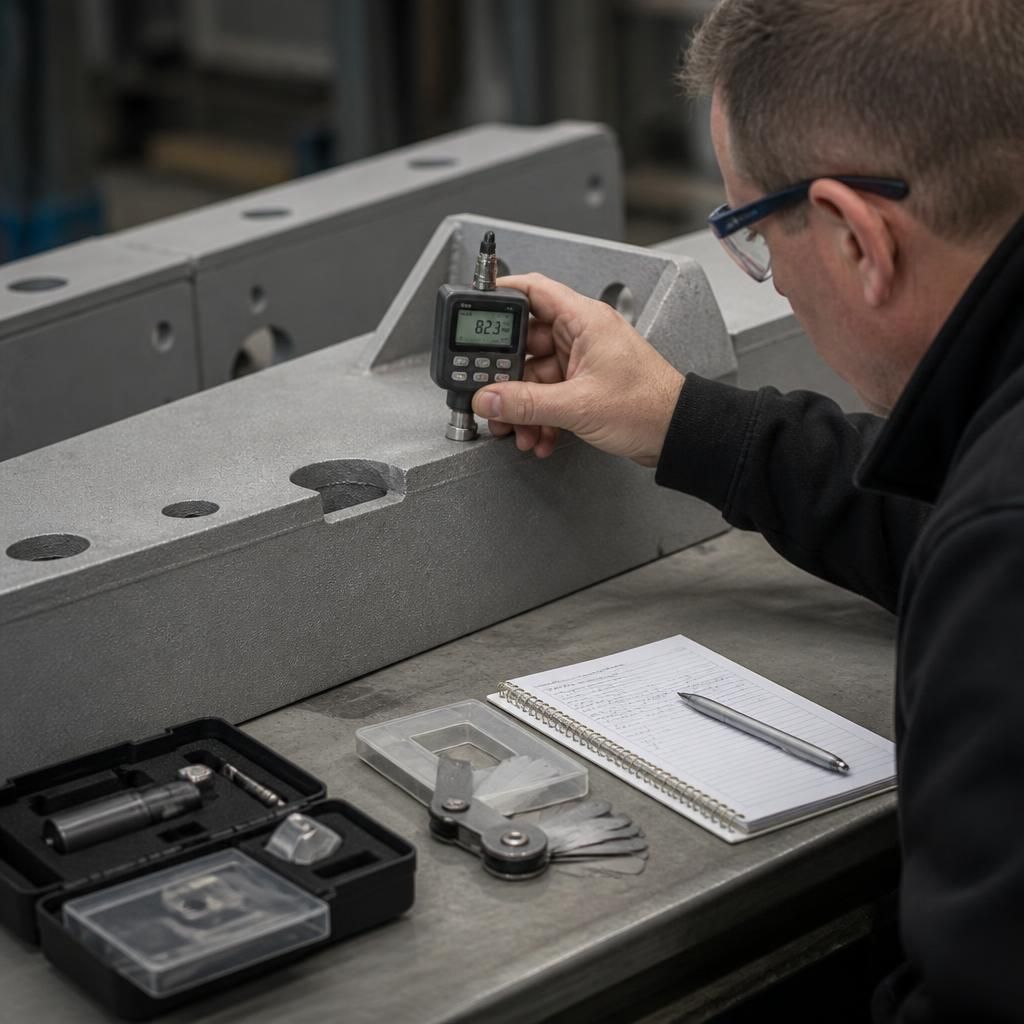
In epoxy powder coating, the blasted surface profile should be verified rather than judged by appearance alone. A visual comparison, surface-profile gauge or replica method can help establish whether the peaks and valleys fall within the range specified for the coating system. This matters because the profile is measured in relation to the planned dry-film thickness: excessive peaks may receive insufficient coverage, while an unnecessarily deep profile can affect finish uniformity and material use.
Verification also creates a record that preparation was suitable before powder application. Where readings or visual checks vary across a component, the part can be reassessed before it enters the coating stage, reducing the risk of treating inconsistent preparation as an application or curing problem later.