

What are the key considerations for maintaining the appearance and integrity of black powder coated finishes?
Maintaining black powder coated finishes requires gentle, suitable cleaning, prompt removal of contaminants, and regular checks for scratches, chips, corrosion or fading. Avoid abrasive materials and harsh chemicals, and address damage early to preserve both the coating’s appearance and the metal’s protection.
Maintaining the appearance and integrity of a black powder coated finish depends on more than routine cleaning. The coating specification, preparation of the metal, exposure conditions, handling methods and the way any damage is repaired all influence how consistently the finish performs over its service life.
Assess the coating system against its environment. Black finishes can show chalking, colour change and uneven sheen more readily than lighter colours, particularly where components receive prolonged ultraviolet exposure. Moisture, condensation, road salt, industrial pollutants, chemical vapours and repeated temperature changes can also affect the coating and the metal beneath it. Components used outdoors or in aggressive industrial environments should therefore be matched with a powder coating system designed for the relevant exposure, rather than selecting a finish on colour alone.
Confirm that the substrate and preparation are suitable. Long-term integrity starts before the powder is applied. The metal must be correctly prepared so that contamination, mill scale, oxidation and residues do not interfere with adhesion. Steel, galvanised steel and aluminium may require different preparation and pre-treatment processes. Poor preparation can lead to adhesion failure, blistering or corrosion developing beneath an apparently intact surface.
Consider edges, joints and concealed areas. Sharp edges can receive less consistent coverage than broad, accessible faces, while seams, recesses, drain points and fixing interfaces may retain moisture or expose the underlying metal. Component design and the coating process should allow adequate coverage and drainage. Where coated parts are assembled, avoid creating locations where water, debris or chemicals can remain trapped against the finish.
Protect the finish during transport and installation. Contact with lifting equipment, unprotected workbenches, metal swarf, drills and fasteners can mark or chip a cured coating. Use suitable separators and handling methods, and avoid dragging coated parts across one another. During installation, washers, gaskets or other interfaces may be needed where metal-to-metal contact could damage the coating or create a route for moisture.
Control contact with incompatible materials. Some sealants, adhesives, solvents, rubber products and treated packing materials can stain a finish, soften its surface or cause localised discolouration. Compatibility should be checked before these materials are used against or near a black powder coated component. Fasteners and adjoining metals should also be selected with the service environment in mind, since corrosion at a joint can spread contamination to the coated surface or undermine the assembly.
Use an appropriate approach to local damage. A touch-up product may improve the visual appearance of a small mark, but it is not automatically equivalent to the original powder coating in colour, gloss, durability or corrosion protection. The affected area, cause of the damage and exposure conditions should be assessed before deciding whether local repair is suitable. Larger defects, under-film corrosion, loss of adhesion or widespread fading may require professional evaluation and, in some cases, complete reprocessing rather than repeated touch-up.
Monitor finish consistency across components. Parts installed next to one another can appear different if they were coated in separate batches, exposed differently, or specified with different gloss levels or textures. Keep coating specifications, colour references and batch information with the project records. When replacement parts are needed, matching the original RAL colour alone may not reproduce the same appearance if the texture, gloss, substrate or application method differs.
Keep maintenance records. Recording the component’s location, exposure, coating specification, installation date and any repair work helps identify recurring causes of deterioration. Patterns such as damage around fixings, fading on one elevation or corrosion at drainage points can indicate a design, installation or environmental issue rather than a problem with the finish itself. This information supports more accurate decisions when components are refurbished or recoated.
For business-critical metalwork, the most reliable maintenance plan combines an exposure-appropriate coating specification with sound preparation, careful handling, compatible installation materials and documented condition monitoring. These controls help preserve both the uniform black appearance and the protective function of the powder coated layer.
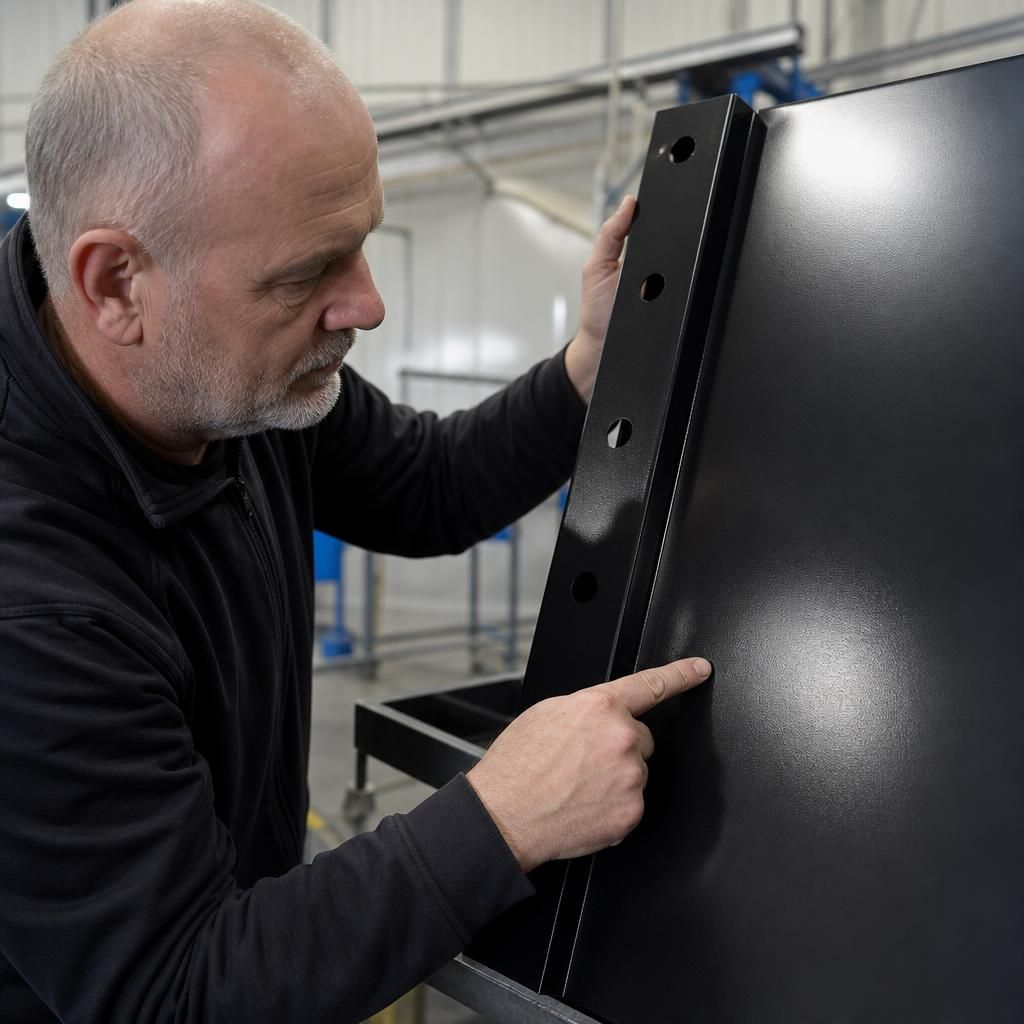
Assess the finish under consistent conditions so that surface contamination is not mistaken for coating deterioration. Black powder coated surfaces can make dust, water marks, fingerprints and uneven reflections particularly noticeable. Inspect the component after it has been cleaned and dried, using the same viewing angle and comparable lighting where possible.
Changes in appearance should then be classified before corrective action is chosen. A removable deposit indicates a cleaning or environmental issue, whereas persistent loss of sheen, patchy colour, chalking or a roughened surface may indicate weathering or coating degradation. Comparing affected areas with a less exposed section of the same component can help establish whether the change is localised or widespread, supporting a more appropriate maintenance or recoating decision.