

Can zinc and fusion bonded coatings be applied to all types of metal components?
No. Zinc and fusion bonded coatings suit many metal components, particularly ferrous parts, but compatibility depends on the base metal, component design, operating environment, surface preparation and coating process. A technical assessment is needed to confirm the appropriate system for each component.
No coating system is suitable for every metal component. Zinc and fusion bonded coatings are most commonly specified for steel and other ferrous components, while non-ferrous metals require a separate compatibility assessment and, in some cases, a different primer or coating system. The correct choice depends on the particular zinc process or fusion bonded formulation, the component’s metallurgy, its geometry and the conditions in which it will be used.
Steel components are generally the most suitable candidates. Carbon steel, mild steel and many low-alloy steels can receive zinc-based protection or a fusion bonded epoxy coating when the coating specification matches the intended service. Typical applications include fabricated frames, brackets, structural parts, pipework, supports, fixings and engineered components. Zinc can provide sacrificial corrosion protection, whereas a fusion bonded coating forms a continuous polymer barrier. In demanding applications, the two approaches may be considered separately or as part of a duplex system.
Cast iron can also be considered, but its surface characteristics need particular attention. Porosity, graphite content, casting residues and irregular surfaces can interfere with coating consistency. Trapped gases or contaminants may become visible during heating, and complex castings may be difficult to coat uniformly. Inspection of the casting and agreement on acceptable visual and thickness criteria are therefore important before production work begins.
Non-ferrous metals are not automatically excluded, but they should not be treated like steel. Aluminium, stainless steel, copper, brass and other alloys have different surface chemistry, thermal behaviour and corrosion characteristics. A standard zinc treatment may not bond or perform as intended on these materials. Some fusion bonded systems can be adapted for selected non-ferrous substrates using a compatible pre-treatment or primer, but this must be confirmed for the specific alloy and end use rather than assumed from the material name alone.
- Aluminium: its oxide layer can make adhesion difficult, and the coating temperature must be suitable for the alloy and any heat treatment.
- Stainless steel: the passive surface may require a carefully controlled preparation method, and the coating must be justified where the stainless surface is intended to provide its own corrosion resistance.
- Copper and brass: their thermal conductivity and surface characteristics can affect curing and adhesion, so a standard steel coating specification may be inappropriate.
- High-strength or heat-treated steels: the coating route must be checked against the material’s mechanical properties, particularly where processing could introduce hydrogen-related or heat-related risks.
Component geometry can be just as important as the metal itself. Zinc processes and fusion bonded coatings may be difficult to apply consistently inside narrow cavities, blind holes, deep recesses, tight gaps and enclosed sections. Hollow fabrications may require suitable drain and vent holes so that treatment materials, air and gases can move safely through the component. Without appropriate access, areas can remain uncoated or collect excess material.
Threads, machined faces, bearing surfaces, slots and close-tolerance interfaces also need consideration. Coating thickness can affect fit, assembly and the movement of mechanical parts. These areas may need masking, post-coating machining or a defined allowance in the component drawing. Masking must be agreed in advance because an apparently small coated area can prevent correct assembly.
Welds and fabricated joints deserve specific attention. Weld spatter, sharp edges, weld porosity and heat-affected areas can create weak points or variations in the finished coating. Rounded edges, sound welds and a coating specification that identifies how welds are to be treated help produce a more consistent result. Components containing dissimilar metals also need review, since exposed metal interfaces can create galvanic corrosion or make masking and preparation more complicated.
The intended service conditions influence whether zinc, fusion bonded epoxy or a combined system is appropriate. Components exposed to soil, standing water, salt, industrial chemicals, abrasion or immersion may need a system designed specifically for that exposure. Contact with aggressive chemicals, high operating temperatures or repeated thermal movement can also rule out a generally suitable formulation. The coating must therefore be selected against the actual operating conditions rather than simply the base metal.
A practical assessment normally considers:
- the exact metal grade, heat treatment and condition of the component;
- the coating type, required thickness and intended corrosion-protection mechanism;
- the component’s dimensions, weight, access points, cavities and close-tolerance areas;
- any existing coating, scale, oil, corrosion or contamination that could affect the finish;
- the service conditions, including immersion, chemical contact, abrasion and temperature;
- inspection requirements, masking details and acceptable limits for appearance and thickness.
Where the material or design presents uncertainty, a trial component or representative test section can help confirm adhesion, coverage, curing and dimensional effects before a full batch is processed. Drawings, material certificates and details of the intended service are particularly useful when deciding whether a zinc or fusion bonded system is technically appropriate.
In practice, the answer is therefore material-specific and component-specific. Steel parts with accessible surfaces and a defined coating specification are usually the most straightforward candidates. Aluminium, stainless steel, castings, mixed-metal assemblies, heat-treated parts and complex fabrications may still be coatable, but they require a tailored specification rather than an assumption that the same zinc or fusion bonded process will work across every component.
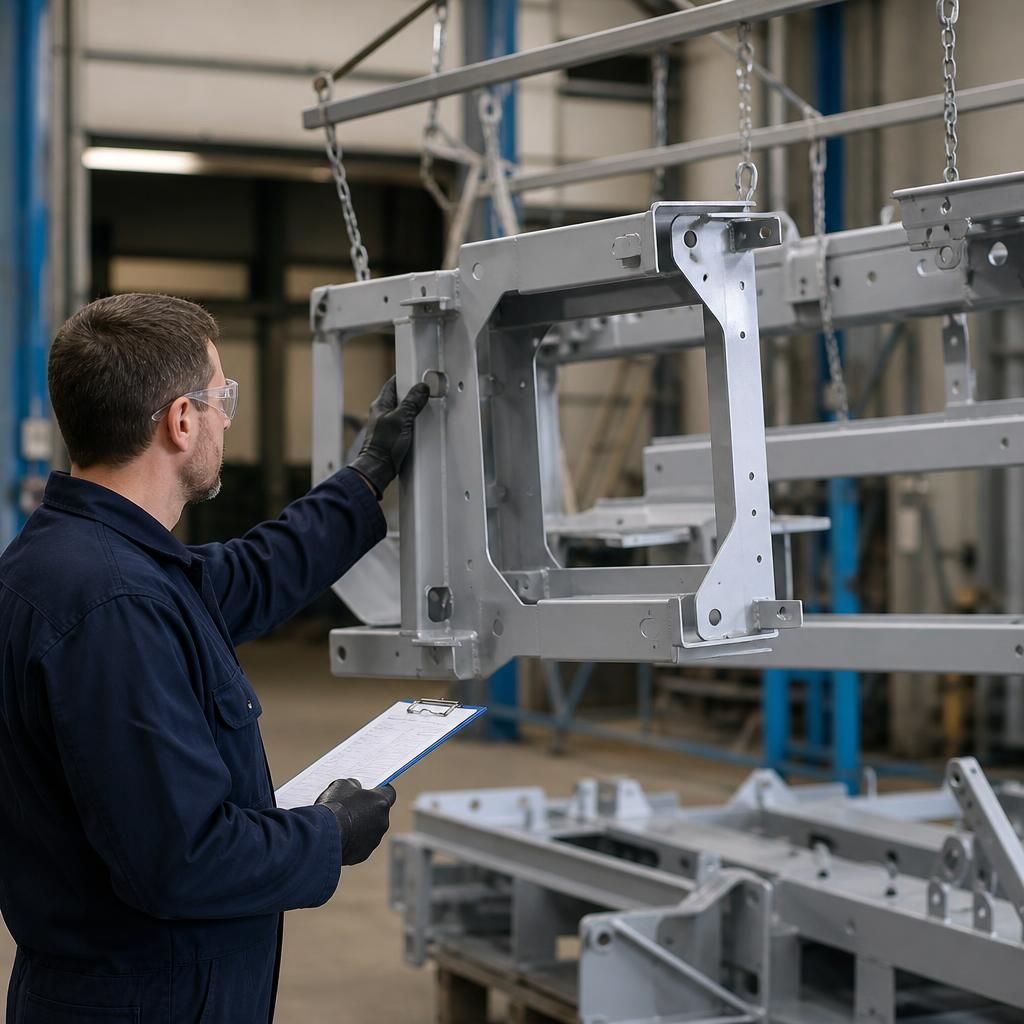
Suitability also depends on whether the component is coated individually or as part of an assembly. Joined surfaces, overlapping plates and moving interfaces can prevent the coating process from reaching every area, while coating between close-fitting parts may affect assembly or movement. Where practical, components should be reviewed in their intended assembly condition so that protected areas, uncoated interfaces and masking requirements are defined before processing.
This is particularly important for fabricated items that include fasteners, hinges, sliding parts or removable covers. A coating specification should identify which surfaces require protection, which must remain clear and how the parts will be assembled after coating. This helps distinguish a component that is suitable in principle from one that needs design changes or a different processing approach.