

Can powder coating be applied to previously painted vehicle parts?
Yes, powder coating can be applied to previously painted vehicle parts, provided the existing paint is removed or fully assessed and the metal is prepared correctly. The part must be clean, sound and suitable for the curing process, as residual paint, corrosion or contamination can affect adhesion and the final finish.
In most cases, previously painted vehicle parts should be stripped back to a clean, stable metal surface before powder coating. Applying powder directly over an old paint layer is usually unsuitable because the coating may contain incompatible materials, weakly bonded areas, corrosion or contaminants that can compromise the new finish during curing.
Assessment comes before preparation. The part should be checked for its base material, the condition of the existing paint and any damage beneath it. Steel and aluminium components are commonly suitable, but thin sections, castings and heat-sensitive alloys need careful treatment. Areas affected by rust, stone chips, bubbling paint or previous repairs should be identified before the old coating is removed, as stripping can reveal pitting, distortion or damaged welds.
The previous coating can be removed using a method appropriate to the component. Common options include:
- Media blasting: useful for removing paint and corrosion from robust steel components, while the media and pressure must be selected carefully for thin panels, aluminium and detailed parts.
- Chemical stripping: can remove several layers without the impact associated with abrasive blasting, although residues must be completely removed before further preparation.
- Mechanical preparation: sanding or controlled abrasion may be suitable for local repairs or limited areas, but it needs to remove loose material and create a consistent surface rather than simply smooth the old paint.
- Thermal stripping: may be appropriate for some heavy components, but excessive heat can distort thin parts or affect the properties of certain alloys, so it is not suitable for every vehicle component.
Once the old paint has been removed, the metal is cleaned and prepared to promote adhesion. This normally includes degreasing, removal of blasting dust and attention to corrosion products, weld spatter and sharp edges. Aluminium may require a preparation system suited to that substrate, while steel may need additional protection against corrosion. Any preparation chemicals or conversion treatments must be compatible with the powder coating system.
Parts also need to be checked for areas where powder must not be deposited. Threads, bearing seats, bores, brake-contact surfaces, earth points, precision mating faces and other close-tolerance areas are commonly masked before coating. Failure to protect these locations can affect assembly, clearances or electrical contact even when the visible finish appears satisfactory.
The curing stage is an important reason not to leave an unknown paint layer underneath the powder. Powder coating is heated in an oven so that the powder flows and cures. Residual paint can soften, blister, release gases or separate from the metal during this process. Porous castings and repaired areas may also release trapped gases, producing pinholes or small surface defects. Thorough cleaning, suitable preheating procedures where appropriate and correct control of the metal temperature help reduce these risks.
Powder coating over an existing finish may be considered in limited circumstances, such as when the original coating is firmly bonded, chemically compatible, free from corrosion and able to withstand the curing cycle. Even then, the old surface normally requires cleaning and abrasion to provide a suitable key. This approach is less predictable than stripping to bare metal, particularly where the age, type or application history of the original paint is unknown.
The condition of the component may determine whether refinishing is practical. Minor pitting can sometimes be addressed during preparation, but deep corrosion, distortion, cracked welds or damage to safety-critical parts should be repaired or assessed before coating. Powder coating conceals the prepared surface; it does not restore structural strength or correct mechanical wear.
For a previously painted vehicle part, useful information to provide before quotation includes:
- the component’s material and approximate dimensions;
- the type and condition of the existing coating, if known;
- any corrosion, filler, previous repairs or contamination;
- the areas that must remain uncoated for fitting or operation; and
- the required colour, gloss level and surface appearance.
A specialist coater can then determine whether the part needs complete stripping, local repair, substrate-specific preparation or further assessment before powder is applied. For automotive components, this preparation decision is often more important to the final result than the choice of colour alone.
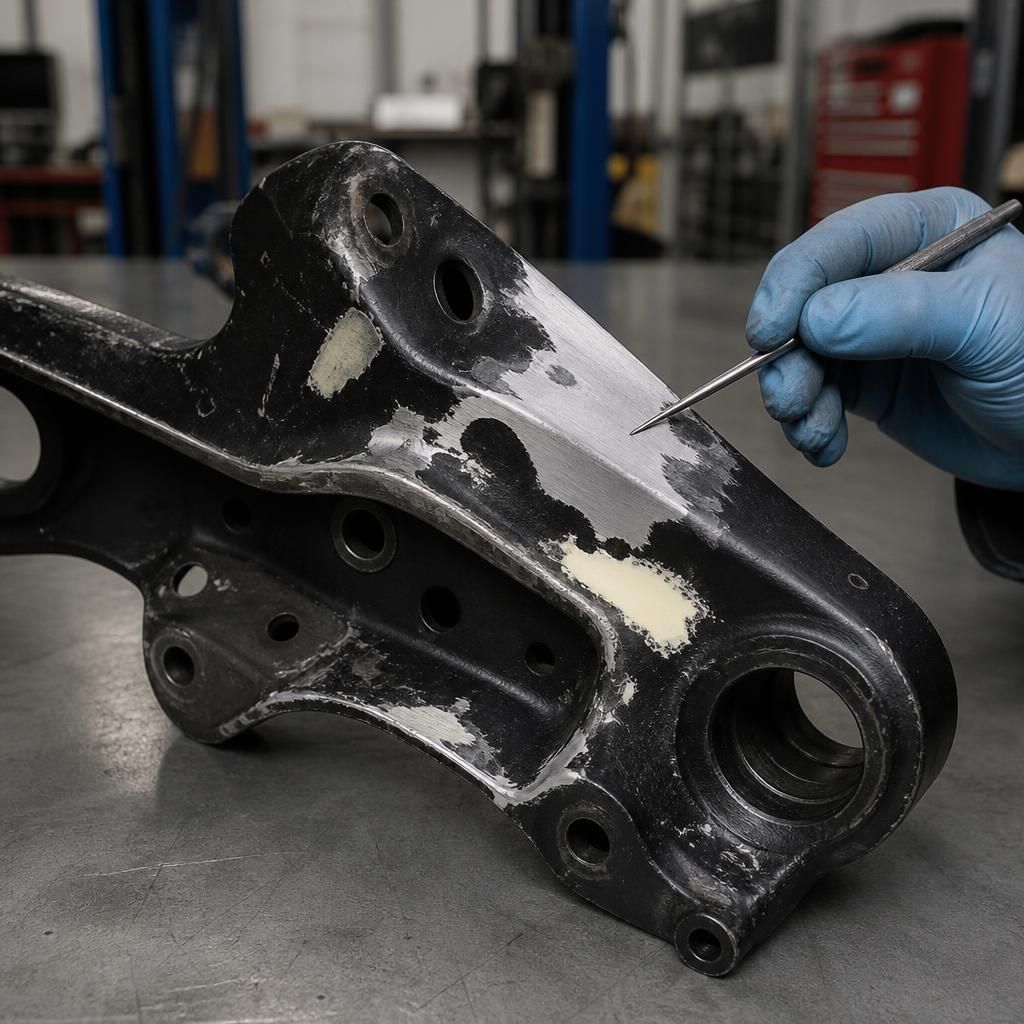
The condition of repairs beneath the old paint can determine whether a vehicle part is suitable for powder coating. Body filler, seam sealant, adhesive residue and other non-metallic materials may react differently from the metal during oven curing, potentially causing movement, outgassing or an uneven surface. These materials should be identified during inspection and removed or replaced with a preparation system compatible with powder coating where necessary.
This is particularly important on refurbished wheels, brackets and fabricated components, where several previous coatings or repairs may be hidden beneath the visible finish. A small exposed area can help establish how many layers are present and whether the substrate has been repaired before the full preparation method is selected. The aim is to create a sound, heat-resistant base rather than simply cover the existing appearance.