

What factors influence the choice of powder formulations in the coating process?
The choice of powder coating formulation is influenced by the metal substrate, the service environment, required durability, appearance and performance characteristics. Application method, curing conditions, film thickness and any specialist requirements must also be considered to ensure the formulation is suitable for the component and intended use.
Powder coating formulations are chosen by matching the powder’s resin system, crosslinking chemistry, additives and physical characteristics to the component’s required function and the way it will be processed. The formulation must produce a stable, consistent film while remaining suitable for storage, application, melting and final conversion into a finished coating.
Resin chemistry
The resin, or binder, forms the main structure of the coating and has a major influence on how the powder behaves during application and curing. Common thermosetting systems include epoxy, polyester and epoxy-polyester hybrid formulations, while thermoplastic powders such as nylon are selected where the coating needs to melt and solidify without undergoing the same irreversible crosslinking reaction.
Thermosetting powders are formulated with a resin and a curing agent that react when heated. The balance between these components affects flow, hardness, flexibility and resistance to chemicals. A thermoplastic formulation is assessed differently because it relies on melting, wetting and solidification rather than chemical crosslinking. This distinction is important when choosing a coating for components that may later require repair, stripping or remelting.
Additives and functional ingredients
Small quantities of additives can significantly change how a powder applies and how the finished film behaves. Flow modifiers help the molten powder spread across the surface, while degassing agents help reduce the risk of pinholes or other defects caused by air or moisture released during heating. Other ingredients may be used to control surface texture, improve slip, reduce friction, support flexibility or provide additional resistance to particular chemicals.
The additive package has to be compatible with the rest of the formulation. An ingredient that improves one property can adversely affect another, for example by changing melt viscosity, surface smoothness, recoat behaviour or storage stability. Formulators therefore consider the complete chemical system rather than selecting individual additives in isolation.
Pigments, fillers and surface effects
Pigments provide colour and can also contribute to opacity, light stability and heat behaviour. Fillers may be used to adjust mechanical characteristics, cost, density or processing properties. Metallic, textured and matt finishes require additional control because the distribution and orientation of particles can affect the consistency of the result.
Some formulations are more sensitive to reclaim, contamination or variations in application conditions than others. This makes the selection of pigments and fillers relevant not only to the intended finish but also to the level of process control available during production.
Particle size and powder flow
The physical characteristics of the powder are also important. Particle-size distribution affects charging, transport through the application equipment, deposition efficiency and the way the powder melts. Excessively fine particles can create handling and recovery difficulties, whereas coarse particles may affect film uniformity or require different processing conditions.
Powder flow and fluidisation behaviour must suit the equipment used. A formulation that feeds consistently from its container helps maintain a stable coating operation, while poor flow can contribute to interruptions, uneven deposition or increased waste. These considerations are particularly relevant for repeat production and larger batches, where small variations can be reproduced across many components.
Manufacturing and handling requirements
A powder must remain stable during manufacture, transport and storage. The formulation is therefore assessed for its tendency to cake, absorb moisture, separate into different constituents or react prematurely. The raw materials must also disperse evenly during manufacture so that each batch has consistent chemical and physical properties.
Where several powders are used in the same facility, compatibility and contamination control become practical considerations. Residues from one formulation can alter the colour, texture or curing response of another. Formulations that are easier to clean between changes may be preferable where a production line handles varied specifications.
Specification and compliance requirements
Selection may be governed by a coating specification, customer drawing, sector requirement or test regime. The relevant documentation can define requirements such as adhesion, impact resistance, flexibility, chemical resistance, electrical insulation or resistance to accelerated testing. The formulation must be capable of meeting the required tests under the specified preparation and processing conditions.
Regulatory and occupational considerations may also influence the raw materials used. Restrictions on certain substances, requirements for product documentation and the need to manage waste or recover overspray can all affect the practical suitability of a formulation.
Rework, repair and future maintenance
The expected treatment of the component after initial coating should be considered before selecting the powder. Some parts may need local repair, recoating or stripping during their service life. Others may be assembled with coated parts, exposed to repeated handling or subjected to contact with oils and cleaning agents. The formulation should therefore be assessed alongside the planned maintenance method rather than viewed only as a one-time finish.
In practice, the most suitable formulation is established by reviewing the component specification, production method, powder-handling requirements and relevant test criteria together. Trial panels or sample components can then be used to confirm that the selected chemistry and physical powder properties produce a consistent result before full-scale processing.
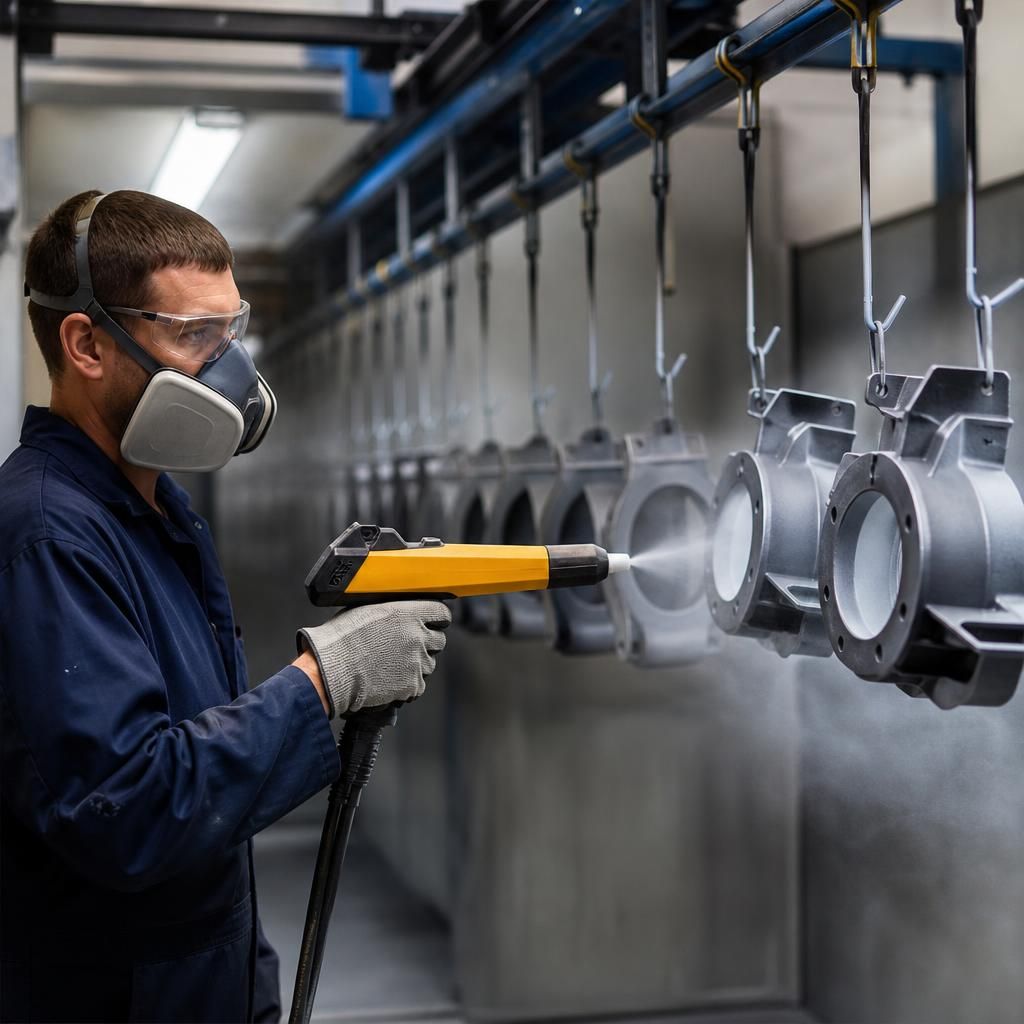
The component’s substrate, geometry and thermal limits can influence the most suitable powder formulation. Steel, aluminium, galvanised metal and other substrates may present different surface conditions, heat responses and adhesion requirements, so the powder must be compatible with both the prepared surface and the curing method.
Part design also matters. Recesses, sharp edges, narrow sections and enclosed areas can affect how consistently powder is deposited and how the film flows during heating. A formulation with suitable melt behaviour and edge coverage can help produce a more even coating across complex components, while the selected process must avoid overheating substrates, inserts or assembled parts that cannot tolerate the curing temperature.