

What are the most common contaminants removed by degreasing before powder coating, and how do they affect adhesion?
Degreasing before powder coating removes contaminants such as oils, grease, dirt, fingerprints, cutting fluids and polishing residues from the metal surface. If these remain, they can form a barrier between the substrate and powder, causing poor wetting, weak adhesion, blistering, pinholing or premature coating failure.
The contaminants most likely to compromise powder coating are organic films and process residues that remain after fabrication, handling or storage. Degreasing is intended to dissolve or lift these materials so the pretreatment and powder coating can contact a chemically clean metal surface. The type of residue matters because different contaminants interfere with adhesion in different ways.
- Drawing compounds and forming lubricants: These are used during pressing, bending and tube forming. They can contain oils, waxes and additives that are difficult to remove once worked into seams, folds or textured surfaces. Any remaining film can prevent consistent pretreatment and leave areas where the coating bonds less effectively.
- Corrosion inhibitors and storage oils: Steel and other metals may be supplied or stored with temporary protective films. These materials are deliberately resistant to moisture, but that resistance also means they can repel aqueous cleaning solutions. Incomplete removal may produce patchy pretreatment and uneven coating performance.
- Coolant and machining-fluid additives: Water-miscible coolants can leave surfactants, corrosion inhibitors and other dissolved residues even after the visible liquid has dried. Neat cutting oils may leave a heavier deposit. Both can alter the surface’s wetting behaviour and cause isolated defects rather than an obvious overall failure.
- Silicone and wax contamination: Silicone-based products, waxes and release agents are particularly troublesome because very small quantities can spread over a large area. They may cause cratering, fisheyes or areas where the powder pulls away during curing. Silicone contamination can also be transferred from gloves, cloths, lubricants or nearby processes.
- Marking materials and adhesive residues: Paint pens, layout fluids, labels and tape adhesives can leave binders, pigments or tacky films. These residues may be chemically different from the surrounding metal and can produce visible outlines, pinholes or localised loss of adhesion after curing.
- Handling contamination: Perspiration contains water, salts and organic compounds. Contact with bare hands can therefore leave a chemically active deposit, while packaging materials may transfer paper fibres, plasticisers or adhesive traces. These deposits are often concentrated around edges, lifting points and areas repeatedly handled during production.
- Cleaning-product residues: Degreasing does not help if the cleaner itself is left on the part. Excess alkalinity, surfactants or poorly rinsed chemistry can form a film that interferes with subsequent conversion treatment and powder wetting. Thorough rinsing and suitable drying are therefore part of contamination control.
Contamination affects adhesion through several mechanisms. A residue can act as a physical separation layer between the metal and the coating, reduce the surface energy needed for the powder to spread, or react with moisture and heat during curing. Volatile material may expand or evaporate in the oven, creating bubbles, pinholes or blisters. A non-volatile film may remain trapped beneath the cured coating, leaving weak interfacial bonding that becomes apparent when the part is knocked, flexed or exposed to moisture.
Not every surface defect is caused by a degreasing failure. Rust, mill scale, heavy oxide, weld discolouration and embedded abrasive material generally require mechanical preparation or a suitable chemical treatment rather than degreasing alone. Degreasing removes organic contamination; it does not restore damaged metal or eliminate every inorganic surface deposit. Confusing these functions can result in a clean but inadequately prepared substrate.
The risk is also influenced by the component’s design. Welded joints, folded returns, blind holes, threads and overlapping sections can retain fluids after washing. If trapped liquid later drains or boils out during curing, it can contaminate adjacent areas or create local coating defects. Components should therefore be designed, positioned and dried so that cleaning chemistry and rinse water can leave the part rather than collect in enclosed features.
Assessment should consider both visible and invisible contamination. A surface may look clean while still carrying a thin molecular film. A controlled water-break observation can help identify areas where water retracts into droplets instead of forming a continuous sheet, although this is an indication of surface condition rather than a complete chemical analysis. Where contamination is persistent, the cleaning process should be reviewed for bath condition, concentration, temperature, contact time, agitation, rinsing and drying, together with the materials used for handling.
For powder coating, the practical objective is not simply to remove visible dirt. It is to produce a uniformly clean, suitably prepared surface with no residual film capable of disrupting pretreatment, powder flow or the bond formed during curing.
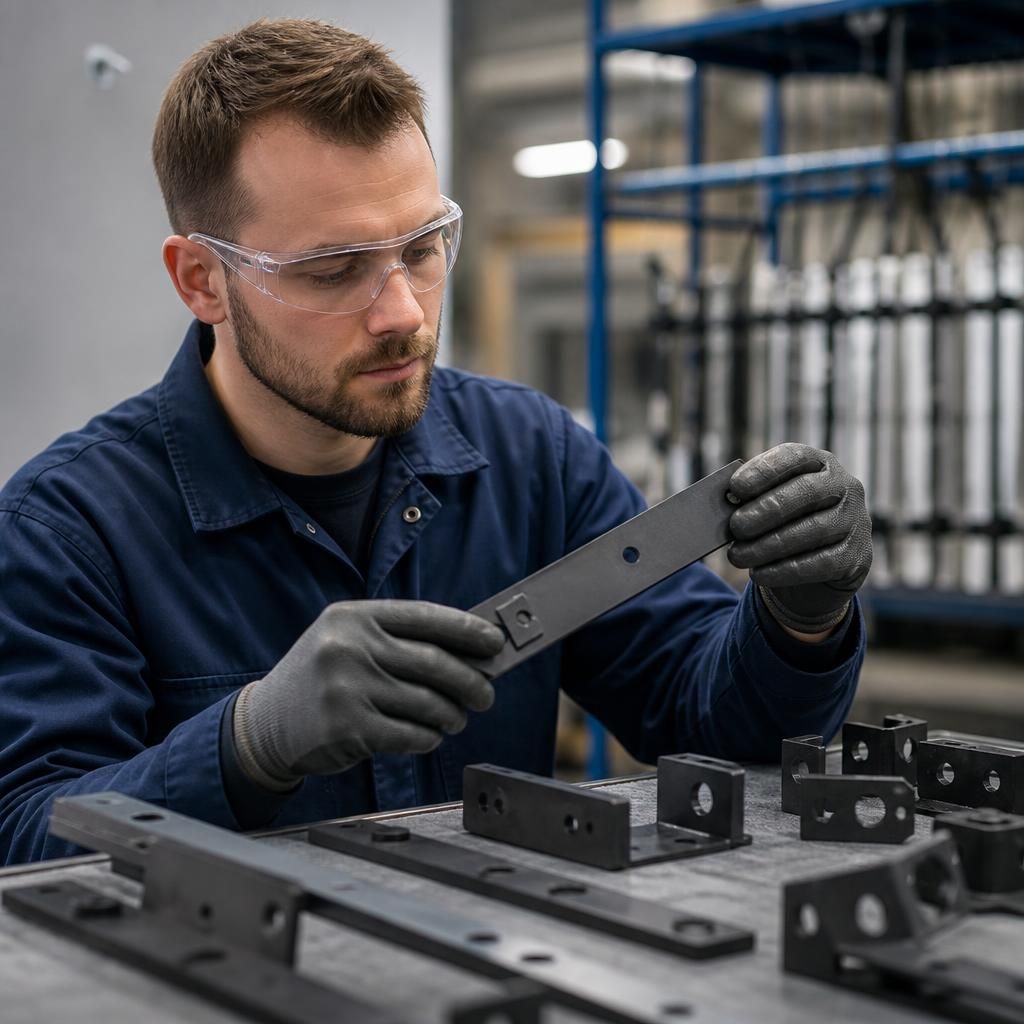
A useful way to investigate adhesion problems is to connect the defect with the stage at which contamination may have entered the process. If coating fails only on particular faces, edges or batches, compare those areas with the fabrication, storage and handling steps applied to them rather than treating the entire coating system as the cause.
Clean reference panels or test pieces processed alongside the components can help separate a surface-preparation problem from an issue with powder application or curing. Where the reference surface performs correctly but a particular component does not, inspect that component for residue retained in joints, recesses or contact areas and review how it was supported, rinsed, dried and handled before coating. This approach makes the contaminant source easier to identify and reduces the risk of repeating the same adhesion defect across a production batch.