

What types of metal components are best suited for metal protective coating spray application?
Metal protective coating spray is best suited to clean, heat-resistant metal components such as steel, iron and aluminium parts, including brackets, frames, panels, enclosures, guards, fabricated assemblies and automotive components. It is particularly practical for components requiring a durable, uniform finish across individual items or production batches, provided their size, shape and material are compatible with the preparation and curing process.
The most suitable components for metal protective coating spray application are rigid, conductive parts that can tolerate controlled preparation, spraying and oven curing without losing their shape or function. Suitability depends not only on the metal itself, but also on the component’s dimensions, geometry, required film build, operating environment and the tolerances of any mating parts.
Fabricated components are usually well suited because their surfaces can be prepared and coated as a complete assembly or as separate parts before final installation. Typical examples include:
- Welded frames, support structures and machine bases
- Brackets, mounting plates, rails and fabricated housings
- Metal guards, covers, access panels and cabinets
- Storage, handling and display equipment
- Architectural and construction-related metalwork
These components benefit from coating when corrosion resistance, surface uniformity and protection against routine handling are important. Open faces, external edges and accessible internal surfaces can generally be treated effectively, although enclosed sections require particular attention to drainage, venting and the movement of air during preparation and curing.
Parts with broad, accessible surfaces are especially practical for spray application. Panels, plates, housings and formed sections allow the coating to be distributed consistently across the main faces without excessive obstruction from adjacent features. Components with recesses, channels or corners can also be suitable, but their design should allow the spray to reach the required areas. Deep pockets, narrow slots and sharp internal angles may receive less material than exposed surfaces and may need design review or a different coating approach.
Components requiring a repeatable finish across batches are another strong application. Powder coating can be considered for repeat-manufacture parts where the same substrate, dimensions and preparation requirements are maintained from one batch to the next. Consistent racking and orientation help ensure that surfaces are presented to the spray equipment in a controlled way, while defined masking protects holes, threads, bearing seats and other areas that must remain free of coating.
Steel and iron fabrications are commonly selected where the component needs protection from moisture, handling and general industrial exposure. The correct preparation is important because mill scale, weld residues, oil, rust and contaminants can affect adhesion and the final appearance. Welded areas, folded edges and cut ends should be assessed rather than assuming that a visually sound surface is ready for coating.
Aluminium components can also be suitable, particularly for housings, panels, frames and fabricated parts where a protective or decorative finish is required. Aluminium presents different preparation considerations from ferrous metals, including its oxide layer and the possibility of contamination from fabrication. The coating specification should therefore identify the alloy or substrate condition where this affects preparation, curing or expected service performance.
Galvanised or previously treated components may be coat-able, but they require assessment before work begins. The surface condition, age of the existing treatment, outgassing risk and compatibility between the previous layer and the new coating can all affect the result. A component should not be selected solely because its base metal is suitable; any existing finish forms part of the coating system and must be considered.
Component size and mass are also important. The part must be capable of being safely handled, racked and moved through the preparation and curing stages. Large fabrications may be suitable where the available equipment can accommodate their dimensions, while very heavy or awkward assemblies may be better divided into coated sections before final assembly. The design should also provide suitable hanging points or non-critical contact areas so that the coating can reach the required faces.
Parts with tight dimensional requirements need particular care. Coating adds a layer to the substrate, so holes, threads, sliding faces, press fits, bearing locations and electrical contact points may need masking, plugging or post-coating treatment. If a coated surface is intended to mate with another component, the specified coating thickness and resulting tolerance should be checked during design rather than after production.
Components that experience impact, abrasion, chemicals, outdoor exposure or repeated handling may be good candidates for a protective coating, but the coating type must match the service conditions. A part used indoors under light handling has different requirements from one exposed to weather, industrial contamination or frequent contact with tools. The most suitable specification should consider:
- The base metal and its surface condition
- Whether the part is used indoors or outdoors
- Contact with water, oils, cleaning agents or chemicals
- Expected abrasion, impact and handling
- Required appearance, gloss and colour
- Permitted coating build on functional surfaces
- Whether the component will later be cut, drilled, welded or assembled
Some components are less suitable unless they are modified or assessed in advance. These include parts containing heat-sensitive seals, adhesives, electronics or trapped moisture; assemblies with closed cavities that cannot vent; materials that deform at curing temperatures; and heavily contaminated or corroded surfaces that cannot be properly prepared. Components combining different metals may also need additional consideration because their preparation and response to heat can differ.
For that reason, the best candidates are not simply the largest or most straightforward metal items. They are parts whose substrate, construction and end use allow the preparation, spray coverage, curing conditions and dimensional requirements to be controlled. Providing drawings, material details, masking requirements and information about the component’s working environment allows the coating specification to be judged against the part’s actual function rather than its appearance alone.
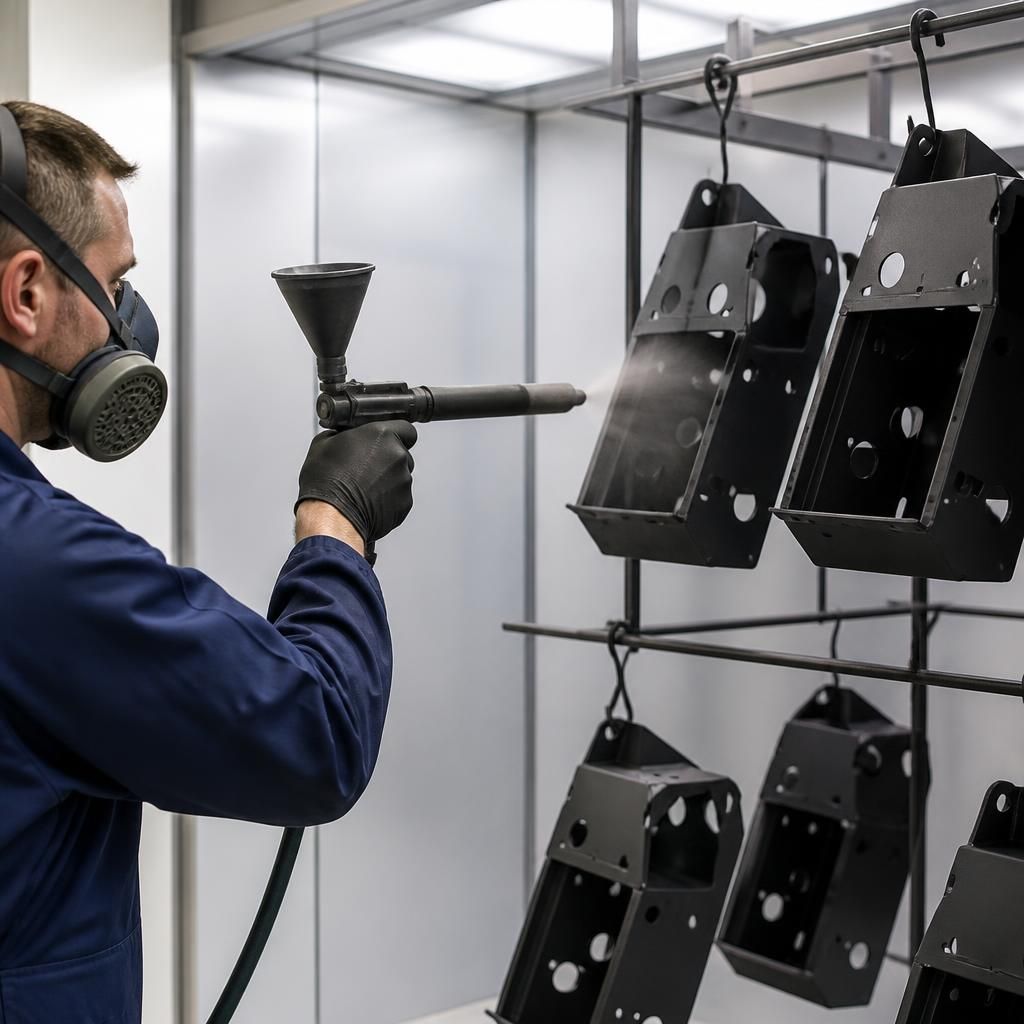
Component geometry can determine whether protective coating spray reaches every required surface. In electrostatic powder coating, charged particles are naturally attracted to exposed faces and may deposit less effectively inside deep recesses or narrow cavities, where the electrical field is weaker. This effect, often called the Faraday cage effect, means that a component with open access and clearly defined surfaces is generally easier to coat consistently than one with enclosed or closely spaced features.
Design drawings should therefore identify critical internal areas, drainage points and surfaces that must remain uncoated. Suitable racking and part orientation can improve access during spraying, while vents and drain holes help preparation and curing processes reach enclosed sections. This assessment is particularly important for fabricated housings, cabinets and guards, where the external finish may appear complete even though concealed areas have received less coverage.
Assess Your Components for Protective Coating Spray
Share your component drawings, substrate details and intended service conditions with Powder-coatings.co.uk for an informed assessment of coating suitability, masking requirements and finish specification. Collection and delivery options are available for businesses across the Midlands and surrounding areas.