

What factors should be considered when selecting the right stainless steel shot blasting media for specific industrial applications?
Selecting the right stainless steel shot blasting media requires matching the shot grade and size to the metal substrate, required surface profile, component geometry and blasting equipment. Also consider contamination control, impact resistance, recyclability, media consumption and the total operating cost for the specific industrial application.
The right stainless steel shot blasting media is selected by considering the required cleaning action, the condition and sensitivity of the component, the required cleanliness before coating, the blasting process, and how consistently the media can be controlled in use. The choice is not based on stainless steel composition alone: the shot’s form, hardness, condition and behaviour in the machine must suit the complete preparation process.
Start with the purpose of blasting. Stainless steel shot may be used to remove scale, oxidation, residues, moulding material, old coatings or manufacturing debris, but each task places different demands on the media. A process intended to clean a robust fabricated part can tolerate more aggressive impact than one intended to prepare a thin pressed component or a precision-machined surface. If the aim is light cleaning rather than substantial removal, an unnecessarily aggressive medium may increase the risk of surface distortion, sharp edge damage or unwanted dimensional change.
Consider the construction and sensitivity of the component. Thin sections, unsupported panels, narrow ribs, threaded areas, machined faces and close-tolerance features need particular care. The blasting method should reach the required surfaces without damaging features that must remain functional. Parts with recesses or partially enclosed areas may also require attention to shot flow, drainage and recovery, since trapped media can interfere with assembly or later finishing. The component’s mass and rigidity are relevant too: a heavy, rigid casting will respond differently from a lightweight fabrication exposed to the same process.
Assess the shot’s physical form and condition. Spherical cast shot produces repeated impact with a relatively uniform contact pattern, while conditioned cut-wire shot may offer a different balance of cutting action and durability. The condition of the particles matters as much as their original specification. Freshly introduced media, rounded working particles and fractured or contaminated particles do not behave identically. Excessively worn shot can reduce cleaning performance, whereas a large proportion of broken particles can alter the process and make the result less predictable. The selected media should therefore be assessed as a working mixture, not just as a new product description.
Check compatibility with the substrate and downstream finish. Stainless steel shot is often chosen where iron transfer from carbon-steel media would be unacceptable, particularly on stainless, aluminium and other corrosion-sensitive substrates. However, the absence of ferrous contamination does not remove the need for process control. Residues from previous jobs, oils, shop dirt or poorly maintained recovery equipment can still affect the prepared surface. The cleaned part should meet the cleanliness requirements of the subsequent powder-coating process, with suitable inspection for visible residue, embedded debris and uneven preparation.
Define the acceptable surface condition before testing. The specification should identify what constitutes an acceptable result, including visual cleanliness, consistency across the component and compatibility with the coating system. Where appearance is important, the evaluation should include visible faces, edges, weld zones, recesses and areas that are difficult for the operator or blast stream to access. Trial processing is useful because the same media can produce different results on castings, sheet, tube, weldments and machined parts. Samples should be checked after blasting and again after coating so that the media choice is judged against the finished requirement rather than cleaning alone.
Review the machine and process controls. Media selection should take account of the way parts are presented to the blast stream, the consistency of coverage, loading arrangements and the ability to separate dust and undersized particles. An appropriate shot can still give poor results if parts shield one another, rotate inconsistently or remain in the machine for an unsuitable exposure period. The process should allow the operator to control the variables that affect repeatability, such as blast intensity, coverage, part orientation and the condition of the working mix.
Consider segregation between materials and jobs. If the equipment is used for different metals or abrasive types, the risk of cross-contamination should be assessed before introducing stainless steel shot. Separate storage, clearly identified transfer equipment and effective cleaning of the machine and recovery system can help preserve media integrity. This is particularly important where one job has strict requirements for iron-free preparation or where residues from a previous material could affect corrosion performance or powder-coating adhesion.
Include health, safety and environmental controls. Although stainless steel shot is durable and reusable, blasting still generates dust from removed coatings, scale and substrate residues. The relevant risks depend on the material being removed, so extraction, enclosure, waste handling and personal protective equipment should be considered as part of the media decision. Existing coatings may contain hazardous substances, and the waste stream should be assessed before processing begins. Media recovery should also prevent spills, mixing with unsuitable waste and unnecessary loss of usable shot.
Evaluate supply and process stability. The chosen specification should be available consistently enough to maintain the same process conditions between production runs. Changes in particle form, cleanliness or working-mixture condition can produce differences in the prepared surface even when the nominal media description remains unchanged. Establishing an approved media specification, recording additions and removals, and inspecting the working mix at defined intervals helps identify drift before it affects a batch of components.
For industrial powder-coating preparation, the most reliable selection process combines a review of the component, the required cleaning action, the downstream coating standard and the available blasting controls. A controlled trial on representative parts is preferable to choosing solely by general-purpose suitability, because it confirms that the stainless steel shot delivers the required preparation without compromising component integrity or process consistency.
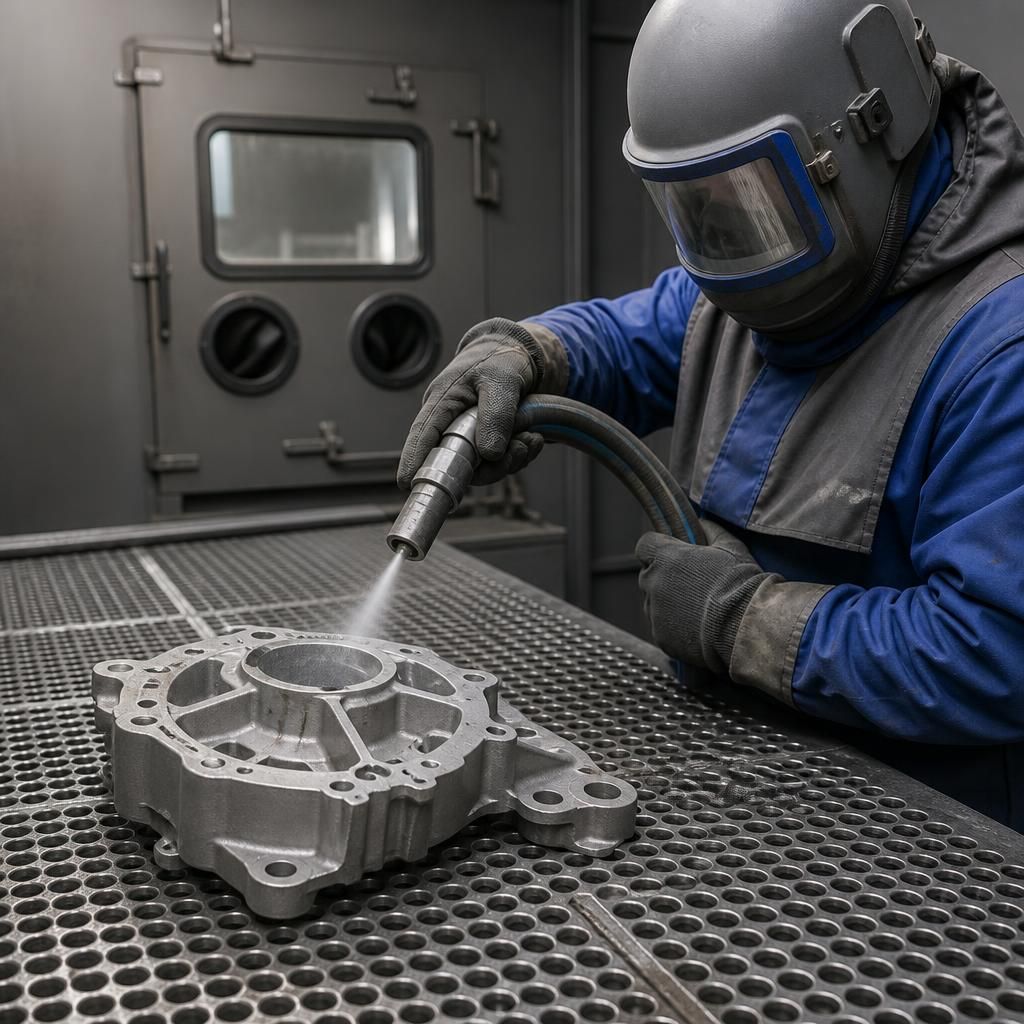
Shot hardness should be matched to the substrate and the required preparation intensity. Harder stainless steel shot delivers more forceful impact and may be appropriate for robust castings or firmly bonded residues, while a less aggressive grade can be more suitable for thinner sections and surfaces where excessive peening or deformation must be avoided. The choice should also consider whether the finished surface needs a controlled profile for powder-coating adhesion rather than simply a visibly clean appearance.
Confirm the result by examining representative areas for consistent texture, undamaged edges and complete removal of the targeted residue. If the surface is too heavily peened, uneven or difficult to coat consistently, review the shot hardness alongside machine settings and exposure conditions rather than changing media size alone.
Discuss Your Stainless Steel Shot Blasting Media Requirements
Discuss your component dimensions, substrate, contamination requirements and proposed blasting process with the powder-coating team to identify a suitable stainless steel shot specification. Representative parts and details of the required finished surface can support a more informed assessment.