

What are the advantages of using different shot blasting media for specific materials?
Different shot blasting media offer specific advantages because their hardness, shape and density determine how they clean and texture a surface. For example, steel shot provides effective cleaning and profiling on robust steel components, while gentler media such as glass bead or aluminium oxide can prepare aluminium and other softer metals with less risk of distortion or excessive abrasion.
The main advantage of matching shot blasting media to the substrate is that it allows the surface to be cleaned and prepared without causing unnecessary erosion, distortion or contamination. The correct media can remove mill scale, rust, old coatings and manufacturing residue while producing a surface profile suited to powder coating adhesion. The best choice depends on the material’s hardness, thickness, geometry, required finish and sensitivity to embedded particles.
Carbon steel and structural steel
Steel shot is effective for robust carbon-steel parts, fabricated assemblies and components with heavy scale or firmly bonded corrosion. Its rounded form provides repeated impact and can clean large areas efficiently while producing a relatively uniform surface. It is particularly useful where the substrate can withstand a stronger mechanical treatment and where preserving the overall shape is important.
Steel grit has an angular form, giving it a stronger cutting action than round shot. This makes it advantageous for removing tightly adhered mill scale, rust and existing coatings from heavily contaminated steel. It can create a more pronounced anchor pattern for powder coating, although the grade and blasting pressure must be controlled so that the profile is not excessive for the coating system.
Stainless steel
Stainless steel benefits from non-ferrous or carefully selected stainless-compatible media where iron contamination could affect the surface. Glass bead can clean and brighten stainless components while producing a fine, even texture with limited cutting. Aluminium oxide is more suitable when stronger removal of heat tint, weld discolouration or firmly attached residue is required.
Avoiding ordinary carbon-steel media can reduce the risk of transferring ferrous particles to the stainless surface. Any remaining dust must still be removed thoroughly, because contamination left before powder coating can interfere with coating consistency and may contribute to later surface defects.
Aluminium
Aluminium is relatively soft and can be marked, distorted or over-profiled by an unnecessarily aggressive abrasive. Fine glass bead offers controlled cleaning and a consistent cosmetic texture, making it useful for visible aluminium components where retaining dimensional detail matters. Aluminium oxide can be used when stronger preparation is needed, but a fine grade, suitable pressure and controlled dwell time are important.
Non-ferrous media also avoids introducing steel particles that may become embedded in aluminium. This is valuable where the finished component must retain a clean appearance or where contamination could complicate subsequent powder coating. Operators should take particular care around thin sections, edges, apertures and machined features.
Cast iron
Cast iron generally tolerates a more forceful abrasive than aluminium, especially when removing foundry residue, rust or an existing coating from a substantial component. Steel grit can provide the cutting action needed for irregular cast surfaces, while steel shot can help produce a more consistent treatment on larger, less heavily contaminated areas.
The media must be selected with the casting’s geometry in mind. Deep recesses, sharp transitions and porous areas can retain abrasive dust, so cleaning and inspection after blasting are essential before powder is applied.
Zinc-coated and galvanised steel
Zinc coatings require a more restrained approach because aggressive blasting can remove the protective layer rather than simply clean it. Fine, non-metallic media can provide controlled preparation with less risk of cutting through the zinc. The objective is normally to remove contamination and provide a suitable surface for the coating system, not to strip sound galvanising unnecessarily.
Testing on a representative area is particularly useful for galvanised parts, as the appropriate media and intensity depend on the zinc thickness, condition and subsequent powder coating specification. Excessive blasting may leave uneven areas that require additional treatment.
Copper, brass and other soft non-ferrous metals
Glass bead or other fine, relatively gentle media can clean copper and brass while limiting the sharp cutting action that may leave deep scratches. This can be advantageous for decorative or accurately formed components. Plastic media may be appropriate where an existing coating needs to be removed but the underlying metal must be protected from substantial abrasion.
These substrates can also show impact marks or changes in surface appearance more readily than steel. Lower-impact media and controlled passes therefore help preserve detail and reduce the need for corrective finishing before powder coating.
Thin sheet, delicate components and mixed assemblies
Plastic media, fine glass bead or selected organic media can be advantageous for thin sheet and delicate parts because they remove surface contamination or old coatings with less risk of heat, warping and edge erosion than a heavy metallic abrasive. They are useful where the substrate has intricate profiles, threads, light-gauge sections or bonded features that could be damaged by aggressive impact.
Organic media such as walnut shell or corn cob can offer gentle cleaning, but they do not provide the same reliable profile as a dedicated abrasive. They may therefore be more suitable for particular cleaning or stripping tasks than for preparing every surface directly for powder coating. Residual dust and organic particles must be removed completely before coating.
How the advantage translates into powder coating quality
- Controlled adhesion: Angular abrasives can create an anchor profile where a stronger mechanical key is required, while fine bead media can prepare surfaces where a shallow, uniform texture is preferable.
- Dimensional protection: Gentler media help preserve holes, threads, edges, thin walls and machined tolerances.
- Reduced contamination: Non-ferrous media can be preferable for aluminium, stainless steel and other substrates where transferred iron would be undesirable.
- More consistent appearance: Uniform media and a controlled process reduce variations in texture that can become visible through the powder coating.
- Efficient coating removal: More cutting media can reduce the effort needed to remove scale or firmly bonded coatings from durable steel, provided the resulting profile remains suitable.
Media selection should not be made by material name alone. Grade, particle size, equipment settings, nozzle distance, blasting angle and exposure time all affect the result. A suitable process normally includes a trial on representative components, followed by inspection for cleanliness, profile, embedded media, distortion and visible defects. The prepared surface should then be protected from renewed contamination and coated in accordance with the specified powder coating system.
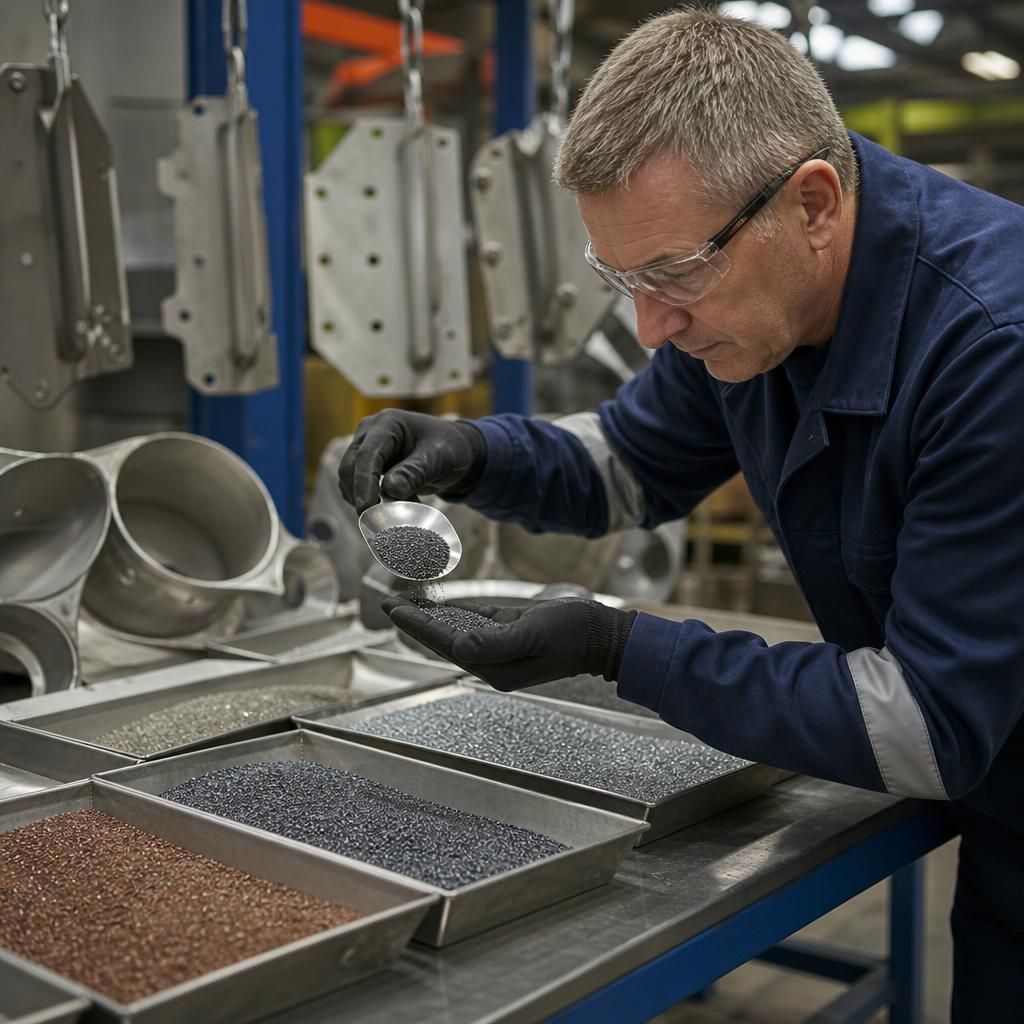
The benefit of selecting media by material is not limited to cleaning performance; it also helps maintain process consistency between components. A media type that is suitable for heavy steel may be unsuitable for a lighter or softer substrate, where the same impact could alter edges, recesses or visible surfaces. Matching the abrasive to the material therefore makes the preparation stage more predictable before powder application.
For production work involving different metals, media should be kept suitably segregated and the equipment cleaned when the process requires it. This reduces the chance of particles from a previous substrate being carried onto the next component. The result is a more controlled preparation process, particularly where the finished powder coating must preserve the appearance or cleanliness of aluminium, stainless steel or other non-ferrous materials.