

What are the benefits of choosing polyester powder as a coating for stainless steel components?
Polyester powder coating provides stainless steel components with a tough, uniform finish that improves resistance to scratching, weathering and general wear. It also offers a broad choice of durable colours and gloss levels, making it suitable where both long-term protection and a consistent appearance are required.
Polyester powder coating is a thermoset finish applied as dry powder and cured onto stainless steel components. Its main benefits are strong substrate protection, dependable performance in exterior environments, controlled application and a wide choice of functional surface specifications without altering the underlying stainless steel component.
Protection suited to demanding environments
Once cured, polyester powder forms a continuous barrier over the stainless steel. This helps limit direct contact between the metal and contaminants such as moisture, salts, atmospheric pollutants and handling residues. The coating can therefore provide an additional protective layer where the component will be exposed to variable conditions, including outdoor installations and industrial surroundings.
The coating does not replace the corrosion resistance of stainless steel, nor does it remove the need to select a suitable stainless grade for the operating environment. It adds value by protecting the surface from contamination and physical contact. Correct preparation remains essential: oil, grease, dirt, oxide and other residues must be removed so the powder can bond consistently to the substrate.
Reliable adhesion when the substrate is prepared correctly
Stainless steel has a relatively non-reactive surface, which means that powder coating cannot be treated in the same way as coating ordinary mild steel. Degreasing, suitable abrasion or chemical preparation, and the correct pretreatment help create a surface to which the powder can anchor. This gives polyester powder a practical advantage over finishes that rely on less robust surface preparation or are more vulnerable to lifting at edges and joints.
Preparation is particularly important around welds, folds, drilled holes, sharp transitions and areas that have been handled during fabrication. A properly controlled process helps the coating follow the component rather than leaving exposed areas that could become points of contamination or premature breakdown.
Good suitability for external use
Polyester formulations are commonly selected for components exposed to sunlight and changing weather because they can retain their finish more effectively than many general-purpose coating types. The appropriate grade can help reduce deterioration caused by ultraviolet exposure, moisture and repeated temperature changes. This makes polyester powder a useful option for stainless steel parts used in architectural, construction, transport and general industrial applications.
Suitability still depends on the specification. Coastal atmospheres, chemical exposure, high temperatures, abrasion and immersion may require a particular polyester formulation or a different coating system. The operating environment should be reviewed before the powder type, film specification and pretreatment are selected.
Consistent coverage on manufactured components
Powder is applied electrostatically, allowing charged particles to be attracted to the earthed metal component before curing. With suitable application settings, this can produce repeatable coverage across batches of brackets, panels, housings, frames and other fabricated parts. Consistency is valuable where components must match across an assembly or where a defined coating thickness is required for fit and function.
The dry application also avoids the solvent evaporation associated with conventional liquid paint. This can simplify the coating system and reduce the risk of defects linked to solvent release, provided the powder is stored, applied and cured under controlled conditions. Uncured powder that does not adhere to the component may also be recoverable in suitable production systems, although the practical benefit depends on the equipment and process design.
Useful functional properties
- Polyester powder can provide a stable insulating layer where the finished component must be electrically separated from adjacent metalwork. The required coating thickness and electrical performance should be specified rather than assumed.
- The cured surface is relatively easy to clean when the correct formulation and finish have been selected, which can be useful for components exposed to dust, handling marks or industrial residues.
- The coating can cover minor visual variation in the prepared stainless surface, helping fabricated batches present a more consistent finish without changing the component geometry.
- Powder coating adds only a controlled surface layer, so it can protect and define the exterior of a part while retaining the strength and form of the stainless steel beneath it.
Lower process disruption than changing the component material
Using polyester powder on stainless steel allows a manufacturer or fabricator to specify a coated finish while continuing to use an existing stainless component design. This can avoid redesigning parts solely to obtain a different surface appearance or additional environmental protection. It is suitable for individual fabricated items as well as repeat production, provided the component can be safely cleaned, coated and cured without affecting its dimensions or heat-sensitive features.
Parts should be reviewed before coating for trapped moisture, blind holes, threaded areas, moving interfaces, masking requirements and surfaces that must remain electrically conductive. These points affect whether polyester powder is appropriate and how the component should be prepared. A clear drawing or coating schedule can define uncoated areas, required film performance and the inspection standard.
Overall, polyester powder is beneficial for stainless steel because it combines an additional protective barrier with controlled batch application and adaptable functional specification. The best results depend on matching the polyester system to the exposure conditions, preparing the stainless steel correctly and controlling application and curing throughout the process.
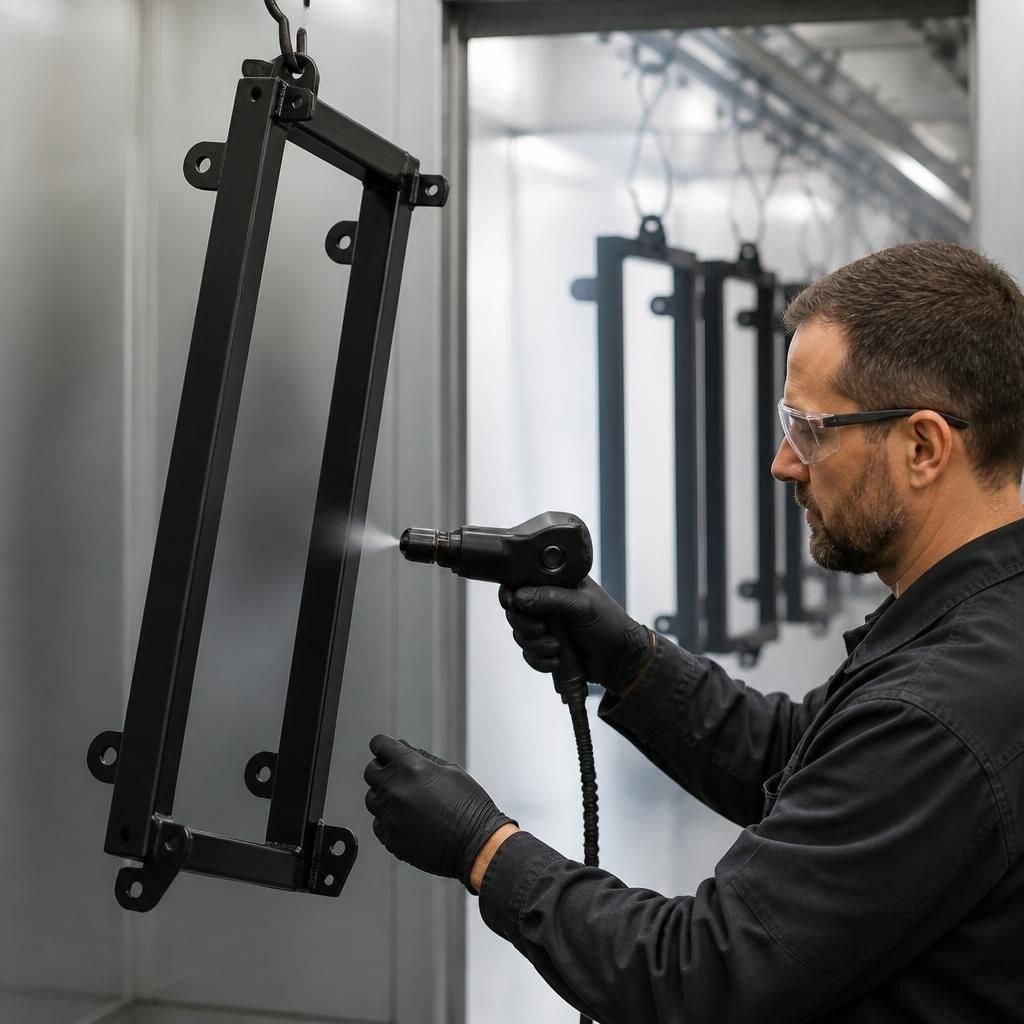
Polyester powder is a thermoset coating, meaning the particles fuse and chemically cross-link during curing to form a fixed film. Unlike a coating that simply dries, the cured layer does not return to a powder state during ordinary service. This gives stainless steel components a stable surface finish where the coating must remain intact and consistent during routine use.
The thermoset structure also makes the coating specification important. Components exposed to elevated temperatures should be assessed against the selected polyester system’s operating limits, while the curing schedule must suit the stainless steel part and any heat-sensitive features. When these conditions are matched correctly, polyester powder provides a durable, defined finish without changing the component’s underlying form.
Discuss polyester powder coating for your stainless steel components
If you are assessing polyester powder for stainless steel components, discuss the part design, exposure conditions and required finish with Powder-coatings.co.uk. Sharing drawings or coating specifications can help establish the appropriate preparation, masking and curing requirements for your components.