

What applications are best suited for black powder coated metal sheets?
Black powder coated metal sheets are well suited to architectural panels, machine guards, equipment enclosures and fabricated components where a consistent appearance and durable protective finish are required. They are particularly practical for manufactured and construction-related parts that need resistance to everyday wear while retaining a clean black finish.
Black powder coated metal sheets are best suited to applications that require a uniform architectural appearance alongside resistance to routine handling, abrasion and environmental exposure. Typical uses include interior and exterior building components, electrical and equipment housings, transport-related fabrications, furniture parts and general industrial assemblies where the coating specification matches the service conditions.
In construction and architectural work, black-coated sheet can be used for fascia, feature panels, soffits, trims, screens, partitions and fabricated cladding details. The finish is particularly useful where several visible metal parts need a consistent colour and surface appearance. For external applications, the coating system should be selected for the expected exposure to sunlight, rain, condensation and pollutants rather than chosen on colour alone. Edges, folded sections, fixings and cut-outs also need proper treatment because these areas can be more vulnerable than the flat face of the sheet.
Interior applications are often less demanding, making black powder coated sheet suitable for wall panels, ceiling details, counters, cabinets, display structures and protective surrounds. It can provide a hard-wearing surface in areas subject to regular contact, provided the correct gloss level and texture are selected. A textured or low-gloss finish may be preferable where fingerprints, minor marks or reflected light would be problematic, while a smoother finish can support a more precise, formal appearance.
For manufacturing and engineering, suitable uses include covers, guards, brackets, access panels, control-panel surrounds and fabricated housings. The coating can help protect the sheet during ordinary service and gives separate components a coherent finish. Application suitability depends on the operating environment: parts exposed to cutting fluids, solvents, abrasive dust, elevated temperatures or repeated impact may require a coating system specifically tested for those conditions.
Black powder coated sheet is also appropriate for fabricated furniture, shelving, frames, racking components and commercial fixtures. These products commonly benefit from a finish that is easy to identify visually and capable of withstanding routine assembly, transport and use. Where panels will be frequently moved or handled, the design should minimise sharp edges and friction points, and packaging should prevent coated faces from rubbing against one another.
Automotive and transport-related components can use black-coated sheet for non-exhaust body parts, brackets, covers, housings and other fabricated items, subject to the required resistance to vibration, stone impact, oils, cleaning chemicals and weathering. Components close to heat sources or exposed to road salt need a coating and pre-treatment suitable for those conditions. Powder coating should not be selected solely because the part is black; the substrate, preparation, film build, curing schedule and test requirements all influence performance.
The application is less suitable where the sheet will remain continuously immersed, face severe chemical attack, operate at temperatures outside the coating system’s limits or require a highly flexible coating over repeatedly moving sections. In these situations, the specification should be reviewed before production. The design should also allow adequate access for cleaning and inspection, as trapped moisture, contamination and damaged edges can shorten the useful life of an otherwise well-finished component.
When specifying black powder coated metal sheets, assess the following points:
- Whether the part is intended for internal, sheltered external or fully exposed use.
- The metal substrate and its compatibility with the proposed pre-treatment.
- Expected contact with moisture, salt, chemicals, oils, impact and abrasion.
- Exposure to sunlight and the required level of colour and gloss retention.
- Required appearance, including gloss, texture, edge coverage and visual uniformity.
- Part geometry, including folds, holes, welds and areas that may retain moisture.
- Operating temperature, cleaning methods and any relevant performance testing.
For B2B projects, providing drawings, material details, batch quantities and service conditions helps the coating process to be matched to the finished component. A regional powder-coating specialist serving the Midlands and surrounding areas can advise on preparation, coating selection and collection or delivery arrangements for manufactured sheet-metal work.
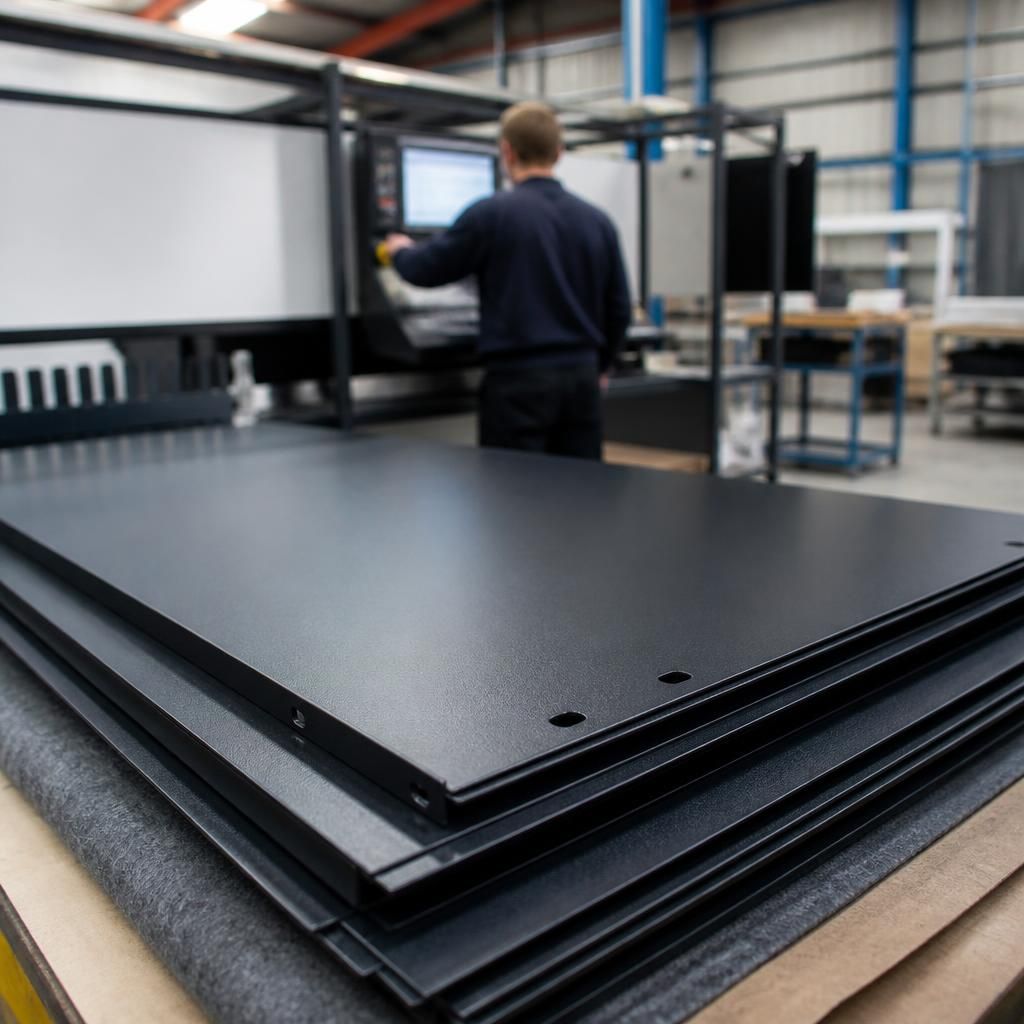
Black powder coated metal sheets are best used as finished, non-structural components rather than as a substitute for the sheet’s engineering design. In enclosures, guards, panels and architectural skins, the coating provides the specified surface finish and environmental protection, while strength, stiffness and load capacity must come from the selected substrate, thickness, folds, stiffeners or supporting frame.
This distinction is important when choosing applications for large panels or fabricated assemblies. The coating should be treated as one part of the specification, alongside the metal grade, joint design and fixing method. Where a component carries loads, supports equipment or forms part of a safety-critical assembly, its structural performance should be assessed independently of the black powder coated finish.