

How does powder coating enhance the corrosion resistance of chassis and frames?
Powder coating enhances the corrosion resistance of chassis and frames by forming a continuous, cured barrier that separates the metal from moisture, oxygen, salts and other corrosive contaminants. When the surface is correctly prepared and the coating is applied consistently, it helps limit rust initiation and slows corrosion across exposed areas, edges and structural sections.
Powder coating enhances corrosion resistance by combining suitable metal preparation with a tightly bonded, cured coating system that reduces the conditions required for rust to develop. On chassis and frames, its effectiveness depends not only on the powder itself, but also on pretreatment, coverage, curing, design details and how the coated part is used.
Corrosion needs access to the metal surface, usually through moisture, oxygen and contaminants such as road salt, industrial residues or trapped dirt. A correctly applied coating separates the substrate from these agents and helps prevent localised corrosion from becoming established. The cured film also resists routine abrasion and handling better than many uncured or poorly bonded finishes, reducing the number of exposed points through which corrosion can begin.
- Consistent film coverage: Powder is electrostatically attracted to the metal before being cured, allowing the coating to cover broad surfaces and many shaped sections. Application still needs careful control around corners, recesses, welds, brackets and fixing points, where thin coverage or missed areas can create weak points.
- Strong adhesion: Surface preparation removes oil, dirt, mill scale and oxidation, while chemical pretreatment can improve the bond between the substrate and coating. Good adhesion helps prevent moisture from travelling beneath the finish if the surface is scratched or exposed to repeated environmental stress.
- Resistance to environmental attack: The appropriate powder formulation can provide resistance to water, humidity, salt-laden spray, oils and other substances encountered by industrial and automotive components. Selection should reflect the actual environment rather than relying on a general-purpose finish for every application.
- Reduced under-film corrosion: Where the coating remains well bonded, corrosion is less likely to spread unseen beneath the finish. This is particularly important on structural components, because corrosion under a coating can remain difficult to detect until bubbling, lifting or visible staining develops.
Chassis and frames present particular challenges because they often combine flat sections, tubular members, folded metal, welds and enclosed or partially enclosed areas. Weld spatter, sharp edges, fabrication residues and heat-affected zones can all affect coating performance. Rounded edges and clean welds generally allow more even coverage than sharp corners, while drain and vent holes can help prevent liquid being retained inside hollow sections during preparation or service.
Corrosion protection is often improved by using a system suited to the base metal and exposure level. Steel components may require thorough removal of rust and scale before pretreatment, while galvanised or previously coated parts need a process that accounts for their existing surface. For demanding conditions, a specified multi-layer system may be considered, with the first layer providing additional protection and the outer layer supplying the required appearance and resistance. The correct choice depends on the component, service environment, coating thickness requirements and any relevant customer specification.
Edges, drilled holes, seams and mechanical joints deserve particular attention. Coating can be damaged when parts are assembled, clamped or fastened, exposing small areas of bare metal. If dissimilar metals are joined, moisture can also contribute to galvanic corrosion at the interface. Design review and suitable touch-up or sealing procedures may therefore be needed where the finished chassis or frame will be drilled, welded, cut or frequently dismantled after coating.
Curing is another important factor. Powder must reach the required metal temperature for the specified time so that it forms its intended film properties. Insufficient curing can leave the finish less resistant to chemicals, impact and moisture, whereas excessive heat may affect the coating or the component. Parts with different thicknesses may heat at different rates, so the process should be controlled according to the thickest or most difficult section rather than simply the oven air temperature.
Powder coating does not make a chassis or frame immune to corrosion. Deep impact damage, prolonged immersion, trapped moisture, contamination or untreated exposed steel can defeat the protective system. Performance is improved when the design avoids water traps, the coating specification matches the operating conditions, and damage is repaired before corrosion spreads. Periodic inspection should focus on stone-impact areas, mounting points, welds, drain holes, lower sections and locations where mud or salt may collect.
For manufacturers and fabricators, the practical assessment should therefore cover the metal grade, fabrication condition, pretreatment route, required finish system, service environment and post-coating assembly method. Powder coating can provide durable corrosion protection for chassis and frames when these factors are considered as one specification rather than treating the coating as an isolated final step.
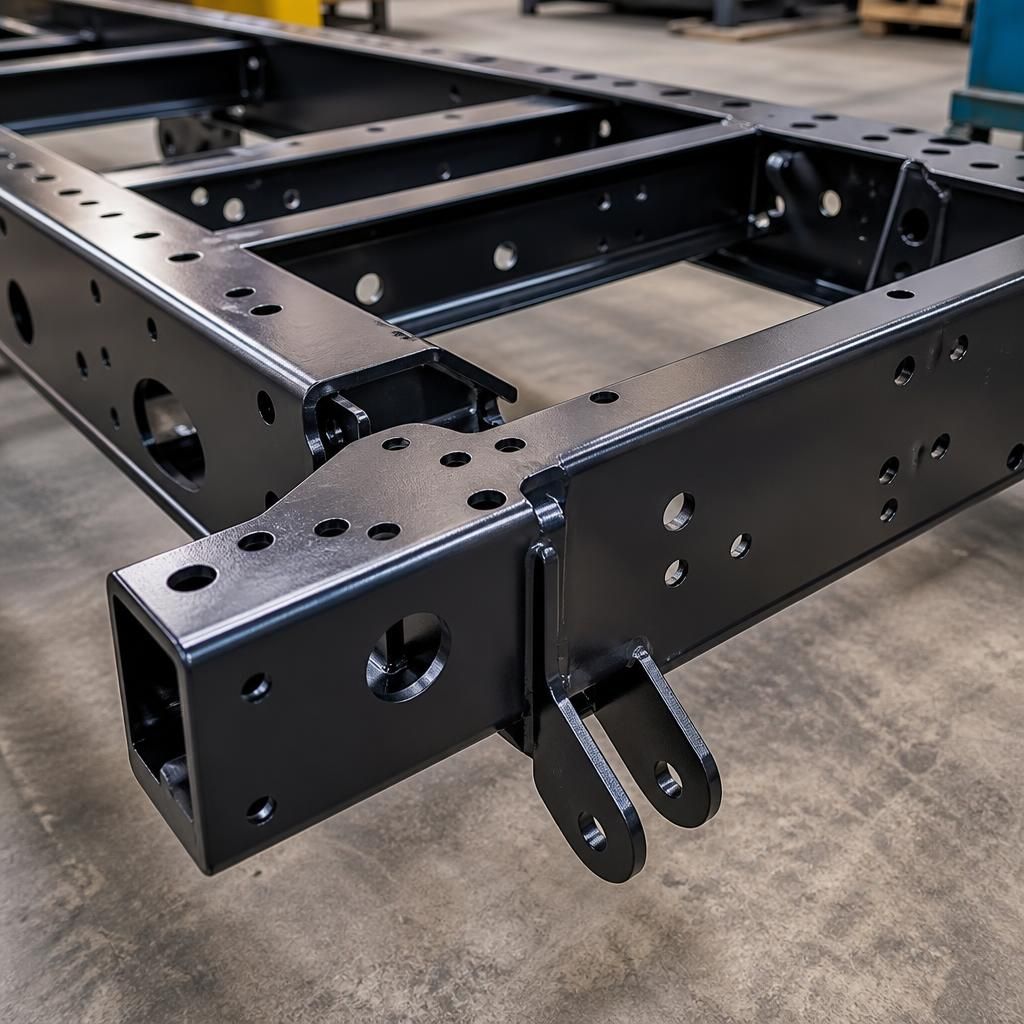
Powder coating improves corrosion resistance by interrupting the electrochemical reaction that turns exposed metal into rust. Corrosion requires an electrical path and an electrolyte, such as a thin film of damp, salt-contaminated water. The cured coating acts as an insulating barrier, reducing contact between the metal and these conductive contaminants.
This is why a visually attractive finish is not, by itself, evidence of effective protection. The coating system must be suitable for the substrate and service environment, with a continuous film that remains bonded during use. If the film is breached, the exposed area can become a local corrosion site, particularly where moisture and contaminants remain against the chassis or frame.