

How does the curing process affect the final finish of electrostatic powder coating?
The curing process melts and cross-links the powder coating, turning it into a continuous protective film. Correct control of curing temperature and time helps achieve the intended colour, gloss, smoothness, adhesion and durability, while under- or over-curing can compromise the final finish.
The final finish is determined by the part’s complete thermal history, not simply by the temperature displayed on the curing oven. The coating must receive the specified combination of metal temperature and dwell time throughout the component. If different areas heat unevenly, the cured finish can vary across the same part, even when the oven air temperature appears correct.
Metal temperature is more important than air temperature. Oven readings show the surrounding air, whereas the powder cures according to the temperature reached by the coated metal. A thin bracket may reach the target temperature quickly, while a heavy fabrication, boxed section or densely packed batch takes longer. If the dwell period begins before the coldest part has reached the required temperature, some areas may receive less cure than others.
This is why cure schedules should be selected using the powder manufacturer’s technical data and verified against the actual component. Oven profiling can identify the heating pattern at several points on a part, helping establish whether the complete load receives a consistent thermal treatment. Loading density, part spacing, airflow, metal thickness and the position of components in the oven can all influence the result.
The heating stage affects surface appearance. Powder first softens and flows before it develops its final structure. If the part heats too slowly or unevenly, the film may not flow consistently, which can leave differences in texture or visible variation between adjacent areas. If the coating is heated too aggressively, trapped air or gases from the substrate may form pinholes, bubbles or small raised defects. These problems are particularly relevant to castings, fabricated sections with enclosed areas and substrates that have absorbed moisture or contaminants.
Preparation remains important because curing cannot correct every substrate-related defect. Oil, moisture, residues, weld contamination, corrosion products and unsuitable pretreatment can interfere with the coating as it flows and cures. On porous materials, heating may release gas through the coating and create outgassing defects. Adjusting the preparation method, preheating approach or powder selection may be more effective than simply increasing the oven temperature.
Under-curing and over-curing produce different types of finish variation.
- Under-cured areas may show inconsistent surface development and can be more vulnerable to marking during handling or assembly.
- Over-cured areas may experience a change in appearance or colour, especially where a component remains hot for longer than intended.
- Parts with different thicknesses can show contrasting results when a single schedule is unsuitable for the whole load.
- Repeated heating, such as during an unsuitable rework process, can alter the appearance of the original coating and may affect compatibility with an additional coat.
The powder formulation also determines how sensitive the finish is to the curing cycle. Different coating chemistries and colours can have different cure requirements and tolerances. A schedule suitable for one product should not automatically be transferred to another, even where the parts look similar. Special finishes, textured coatings and heat-sensitive substrates require particular attention because changes in flow or surface texture can be more noticeable.
Cooling and handling can affect the finish after the oven stage. A component may still be hot enough for its surface to mark when it contacts packaging, supports or other parts. Moving or stacking items before the coating has stabilised can create impressions, scuffs or local loss of texture. Components should therefore be supported in a way that minimises contact with visible faces and handled according to the coating system’s requirements.
Consistent results come from controlling the whole process rather than treating curing as an isolated oven setting. A suitable process review considers:
- the powder system and its specified cure schedule;
- the thickest and thinnest sections of the component;
- the position, spacing and quantity of parts in the oven;
- the effectiveness of oven airflow and temperature uniformity;
- the condition and preparation of the substrate;
- the required appearance, texture and service conditions; and
- the method used to confirm that the metal, rather than only the air, has reached the required thermal profile.
For batch or complex components, these checks help distinguish a curing issue from a preparation, application or material issue. They also make it easier to reproduce the same finish across future production runs, particularly where parts vary in mass or geometry.
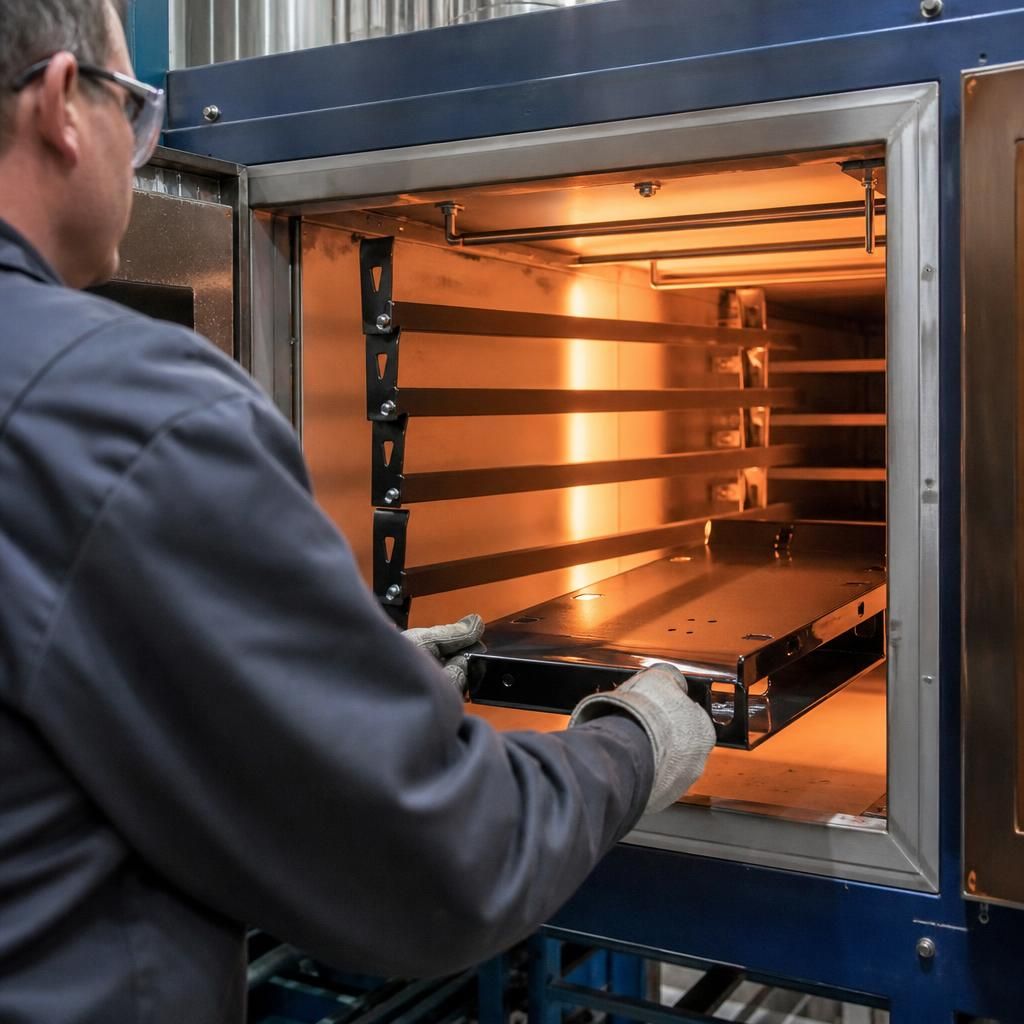
Curing affects more than the visible appearance of an electrostatic powder coating. As the powder cross-links, it develops the film properties needed to withstand handling, moisture, chemicals and service-related wear. A surface can look smooth and evenly coloured while still lacking the intended performance if the coating has not received the correct thermal treatment.
The required level of cure depends on the powder chemistry and the conditions in which the component will be used. For that reason, finish assessment should consider both appearance and performance requirements. Where a component must resist abrasion, cleaning agents or demanding industrial exposure, the cure schedule should be confirmed against the powder manufacturer’s technical information rather than judged by visual inspection alone.
Discuss Your Powder Coating Cure Requirements
Discuss your component’s required finish, service conditions and powder coating cure requirements with the team before production begins. Sharing details of the part geometry, material and batch profile helps identify the appropriate curing considerations for your project.