

What safety precautions should be taken during the sandblasting of wrought iron?
During wrought iron sandblasting, isolate the work area, use suitable respiratory and personal protective equipment, and control airborne dust through effective enclosure, ventilation and extraction. Operators should also inspect blasting equipment, secure hoses and connections, manage abrasive waste safely, and follow the relevant risk assessment and COSHH requirements.
Safe sandblasting of wrought iron requires control of hazardous coatings, high-pressure equipment, noise, flying debris and manual-handling risks before blasting begins. A documented method statement and risk assessment should define the work sequence, competent personnel, restricted access, emergency arrangements and the controls required for the specific component and abrasive.
Assess the existing finish before work starts. Older wrought iron may carry lead-based paint, chromates, rust inhibitors or other hazardous residues. Coatings should be identified or tested where their composition is uncertain, and the findings used to select the correct control measures and waste route. Blasting should not begin until the operator understands whether the substrate, previous coating or accumulated contamination presents an additional health risk.
Use trained and authorised operators. Personnel should understand the blast equipment, abrasive characteristics, work permit requirements and the limitations of the protective systems being used. A supervisor should confirm that the agreed controls remain effective, particularly when work involves intricate scrolls, sharp edges, enclosed cavities or components with unstable corrosion.
Control access and visibility around the operation. Barriers and warning notices should prevent unauthorised people from entering the blasting zone, including anyone who may be exposed through adjacent work areas. The operator should have a reliable view of the work or an agreed communication method with any attendant. Lighting must be sufficient to identify surface defects, blocked recesses and people approaching the controlled area.
Manage pressure and stored energy correctly. Abrasive-blasting equipment contains stored compressed energy, so starting, stopping and maintenance procedures should follow the equipment instructions. The system should be made safe and fully depressurised before clearing blockages, changing components or carrying out adjustments. The blast control should be designed to stop the abrasive flow immediately when the operator releases it, and the dead-man control must never be bypassed.
Protect the workpiece and nearby property. Wrought iron can have fragile sections, decorative details, welds or concealed voids that may be damaged by excessive impact. The operator should select pressure, nozzle distance and abrasive action appropriate to the metal and avoid directing the blast at people, unprotected glazing, electrical equipment or combustible materials. Components should be supported securely so that vibration or the reaction force cannot cause them to shift, topple or fall.
Address noise and physical strain. Blasting can produce harmful noise levels even where dust is effectively controlled. A noise assessment should determine the need for hearing protection, exposure limits, rotation of tasks and health surveillance. Operators should also use suitable lifting aids or team-handling techniques for heavy wrought-iron sections, rather than attempting to reposition unstable or awkward items manually.
Keep ignition and electrical risks under control. The work area should be checked for ignition sources and incompatible nearby processes. Electrical equipment used in or near the blasting zone must be suitable for the conditions, protected from abrasive damage and connected safely. Where coatings or contaminants could create a fire or explosion risk, the work should not proceed until that risk has been specifically assessed and controlled.
Provide suitable welfare and emergency arrangements. Workers should have access to hand-washing facilities and a clean area for removing contaminated clothing or equipment. The site should have a clear response for eye or skin contamination, inhalation, injury, equipment failure and suspected exposure to hazardous coatings. Incidents, defects and near misses should be recorded and reviewed before the process resumes.
After blasting, the component and surrounding area should be checked for sharp projections, residual abrasive, loose scale and hidden contamination before inspection, coating or handling. Any remaining residue should be removed using a method that does not create a new airborne hazard. These precautions help ensure that preparation is controlled from the initial coating assessment through to the safe release of the cleaned wrought iron.
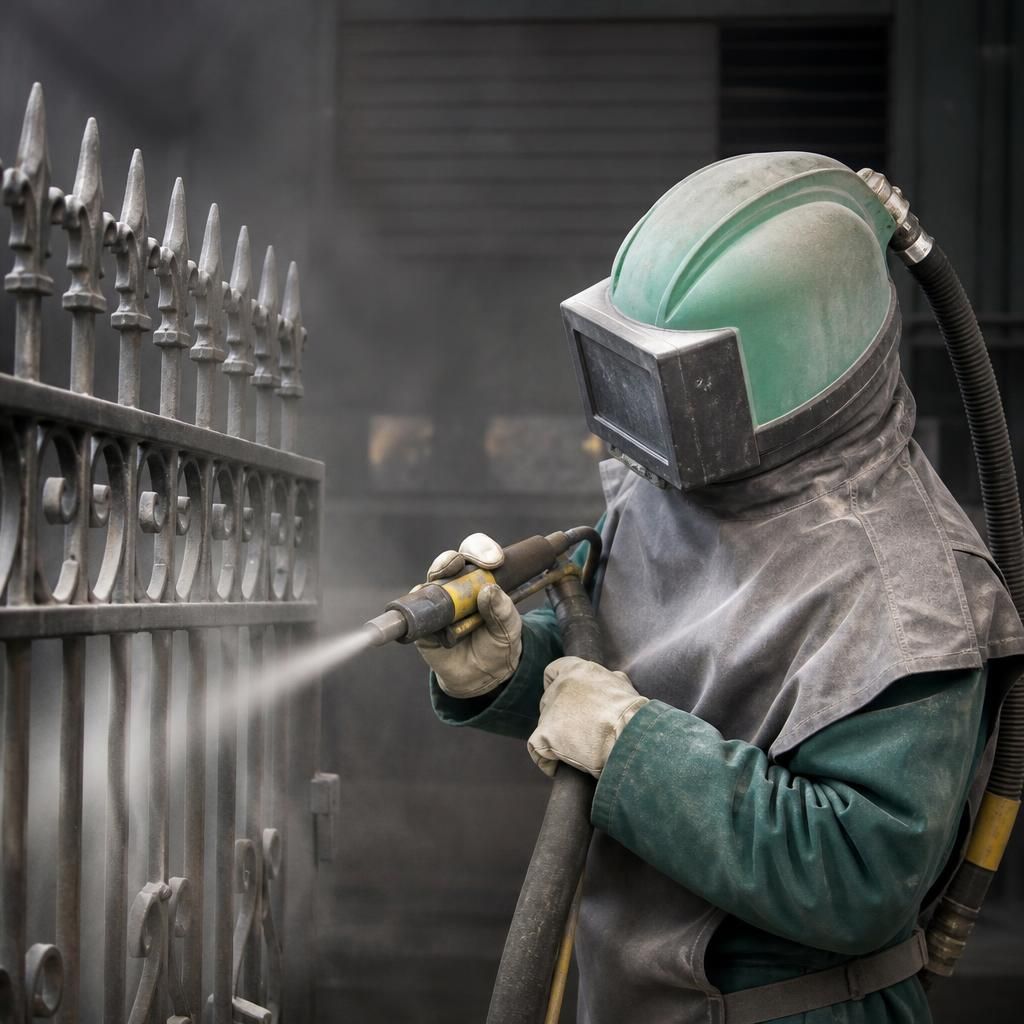
Respiratory protection for wrought iron sandblasting must be selected for the actual dust and coating hazards, rather than treated as a substitute for enclosure and extraction. The blaster should use a suitable abrasive-blasting helmet with an approved air supply where required by the risk assessment. Disposable dust masks are not an equivalent alternative for high-pressure blasting, particularly when old paint or unknown residues may be present.
Protective equipment must fit correctly and be kept in serviceable condition. Face and eye protection, hearing protection, gloves, protective clothing and suitable safety footwear should be checked before each use. Tight-fitting respiratory equipment requires an appropriate face-fit test, and facial hair or other obstructions can prevent an effective seal. Contaminated clothing and reusable equipment should be handled and cleaned according to the control procedure so that hazardous dust is not carried into clean areas.