

How does the application process for black protective primer finishes differ from other primers?
Black protective primer finishes follow the same essential stages as other primers—surface preparation, controlled application and curing—but require careful control of coverage and finish consistency. The black colour does not replace the need to select a primer compatible with the metal substrate and intended service conditions.
The application of a black protective primer is not usually a separate manufacturing method, but it does require tighter control of film appearance, coverage and compatibility with the complete coating system. Compared with a conventional primer, the applicator must pay particular attention to opacity, edge protection, inspection lighting and the requirements of any subsequent topcoat.
Black pigmentation can make a coating appear uniform before it has achieved the required protective film. A surface may look fully covered while areas around holes, corners, welds, recesses or sharp edges remain thinner than intended. For this reason, application is assessed by more than colour alone. The coating specification, product data sheet and agreed inspection method determine whether film thickness, adhesion and cure are acceptable.
Several points distinguish the process from applying a general-purpose primer:
- Formulation must be confirmed first. Black protective primers may be supplied as powder or liquid systems and may contain different corrosion-inhibiting pigments, binders and additives. The application equipment, substrate temperature, spray settings and curing conditions must match that particular formulation rather than being copied from another primer.
- Coverage needs to be checked on complex areas. Spray angle, gun distance and component positioning affect how much material reaches internal corners and recessed sections. Components may need to be rotated or presented in a planned sequence so that exposed edges and less accessible faces receive the specified coating.
- Edge and weld treatment can be more critical. Sharp edges, weld spatter, pinholes and surface irregularities can interrupt the protective film. These areas are normally dealt with through the specified preparation and application method, rather than relying on extra passes applied indiscriminately, which could create runs, excessive build or uneven curing.
- Inspection is less dependent on colour contrast. A black finish can make small defects, thin areas and contamination difficult to identify under unsuitable lighting. Inspection should therefore use consistent lighting and, where required, suitable thickness or continuity checks. Visual uniformity is useful, but it does not prove that the protective requirements have been met.
- Overspray and masking require planning. Black material can be highly visible on adjacent surfaces and may contaminate areas intended to remain uncoated. Masking materials must tolerate the process temperature or drying conditions, and masking lines should be positioned so that they do not create an unprotected boundary on a functional surface.
- Recoat and topcoat compatibility must be established. Some black primers are intended to remain as the visible finish, while others form the first layer beneath a decorative or weather-resistant topcoat. The interval before recoating, surface condition at recoat and required keying or cleaning method vary between systems. Applying a topcoat outside the specified window can affect adhesion even if the primer looks sound.
The curing stage also requires particular discipline. For a powder system, the part and coating must reach the specified metal temperature for the required cure cycle; oven air temperature alone is not a reliable indication of this. For a liquid system, drying and curing depend on the product chemistry, coating thickness, ventilation and environmental conditions. Handling a component too soon can mark the finish or compromise the primer before it has developed its intended properties.
Application records are useful where black protective primer is part of a repeat production process. They can include the primer identification, batch details, preparation method, equipment settings, component temperature or environmental conditions where relevant, cure information and inspection results. This creates a traceable basis for investigating defects such as poor adhesion, gloss variation, pinholing or premature corrosion.
In practice, the main difference is not the black colour itself. It is the need to treat appearance checks, coverage of difficult geometry and the relationship between primer and topcoat as controlled technical requirements. A black protective primer should therefore be applied as part of a defined coating system, with its product instructions and the component’s service conditions determining the exact method.
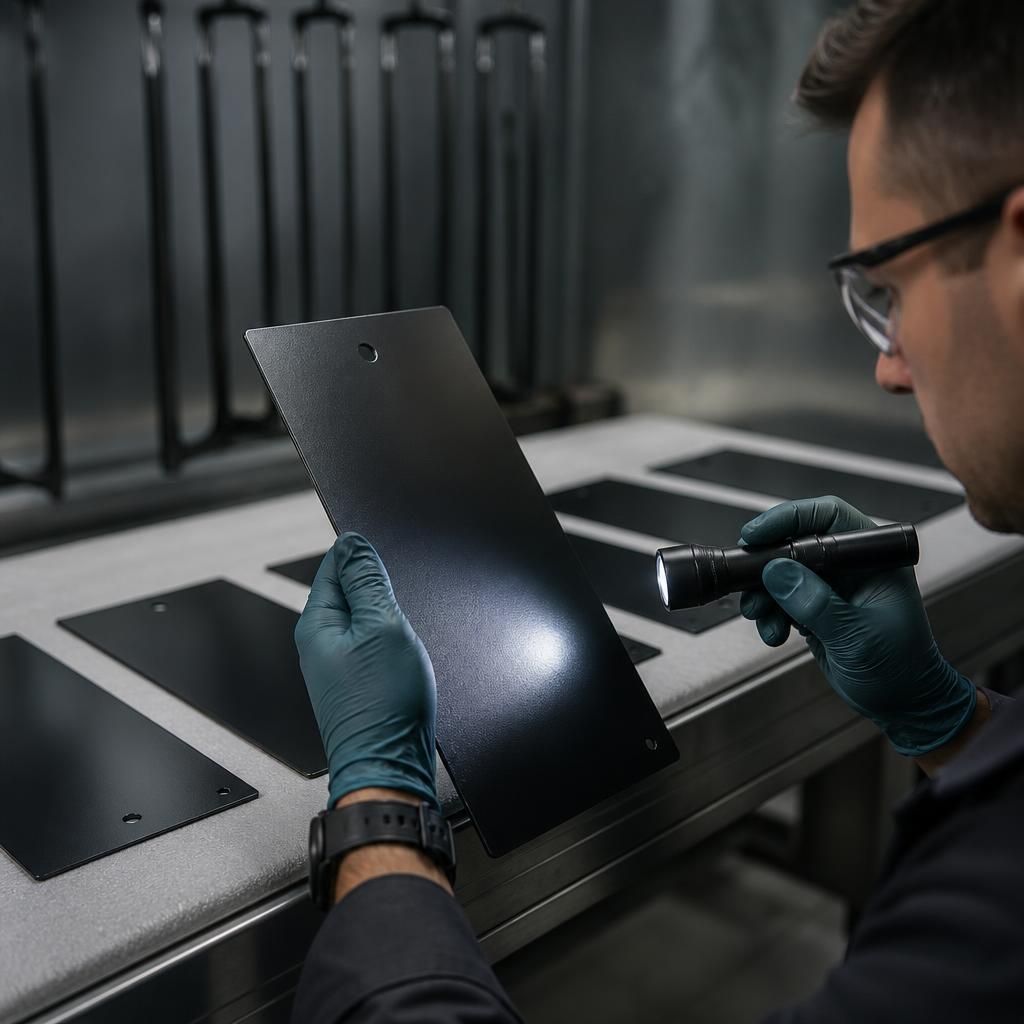
A pre-production test panel can be particularly useful when a black protective primer will sit beneath another coating. The panel should use the same metal, preparation method, primer, application settings and curing conditions intended for the production components.
Assessment should cover more than the black appearance. The completed system can be checked for intercoat adhesion, surface uniformity, edge coverage and the appearance of the final topcoat. This helps identify incompatibility or visible defects before the full batch is processed and provides a practical reference for production inspection.
Discuss your black protective primer requirements
Discuss your black protective primer requirements with our coating specialists, providing details of the metal components, service conditions and intended coating system. We can help establish the appropriate preparation, primer and application requirements for your project.