

How does your aluminium section powder coating process ensure quality and consistency?
Our aluminium section powder coating process ensures quality and consistency by controlling surface preparation, powder application and curing for each batch. Careful handling and finish checks help produce an even, durable coating across sections and components.
Aluminium section powder coating quality and consistency depend on controlling the complete job specification, not simply applying the same colour to every component. Each order should be assessed according to the aluminium alloy, section profile, dimensions, required appearance, service conditions and chosen powder system. These details establish the acceptance criteria against which the finished work can be assessed.
Aluminium sections can vary considerably in shape. Hollow profiles, deep channels, sharp edges and thin walls may respond differently during processing, while large or complex sections can affect how the coating is distributed and how heat reaches the metal. Racking and component positioning are therefore important. Sections need to be supported securely without creating unnecessary contact marks, while the arrangement must allow suitable access to all visible surfaces.
Consistency is also supported by controlling the powder material before use. The powder should be identified against the job specification and stored in suitable conditions to protect its properties. Colour, gloss level and coating type must be confirmed before production, particularly where sections are being matched to existing components or produced in separate batches. Keeping the material and specification traceable helps reduce the risk of an incorrect finish being used.
Application equipment settings are selected to suit the component rather than relying on one setting for every aluminium section. Factors such as profile geometry, edge detail and the required coating build influence the way powder is applied. Operators monitor the distribution of the coating across accessible faces, edges and recesses so that the finish is not visibly heavier in one area or insufficient in another.
Controlled heating is essential because the metal temperature, rather than oven air temperature alone, determines whether the powder develops its intended properties. Section size, wall thickness, loading pattern and the thermal behaviour of aluminium can affect heat penetration. Maintaining a suitable and repeatable heat cycle helps achieve the specified finish without creating avoidable defects such as under-cured areas, excessive gloss variation or surface distortion.
Quality checks should assess both appearance and performance. Depending on the order requirements, these may include checks for:
- Colour and gloss uniformity across the batch;
- Coverage on faces, edges, recesses and other visible areas;
- Film thickness against the specified coating requirement;
- Surface defects, contamination, pinholes, runs or impact marks;
- Adhesion and general film integrity where testing is required; and
- Correct masking, dimensions and protection of areas that must remain uncoated.
Inspection is more reliable when it is carried out under consistent viewing conditions and against an agreed reference or specification. Any deviation can then be isolated rather than allowing a variable finish to continue through the batch. Components that do not meet the required standard should be identified and assessed before packing, with rework or replacement considered according to the nature of the defect.
Batch records provide an additional layer of control. Recording the material specification, component details, process settings and inspection findings makes the work more repeatable and gives manufacturers and fabricators a clearer basis for checking future orders. This is particularly useful when aluminium sections are supplied in recurring batches, where maintaining the same appearance between production runs is as important as the finish on an individual component.
The result is a process based on defined specifications, controlled component handling, repeatable equipment settings, appropriate thermal treatment and documented inspection. Together, these controls help produce aluminium sections with a uniform appearance and a dependable coating finish across the required batch.
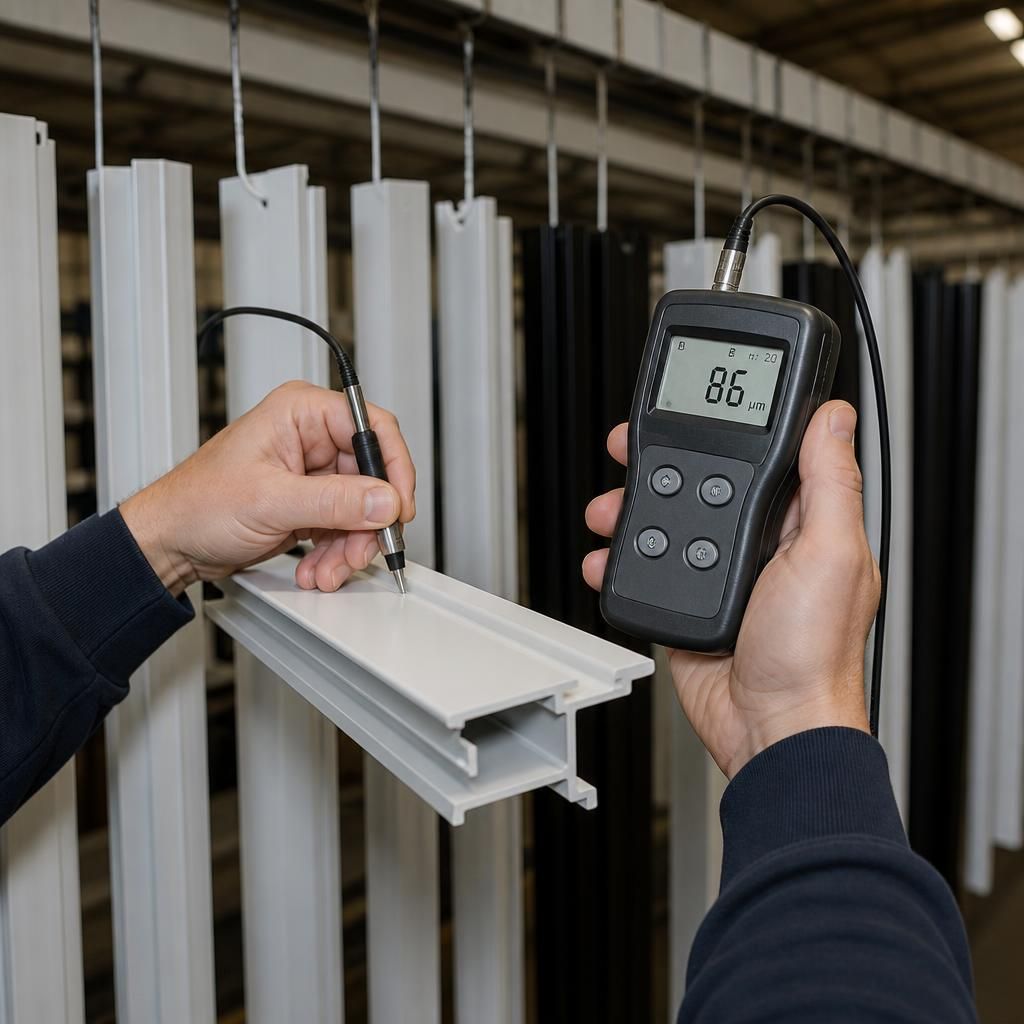
Objective measurement makes aluminium section coating checks more consistent than visual inspection alone. Film thickness, gloss and colour should be assessed using suitable instruments and a defined sampling approach, with readings taken from representative faces rather than only the easiest accessible area. This helps distinguish a local variation from a batch-wide issue and allows results to be compared between production runs.
The sampling plan should reflect the section’s geometry, including exposed faces, edges and areas where powder deposition may vary. Results can then be assessed against the agreed job specification, with any outlying reading investigated before the batch is released. Combining measured evidence with visual review supports a more repeatable decision on whether the finish meets the required standard.
Discuss Your Aluminium Section Powder Coating Requirements
Discuss your aluminium section powder coating requirements with the team, including the section profile, finish specification and intended application. Providing these details helps establish the appropriate process requirements for your batch.