

What preparation is required for aluminium components before electrostatic powder spraying?
Before electrostatic powder spraying, aluminium components must be cleaned and degreased to remove oil, dirt, oxidation and other contaminants. The surface is then suitably pretreated, dried and checked, with areas such as threads or contact points masked where required, so the powder can adhere consistently and cure to a durable finish.
Preparing aluminium components for electrostatic powder spraying involves more than treating the surface. The metal must be structurally sound, suitably designed for coating, accessible to the spray equipment and capable of being securely racked in the curing process. Component condition, geometry, alloy, joint details and the required dimensional tolerances should all be considered before coating begins.
Confirm the component specification
- Identify the aluminium alloy and whether the component is extruded, fabricated, cast or machined. Different materials and manufacturing routes can behave differently during heating.
- Confirm the required powder type, colour, gloss level and performance specification before preparation starts. The coating system can affect curing requirements, film thickness and acceptable tolerances.
- Identify surfaces that must remain uncoated, such as precision fits, bearing seats, electrical earth points and areas that will be welded or bonded later.
- Allow for the coating thickness in close-fitting assemblies, threaded connections, sliding parts and other areas where dimensional accuracy matters.
Make the metal suitable for coating
Aluminium parts should arrive free from manufacturing defects that could remain visible through the finished coating. Deep scratches, dents, embedded abrasive material, burrs, sharp fins and machining marks may need to be corrected before the coating stage. Powder will follow the profile of the substrate rather than hide significant damage, so repairs should be agreed before the parts are processed.
Fabricated components also need particular attention around welds, folded edges and joints. Weld spatter, incomplete joints, trapped residues and excessive weld reinforcement can create visible irregularities or interfere with coating coverage. Welded assemblies should be designed so that enclosed sections do not retain moisture or processing residues. Where hollow sections are used, suitable drain and vent openings may be needed to support safe heating and prevent pressure build-up.
Review edges, corners and geometry
Very sharp edges can produce a thinner coating at the edge than on adjacent faces. Where the design permits, edges should be softened or radiused to promote more uniform coverage. Deep recesses, narrow channels and overlapping folds can also restrict the electrostatic field and make it harder for powder to reach the required areas. Discussing these features before manufacture can help determine whether changes to the design, spray direction or racking arrangement are necessary.
Complex profiles should be presented in a way that gives the coater access to all specified surfaces. Parts that touch one another, nest together or contain narrow internal spaces may require an agreed orientation or separation during processing. If a section is not intended to receive coating, that requirement should be clearly identified on the drawing or job instructions rather than left to interpretation.
Plan racking and electrical contact
Electrostatic spraying relies on the component being electrically connected to the coating system. Each aluminium part therefore needs a suitable racking or hanging point that provides reliable contact without compromising important finished surfaces. Contact points should be located on areas where a small uncoated mark can be accepted, concealed or subsequently dealt with during assembly.
The component should be supported so that it remains stable while being moved and cured. Poor support can allow a part to swing, touch another component or develop handling marks. Large or thin sections may also need additional support to reduce distortion during heating. The intended orientation should take account of drainage, recesses, part weight and access to the spray gun.
Consider castings and porous materials
Cast aluminium can contain pores or cavities that release trapped air or vapour when heated. This may lead to pinholes, bubbling or surface defects in the cured coating. Castings should therefore be assessed for porosity and, where necessary, subjected to an agreed pre-treatment or conditioning procedure before production coating. The appropriate approach depends on the casting method, wall thickness and performance requirement; it should be established through a trial where the risk is significant.
Components assembled from different aluminium sections should also be reviewed for gaps, overlaps and enclosed pockets. These features can retain contaminants or moisture and may affect both appearance and long-term performance. Sealing, redesign or additional drainage may be preferable to relying on the coating to bridge the problem.
Separate preparation from post-coating operations
Any drilling, tapping, cutting, welding or forming that can be completed before coating should normally be planned in advance. Carrying out these operations afterwards can damage the finish and expose uncoated metal. Conversely, some precision machining or final fitting may need to take place after coating, in which case the permissible coating build and repair method should be agreed beforehand.
Parts should be handled with clean, non-damaging equipment after preparation and kept protected from workshop dust, moisture and contact with unsuitable materials. Packaging, separators and transport arrangements should not mark edges or deposit residues on surfaces intended for coating.
For repeat or batch work, provide a drawing or preparation schedule showing the coating areas, contact points, critical dimensions, finish requirements and any features requiring special treatment. A representative sample or first-off component can be used to confirm racking, coverage, appearance and fit before the full batch is processed. This is particularly useful for new aluminium designs, castings, intricate profiles and components with tight assembly tolerances.
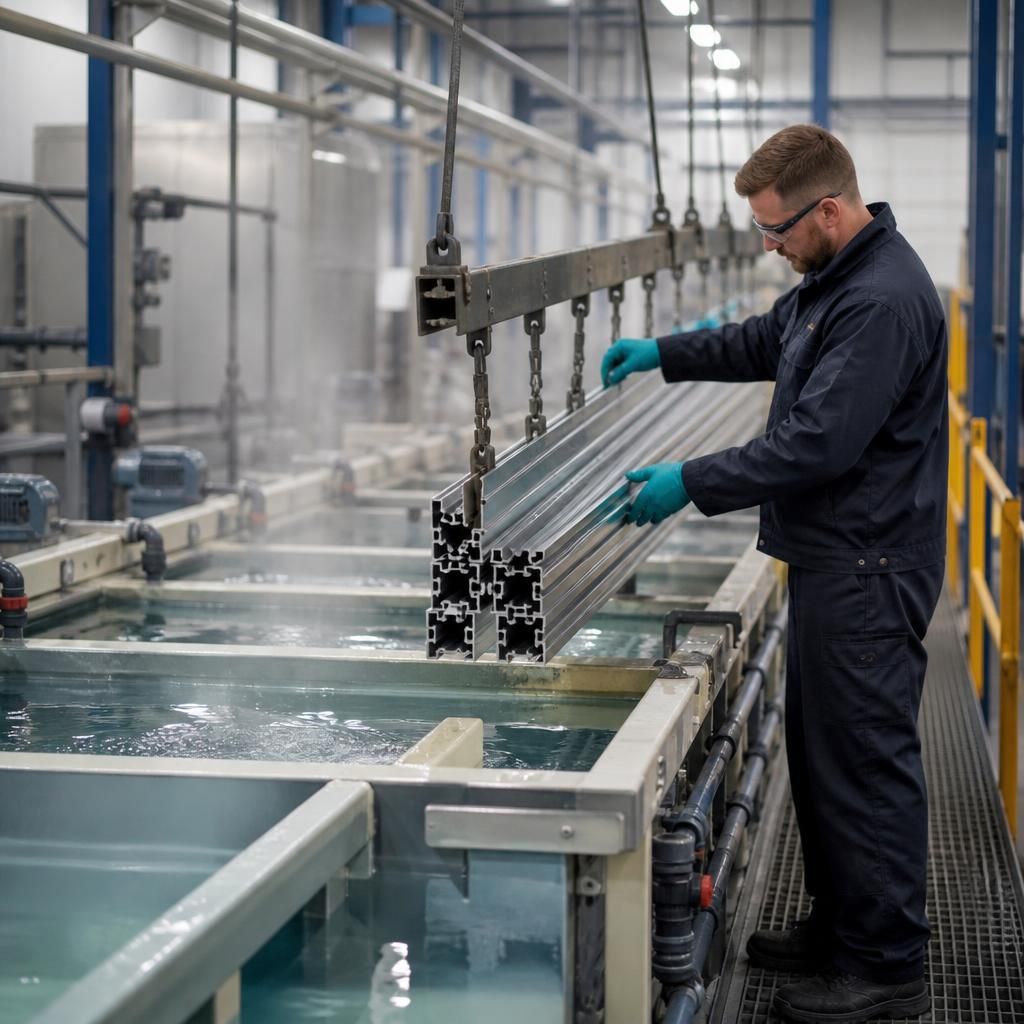
Aluminium usually needs a chemical pretreatment after cleaning because its oxide layer can reduce powder-coating adhesion. The treatment should be compatible with the alloy, the intended service conditions and the powder system. Depending on the specification, this may involve controlled etching followed by a conversion treatment that creates a suitable surface for the coating to bond to.
Pretreatment must be evenly applied and thoroughly rinsed so that cleaning chemicals, salts or treatment residues are not left on the component. The aluminium should then be dried completely before spraying. Any sign of flash oxidation, staining or residue should be assessed before coating, as applying powder over a contaminated or unstable surface can affect adhesion and the appearance of the cured finish.