

What does the curing process involve in ensuring the quality of aluminium powder coatings?
Curing aluminium powder coatings involves heating the coated component under controlled conditions so the powder melts, flows into a continuous film and chemically cross-links to form a durable finish. Correct control of the metal temperature, oven conditions and curing time is essential for consistent adhesion, appearance and protective performance.
The curing stage is the point at which a powder coating develops its intended mechanical and chemical properties. For aluminium components, quality depends on achieving the coating supplier’s specified cure schedule throughout the part, rather than relying solely on the oven’s displayed air temperature. The result must be assessed across the complete component, including recessed areas, edges, heavy sections and areas close to racks or masking.
What happens during curing
Once the coated aluminium reaches the required thermal condition, the powder particles soften and merge into a uniform film. The resin then reacts with the curing agent, creating a cross-linked structure. This reaction gives the coating its resistance to handling, moisture, chemicals, abrasion and weathering. If the reaction is incomplete, the film may remain comparatively soft or vulnerable; if the coating receives excessive heat, its colour, gloss or other appearance characteristics can change.
Controlling the part temperature
Oven air temperature is not the same as the temperature of the aluminium. A light extrusion, a thick casting and a component with enclosed sections can absorb heat at different rates. The curing schedule therefore needs to account for the component’s material thickness, shape, loading arrangement and thermal mass. Monitoring or validating the metal temperature helps establish when the coating has actually reached the required condition and prevents a surface layer from appearing cured while less accessible areas have not received equivalent treatment.
Maintaining consistent oven conditions
Air circulation should provide an even thermal environment around the load. Poor circulation, obstructed airflow, unsuitable loading density or direct exposure to a hotter area of the oven can create variation between components or across one large part. Racks and hanging points also need to support the work without shielding significant coated surfaces. Consistent positioning makes the thermal profile more repeatable and reduces differences in gloss, colour and film performance between batches.
The oven itself should be checked as part of process control. Temperature sensors, recording equipment and the heating and ventilation systems need to operate correctly, while the chamber should be kept free from contamination that could settle on the finish. A validated profile can then be repeated when the component, powder specification and loading arrangement remain comparable.
Why aluminium presents particular considerations
Aluminium conducts heat efficiently, but its thin sections, complex profiles and varying wall thicknesses can still produce different heating behaviour within one component. Thermal expansion can also affect how parts are supported during the process. Components should be arranged so that air can circulate around them and so that contact points do not interfere with the coated surface. Any trapped moisture or contamination from earlier preparation stages can become more significant as the part is heated, which is why cleaning and pretreatment remain closely linked to curing quality.
Recognising under-cure and over-cure
Under-cured powder may show reduced hardness, weaker resistance to chemicals or marking during handling. It can also compromise the coating’s ability to withstand the service conditions for which it was selected. Over-curing can alter colour and gloss and may reduce the appearance consistency of the finish. These faults are not always obvious from a visual inspection alone, so process records and suitable quality checks are important where the coating has a demanding industrial application.
Checks may include film-thickness measurement, adhesion assessment, visual inspection for pinholes, runs, craters and uneven gloss, and tests appropriate to the specified coating system. A solvent resistance or cure assessment can help indicate whether the resin has reacted sufficiently, while colour and gloss checks can identify differences between areas or batches. The exact tests should reflect the powder specification, component use and customer requirements rather than being selected in isolation.
Managing the process from batch to batch
Reliable curing requires the powder specification, substrate condition, application settings and oven profile to be considered together. Changes in component design, load size, rack position or coating type can alter the thermal result even when the oven settings appear unchanged. Recording these variables provides a basis for investigating defects and confirming that a repeat batch has been processed under suitable conditions.
Before production coating, unusual shapes, thick sections or new loading arrangements may require a trial or thermal profile. This helps identify cold spots, excessive heat exposure and inaccessible surfaces before a full batch is processed. Careful handling after curing is also necessary: the finish should be allowed to reach a suitable handling condition, and coated parts should be protected from abrasion, impact and contamination during inspection, packing and transport.
In practice, the quality of cured aluminium powder coating is demonstrated by a complete and repeatable thermal process, supported by appropriate inspection. Correct preparation and application create the conditions for a sound finish, but curing determines whether the applied film achieves the performance expected from the selected powder system.
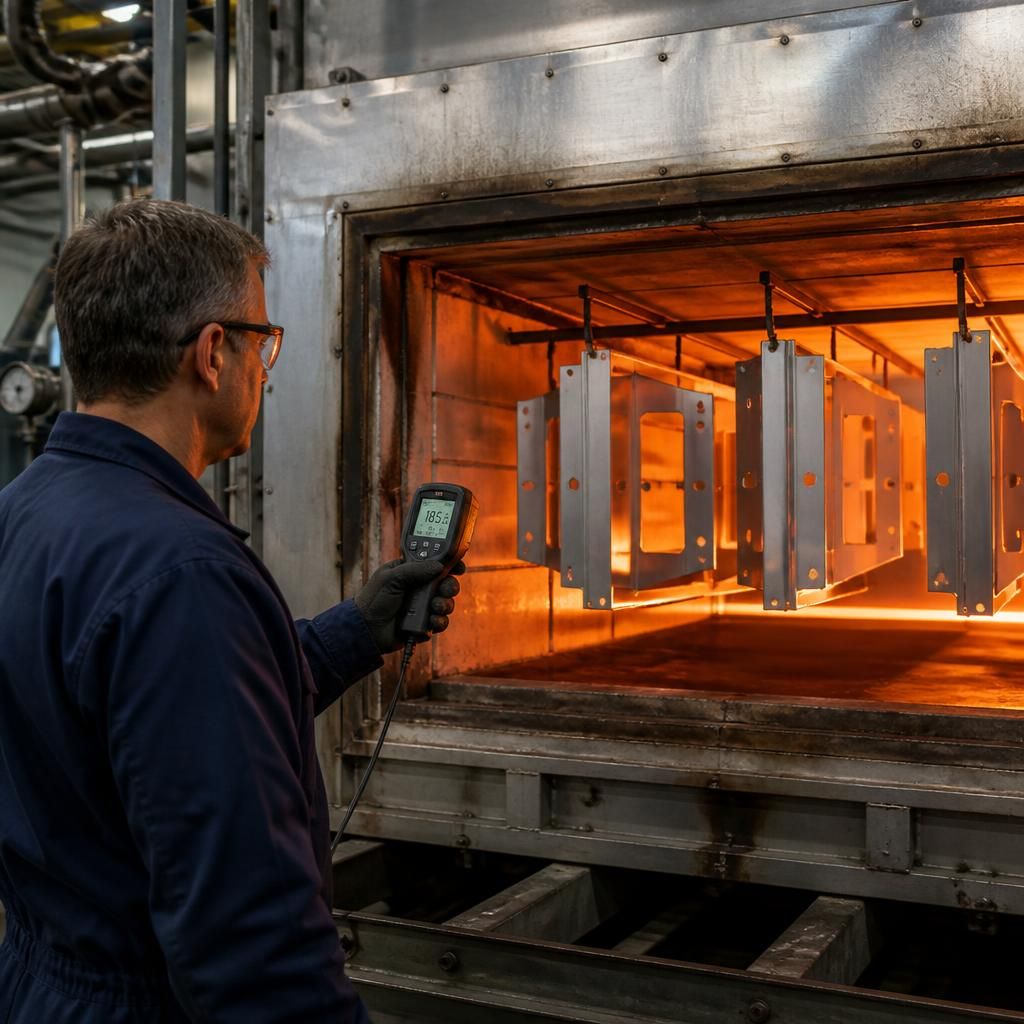
Curing time is measured at the component’s temperature, not simply from the moment it enters the oven. The powder first melts and gels as the aluminium heats, then continues reacting until the specified cross-linking level is reached. For this reason, a component’s heating-up period and its required cure dwell are separate parts of the schedule. Treating oven entry time as the full cure time can leave areas of a complex aluminium part short of the required reaction, even when the oven itself has been set correctly.
Discuss your aluminium powder coating requirements
Discuss your aluminium components, powder specification and intended service conditions with our Midlands team to identify a suitable curing and inspection approach. Providing details of the component design and batch requirements helps ensure the process is assessed against the coating’s required performance.