

What types of protective primers work best with different powder coating finishes?
The best protective primer depends on the metal substrate, exposure conditions and powder coating system: epoxy primers suit general adhesion and corrosion protection, while zinc-rich primers are better for steel in more corrosive environments. For aluminium and other non-ferrous metals, use a compatible etch or adhesion primer, then confirm that the primer can withstand the powder coating’s curing process and is suitable for the intended finish.
The most suitable protective primer is the one that forms a stable bond with both the repaired substrate and the particular powder coating finish applied over it. Selection should therefore account for the powder coating’s resin chemistry, gloss level, texture, colour, film thickness, curing requirements and exposure conditions, rather than relying on a single general-purpose primer.
Primers for polyester powder coatings
Polyester powder coatings are widely used where the finished component will experience outdoor exposure. A compatible epoxy-polyester or corrosion-resistant liquid primer can be suitable for local repairs, provided it is approved for use beneath the selected polyester topcoat and can tolerate the relevant service conditions. For exterior work, the primer should not undermine the coating system’s resistance to moisture and weathering.
Where a repair is visible, the primer should also be suitable for the intended colour and gloss. A strongly contrasting primer may affect the apparent shade of a light or translucent finish, particularly where the repaired area is thin. The repaired primer film should be sufficiently smooth and level for the polyester topcoat; excessive build or visible brush marks may remain noticeable beneath a fine-textured finish.
Primers for epoxy powder coatings
Epoxy powder coatings are commonly selected for strong adhesion and resistance to many indoor chemical and mechanical demands. They generally work best with a primer that has similar overcoat compatibility and does not contain components likely to interfere with intercoat adhesion. The primer supplier’s technical data should confirm whether the product is intended for use under an epoxy powder finish or only as a standalone repair coating.
Epoxy finishes can chalk or lose colour when exposed to prolonged ultraviolet light, so they are normally considered in relation to the service environment rather than appearance alone. A primer can support corrosion protection, but it cannot correct a mismatch between an interior-oriented epoxy topcoat and an exposed outdoor application.
Primers for epoxy-polyester hybrid finishes
Hybrid powders combine epoxy and polyester characteristics and are often used for interior components. A primer for this type of finish must withstand the powder coating’s cure schedule without softening, blistering or releasing gases. It should also provide a compatible surface for the hybrid film, as a primer designed solely for a different resin family may produce poor intercoat adhesion.
Hybrid finishes are frequently used on items where decorative appearance and general protection are required, so the primer should be assessed for its effect on colour, smoothness and gloss. This is especially important beneath pale, satin or high-gloss finishes, where surface defects and shade variation are easier to detect.
Primers beneath textured, wrinkle and matt finishes
Textured and wrinkle powder coatings can disguise minor surface variation more effectively than smooth finishes, but this does not make primer preparation unimportant. Uneven primer coverage, contamination or excessive film thickness can alter the texture and create localised gloss differences. A primer with a controlled application characteristic is preferable, and the coating should be allowed to reach the required condition before the powder finish is applied.
Matt and fine-textured finishes can be particularly sensitive to surface contamination. Silicone, wax, oil, moisture and residues from cleaning products may cause cratering, fisheyes or areas of poor adhesion. Preparation should therefore include removal of loose coating and corrosion, degreasing with a compatible cleaner, and drying before priming. The prepared area should not be touched with bare hands before overcoating.
Primers for metallic, bright and lightly pigmented finishes
Metallic and lightly pigmented powders can reveal differences in substrate tone or primer colour more readily than heavily pigmented opaque finishes. The primer should be selected for colour compatibility as well as protection. A dark or strongly coloured primer under a thin metallic coating may change the visual effect, while an unevenly applied primer can produce patchiness or apparent variation in the metallic orientation.
For these finishes, test application on a prepared sample or an inconspicuous area is useful. The test should assess not only adhesion but also shade, gloss, texture and the visibility of the repair after the full coating system has cured.
Primers for high-build and heavy-duty finishes
Where the powder coating is intended to provide enhanced resistance to abrasion, impact or chemicals, the primer must be able to support the same performance objective. A thin decorative primer may not be appropriate beneath a heavy-duty system if it has inadequate mechanical resistance or is unsuitable for the specified film build. Conversely, applying too much primer can cause solvent entrapment, blistering or loss of edge definition.
For steelwork exposed to severe corrosion, a zinc-containing primer may be considered as part of a tested coating system. Its suitability depends on the exact product, the preparation standard, the topcoat chemistry and the curing process. Zinc-rich products can also create application and appearance issues if they are used without observing the manufacturer’s requirements, so they should not be treated as interchangeable with ordinary primers.
Checking compatibility before application
- Identify the powder coating resin type and whether the finish is smooth, matt, textured, metallic or otherwise specialised.
- Confirm that the primer is intended for the substrate and for use beneath the selected powder coating or repair topcoat.
- Check the primer’s curing, drying and overcoating requirements, including any maximum or minimum recoat interval.
- Compare the primer’s resistance to chemicals, moisture, heat, abrasion and ultraviolet exposure with the conditions the finished component will face.
- Assess colour, gloss, texture and film-build effects on a representative test area where the repair will be visible.
- Inspect the cured repair for adhesion, lifting, pinholing, blistering, cracking and visible variation before the component is returned to service.
A product data sheet and, where necessary, a coating-system specification should take precedence over a generic description such as “epoxy primer” or “metal primer”. Different products within the same category can have very different overcoat limits and performance characteristics. For an industrial repair, the reliable approach is to match the primer and powder finish as a complete system, prepare the damaged area thoroughly, and verify the result on the actual substrate and finish rather than assuming that any protective primer will be compatible.
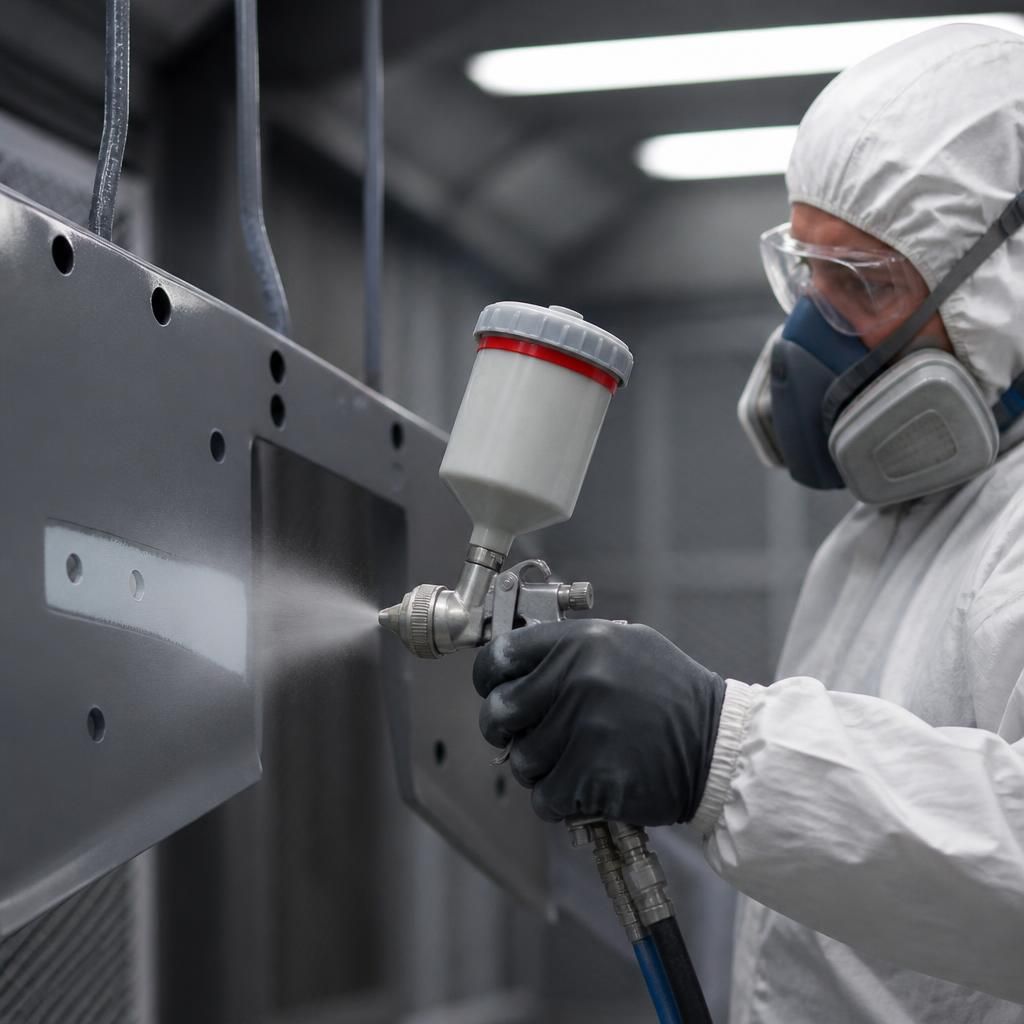
The condition of the damaged coating edge can be just as important as the primer selected. Any loose or lifting powder should be removed, and the remaining sound coating should transition gradually into the prepared area rather than leaving a sharp step. This helps prevent the repair boundary from showing through smooth, high-gloss or lightly pigmented finishes.
After preparation, the primer should be applied only to the required area and kept even at the edges. Excessive build can create a visible ridge, while insufficient coverage may leave the substrate vulnerable beneath the repair. A controlled edge and uniform primer film give the chosen powder coating finish a more consistent surface to bond to and cover.