

What are the best practices for maintaining automated conveyor systems to ensure optimal powder coating quality?
Maintain automated conveyor systems through scheduled inspection, cleaning, lubrication and calibration, with particular attention to hooks, carriers, drive components and speed control. Recording maintenance findings and correcting contamination, wear or alignment issues promptly helps keep parts moving consistently through each coating stage and supports uniform powder coating quality.
Best practice for maintaining an automated conveyor system is to manage it as part of the complete powder coating process rather than as an isolated transport machine. The conveyor determines how consistently each component passes through pretreatment, drying, powder application and curing, so maintenance should protect part presentation, electrical continuity, process timing and safe, repeatable operation.
Start with a documented maintenance standard. Create an equipment register covering the conveyor, loading points, transfer sections, switches, sensors, controls and safety devices. For each item, define the inspection method, acceptable condition, responsible person and action required when a defect is found. Manufacturer instructions should form the basis of the schedule, but the standard should also reflect the components being coated, the operating environment and the consequences of a conveyor fault.
- Record inspections, defects, corrective work and replacement parts in a traceable log.
- Use consistent terms for faults such as mis-tracking, impact damage, abnormal noise, sensor failure and loss of electrical continuity.
- Review recurring faults to identify an underlying cause rather than repeatedly treating the symptom.
- Keep maintenance instructions, isolation procedures and control-system settings available to authorised personnel.
Protect reliable part presentation. A component must remain stable and correctly oriented as it travels through each stage. Examine loading fixtures and attachments for distortion, damaged contact points, excessive build-up or signs that parts are rotating unexpectedly. Check that the load arrangement does not allow components to touch one another, strike booth equipment or obstruct spray access. A well-maintained conveyor cannot compensate for overloading or inconsistent loading, so operators should use defined loading patterns and maximum permissible weights for each product family.
Where components vary substantially in size or geometry, verify that the chosen carriers and attachment arrangements keep critical faces exposed. Changes to a jig, bar or hanging method should be treated as a controlled process change, because they can affect coating access, drainage during pretreatment and heat exposure during curing.
Maintain electrical continuity and earthing. Powder application relies on a dependable electrical path between the part and earth. Paint accumulation, oxidation, loose connections and worn contact surfaces can increase resistance and contribute to uneven transfer or poor deposition. Test continuity using a suitable method and at a defined frequency, particularly after cleaning, fixture changes or work on the conveyor structure. Results should be recorded against an agreed acceptance criterion rather than judged only by appearance.
Inspect earthing connections, bonding straps and contact points for damage or looseness, while following the site’s electrical safety and isolation procedures. If coating build-up is removed from contact areas, ensure the cleaning method does not damage the surface or create a new contamination source.
Keep the conveyor environment compatible with coating quality. Overspray and powder residue should not be allowed to migrate into sensors, control cabinets, bearings, contact assemblies or other moving interfaces. Cleaning methods must suit the equipment: dry removal, approved vacuum equipment or other controlled techniques may be preferable to dispersing powder through compressed air. Do not use a cleaning material that leaves oil, fibres or chemical residue on surfaces that can affect the coating process.
Inspect the areas around loading and unloading for loose debris, damaged packaging and sources of oil or moisture. Contamination introduced before the booth may appear later as craters, pinholes, poor adhesion or other finish defects, making it important to investigate the full material path rather than assuming that the powder application equipment is at fault.
Verify sensors, interlocks and controls after intervention. Photoelectric sensors, proximity switches, encoders and position devices help coordinate movement and protect people and equipment. Check that sensors are securely mounted, correctly aligned and free from deposits. Test emergency stops, guards, access interlocks and fault indications according to the site’s risk assessment. After replacing a sensor, drive component or control element, carry out a controlled test run before returning the line to normal production.
Any change to a programme, variable-speed drive or control logic should be authorised and documented. Confirm that the conveyor starts, stops and responds to faults in the intended sequence. A line that moves apparently normally may still create quality variation if a sensor intermittently loses the position signal or if a control change causes inconsistent dwell through a process stage.
Coordinate conveyor maintenance with coating checks. Review coating results alongside maintenance records. Defects concentrated at particular positions on a rack, batch or conveyor section may indicate a presentation, continuity or contamination issue. If a defect begins immediately after work on the line, compare the pre-maintenance and post-maintenance conditions, including loading method, attachments and control settings. Where applicable, confirm cure performance with the coating process owner rather than relying solely on the conveyor’s displayed values.
Planned maintenance should be arranged around safe isolation, access requirements and a suitable verification run. Before releasing the line, remove tools and temporary materials, refit guards, confirm that all inspection covers are secure and check that no maintenance residue can reach coated components. Combining disciplined records, controlled loading, dependable earthing, clean operating conditions and post-maintenance verification gives the conveyor the best chance of supporting consistent powder coating quality.
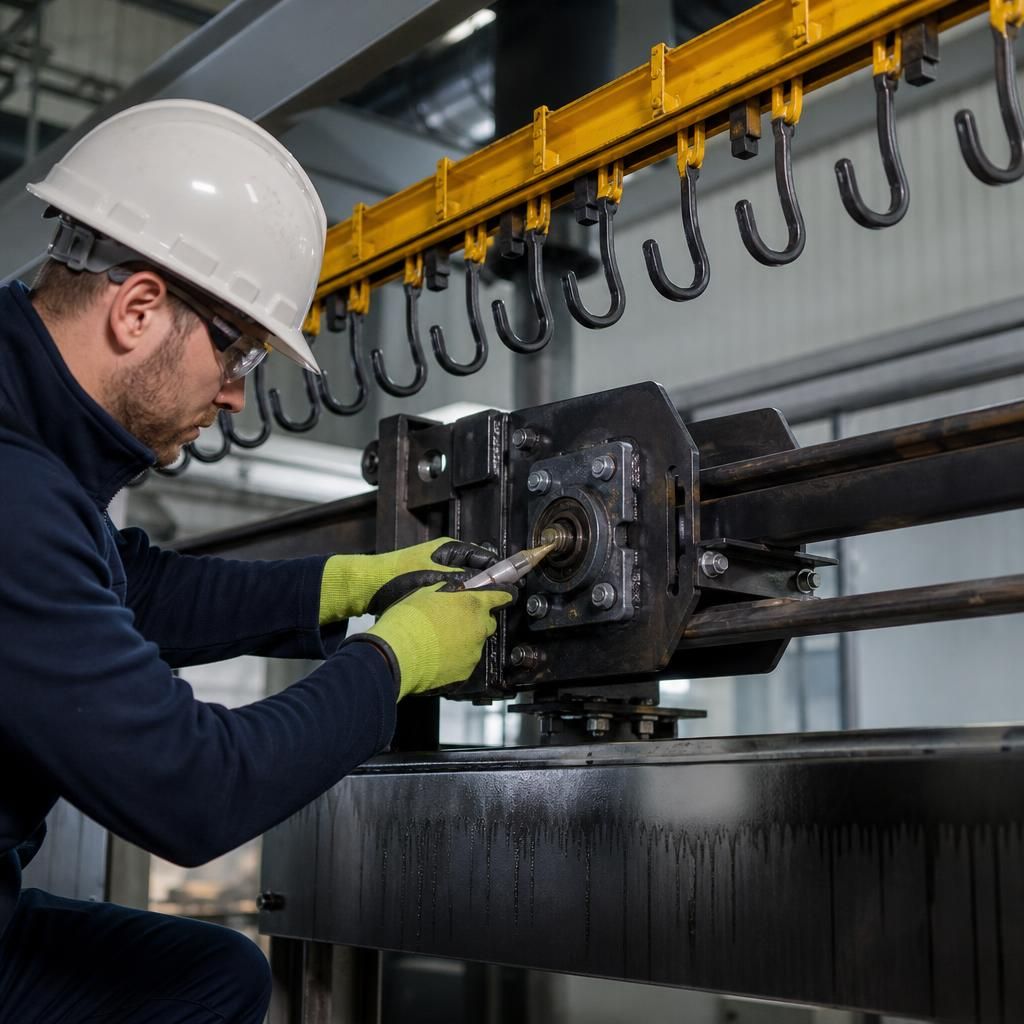
Lubrication should be treated as a controlled maintenance task because excess grease or oil can become a coating contaminant. Use only the lubricant specified for each conveyor component, apply the required amount at the correct service point and protect nearby hooks, parts and process equipment during application. Wipe away excess material and investigate any lubricant that appears outside its intended location rather than allowing it to travel into the pretreatment, booth or curing stages.
Maintenance records should also identify recurring lubricant loss, unusual consumption or contamination around seals and housings. These signs can indicate deterioration that requires more than routine re-lubrication. Replacing a worn seal, bearing or related component under an approved isolation procedure can prevent lubricant migration and reduce the risk of introducing defects into subsequent coating batches.
Discuss Conveyor Maintenance for Consistent Powder Coating Quality
If conveyor-related defects are affecting your powder coating process, contact Powder-coatings.co.uk to discuss your components, finish requirements and production needs. The team can help establish whether its industrial powder coating service is suitable for your application.