

How does proper surface preparation impact the longevity of a powder coated finish?
Proper surface preparation extends the life of a powder coated finish by removing oil, rust, scale, old coatings and other contaminants that can prevent adhesion. A clean, suitably profiled and chemically prepared surface gives the powder coating a stable foundation, reducing the risk of peeling, blistering, corrosion and premature finish failure.
Proper surface preparation extends powder coating life by creating the correct physical and chemical conditions for the coating system to bond, cure and resist corrosion. The quality of the finished coating is therefore determined partly before any powder is applied: preparation affects adhesion strength, under-film corrosion, edge protection, appearance and the coating’s ability to withstand handling and service conditions.
It creates a reliable bonding surface
Powder does not adhere equally well to every metal surface. A prepared substrate has a controlled surface energy and texture that allow the melted coating to wet the metal rather than sit on a weak boundary layer. Abrasive blasting can create a consistent key, while chemical pretreatment can improve bonding and provide additional corrosion resistance. If either stage is uneven, the coating may appear sound initially but have weak areas that become vulnerable during fabrication, transport or use.
The surface profile must be appropriate to the coating and the metal. An insufficient profile can provide too little mechanical key, whereas an excessively rough profile can leave peaks with inadequate coating coverage and valleys that retain treatment residues. Preparation should consequently be selected according to the substrate, coating specification, component geometry and intended environment rather than applied as a single standard process to every part.
It reduces corrosion beneath the coating
Powder coating is a barrier, not a substitute for sound metal or suitable corrosion control. Any remaining corrosion-active material, trapped residue or poorly treated area can allow deterioration to continue beneath an apparently intact film. As corrosion products occupy more volume than the original steel, they can lift the coating, produce blistering and cause progressive loss of adhesion.
Consistent preparation is particularly important at welds, joints, folded sections, drilled holes and sharp transitions. These areas can retain residues, show differences in surface texture or receive less effective treatment than broad, accessible faces. Rounding sharp edges where the design permits, removing weld spatter and checking difficult-to-reach areas helps the coating form a more continuous protective layer.
It ensures pretreatment is compatible with the substrate
Steel, aluminium, galvanised components and previously coated metal do not respond identically to cleaning, blasting or chemical treatment. The preparation method should avoid embedding unwanted material, damaging a softer substrate or removing protective layers that the coating system is intended to work with. Galvanised surfaces may require controlled treatment to address their surface condition, while aluminium requires care to prevent an unsuitable oxide layer or excessive roughening.
Conversion treatments and other chemical pretreatments must be applied at the correct stage and then rinsed or dried appropriately. Residues left on the surface can interfere with adhesion and may contribute to osmotic blistering or corrosion. The preparation process should also prevent flash rust after water-based cleaning or rinsing. Parts that remain damp, are handled with contaminated gloves or are stored in a corrosive atmosphere can lose the benefit of earlier preparation.
It improves coverage and film consistency
Surface condition influences how powder is deposited and how the coating flows during curing. Irregularities such as burrs, sharp projections, deep pits and damaged old coating can remain visible through the new finish or create areas of reduced protection. Filling or repairing such defects is a design and fabrication decision as well as a coating decision; powder coating will not reliably level substantial metal damage or bridge every discontinuity.
Uniform preparation also supports more consistent film build across the component. This matters on edges, recesses and complex profiles, where electrostatic application and melt flow may produce different coverage from that achieved on flat faces. A sound, consistently prepared surface gives the applicator a more predictable basis for achieving the specified finish without relying on excessive coating thickness to conceal defects.
It prevents premature failure caused by gases and residues
Porous castings, threaded holes, lap joints and some fabricated assemblies can retain moisture, oils or cleaning materials. During oven curing, trapped substances may release gases and cause pinholes, craters, bubbles or local loss of adhesion. Preparation should therefore include attention to component design, drainage, venting and the condition of enclosed sections, not only the visible outer faces.
Outgassing from the substrate is a material-related risk that may not be solved by blasting alone. Where suitable, preheating, controlled degassing or a coating system designed for the component can reduce defects. These measures should be considered during specification, particularly for castings and parts with porous or enclosed sections.
Preparation must be verified, not assumed
A durable result depends on process control at each stage. Useful checks can include:
- confirming the substrate and its existing condition before selecting the preparation method;
- checking that blasting media, pressure and technique produce the required surface profile without damaging the part;
- inspecting welds, edges, recesses, holes and underside areas rather than assessing only the most visible face;
- checking for remaining residues, moisture, flash rust and handling marks before coating;
- verifying that chemical pretreatment has been applied, rinsed and dried in accordance with the coating specification;
- recording relevant preparation and application conditions where repeatability is important; and
- checking the completed coating for film thickness, adhesion and visible defects using appropriate inspection methods.
Adhesion testing is most meaningful when related to the coating specification and the substrate. A visual inspection alone may not reveal a weak boundary or concealed corrosion risk, while an isolated test result cannot compensate for inconsistent preparation across a batch. Inspection should therefore combine process checks with examination of representative finished parts.
The service environment determines how much preparation is needed
A component exposed indoors in a dry, controlled environment does not face the same demands as one exposed to rain, road salts, industrial pollutants, moisture or repeated temperature changes. More aggressive conditions increase the importance of substrate condition, edge treatment, pretreatment and the compatibility of the complete coating system. The specified preparation should be proportionate to the expected exposure and the consequences of coating failure.
In practice, surface preparation is one part of a controlled system that includes suitable powder selection, correct film thickness, accurate curing and appropriate component design. Even a well-prepared surface can suffer if the coating is under-cured, over-cured, damaged during handling or exposed beyond its specification. Conversely, careful preparation removes avoidable weaknesses before they become failures.
For manufacturers and fabricators, discussing substrate type, previous finishes, weld quality, component geometry, service exposure and inspection requirements before processing helps establish a preparation route that is repeatable across batches. That technical planning is what turns powder coating from a surface appearance treatment into a durable protective finish.
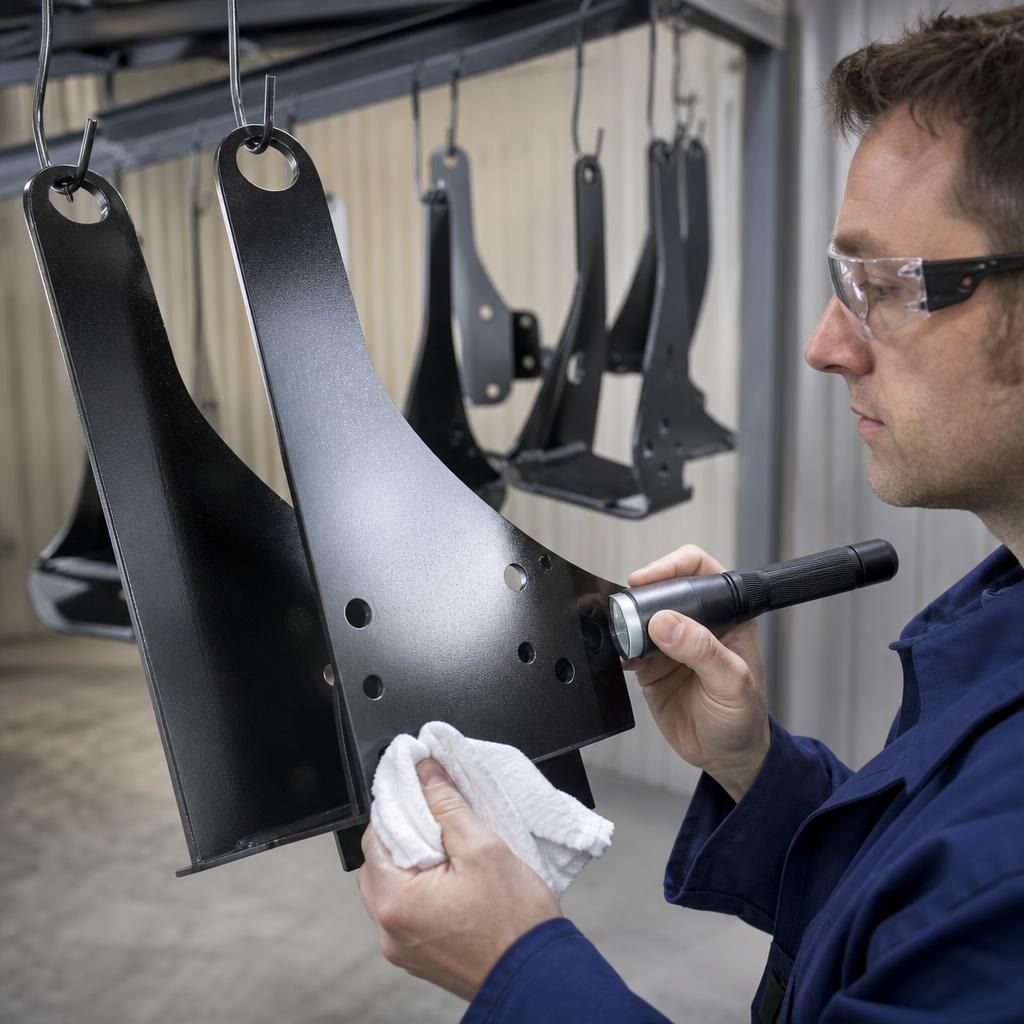
A surface can look clean while still carrying invisible contamination that shortens coating life. Thin films of oil, handling residue or soluble salts may not be obvious during visual inspection, yet they can prevent intimate contact between the powder coating and the metal. Under moisture exposure, soluble residues can also draw water towards the interface, increasing the risk of blistering and loss of adhesion.
For this reason, preparation quality should be assessed by process checks as well as appearance. Cleaning, rinsing and drying need to be controlled, and freshly prepared parts should be protected from recontamination before coating. This is particularly important for components that will face damp, polluted or salt-contaminated environments, where a minor invisible defect at the interface can become a larger coating failure over time.