

What are the specific benefits of using sandblasting over other surface preparation methods before powder coating repair?
Sandblasting removes rust, failed powder coating, mill scale and other contaminants more thoroughly than methods such as hand sanding or chemical cleaning, while creating a consistent surface profile. This combination gives the repair coating a cleaner, more receptive substrate, supporting stronger adhesion and a more uniform, durable finish.
Sandblasting is often preferred before powder coating repair because it provides a controllable, mechanical method of preparing the entire repair area, including edges, recesses and irregular profiles, without relying solely on manual access. Compared with hand sanding, wire brushing, power-tool abrasion or chemical stripping, it can produce a more even preparation across complex metal components while also allowing the operator to identify defects that could affect the repair.
- Better access to difficult areas: Abrasive media can reach corners, grooves, holes, weld areas and other contours that are difficult to prepare consistently with a sanding block or rotary tool. This is particularly useful where a damaged coating extends around an edge or into a recessed section.
- Less dependence on the operator’s reach: Manual preparation can vary according to pressure, tool angle and accessibility. Controlled blasting applies the preparation process across the selected surface, helping reduce isolated areas that have been lightly treated or missed altogether.
- No chemical stripping residue: Chemical cleaning can leave residues if it is not thoroughly removed or neutralised. Sandblasting is a dry mechanical process, so it avoids introducing stripping chemicals into the repair procedure. The substrate still needs to be properly cleaned after blasting to remove dust and loose media before coating.
- More suitable for localised repairs: Blasting equipment can be directed at a defined damaged area and feathered into the surrounding coating, allowing the repair zone to be prepared without automatically treating every part of the component. Masking and careful control remain important where adjacent coating must be retained.
- Improved defect visibility: Once surface contamination and loose material have been removed, pitting, corrosion damage, weld irregularities and other substrate defects are easier to assess. This helps determine whether the area needs filling, further mechanical treatment or repair before powder is applied.
- Greater control over the preparation method: The abrasive type, air pressure, nozzle distance and working angle can be selected according to the metal, the existing coating and the condition of the repair area. This makes the process more adaptable than using one sanding grade or one chemical treatment for every component.
- Consistent preparation for repeat work: Where similar components require repair, defined blasting settings and an agreed preparation standard can make the process easier to reproduce from one part to the next. That repeatability is valuable for manufacturers and fabricators handling batches of coated metalwork.
- Reduced risk of chemical compatibility problems: Some chemical treatments may interact with existing finishes, sealants or residues. A correctly controlled abrasive process avoids that particular source of incompatibility, although the selected media and blasting pressure must still be appropriate for the substrate.
Sandblasting is not automatically the best choice for every component. Thin sheet, soft alloys, delicate edges and parts containing protected bearings, threads or precision surfaces may require lower-impact preparation, masking or another method. Excessive pressure or unsuitable abrasive can distort a surface, embed media or alter dimensions. The benefit comes from matching the equipment and abrasive to the metal and restricting treatment to what the repair requires.
For powder coating repair, the practical advantage is therefore not simply that sandblasting is more aggressive. It offers controlled preparation over complex shapes, avoids chemical stripping residues, exposes the true condition of the substrate and can be repeated to a defined standard. Those characteristics make it particularly useful where a repair must be assessed carefully and prepared consistently before the replacement powder coating is applied.
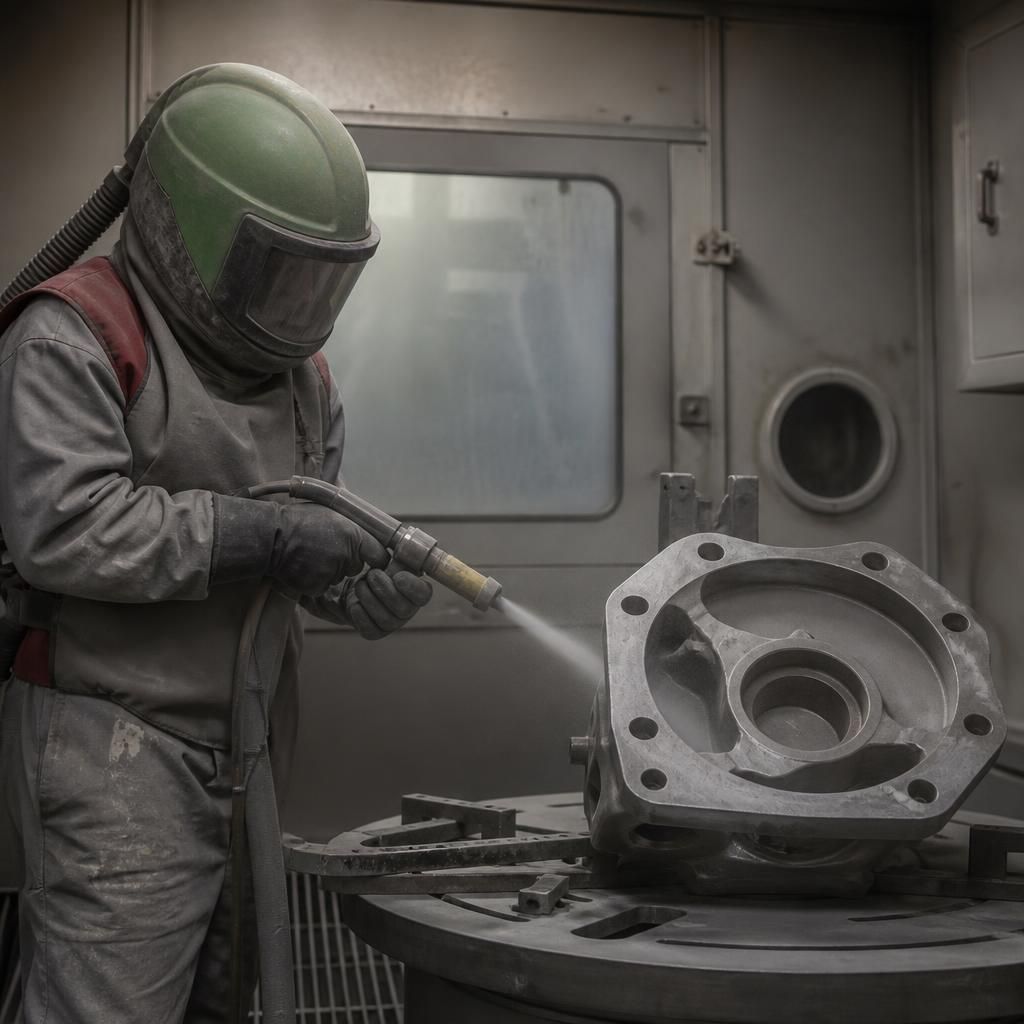
A key benefit of dry sandblasting is that it avoids introducing wash water into pits, seams and joints before powder coating repair. Compared with wet cleaning, this reduces the risk of retained moisture beneath edges or inside recesses, where it could interfere with coating application or contribute to early corrosion. The prepared metal must still be inspected for condensation, dust and flash rust, then coated within an appropriate process window.
This makes sandblasting useful where the repair area has intricate geometry or porous corrosion damage that would be difficult to dry reliably after washing. It provides a clean, dry starting point without adding a separate water-removal stage to the preparation process.
Discuss Your Sandblasting Requirements for Powder Coating Repair
Discuss the metal component, existing coating and repair area with the powder-coating team to establish whether controlled sandblasting is the appropriate preparation method. You can also clarify masking, abrasive selection and the finish required before arranging collection or delivery.