

What industries benefit the most from using Nylon & Rilsan powder coating?
Nylon and Rilsan powder coating benefits industries that need durable protection for metal components exposed to wear, impact, moisture or chemicals, particularly manufacturing, metal fabrication, construction and automotive businesses. It is well suited to components where a tough, resilient finish can help preserve performance and reduce the need for frequent recoating.
The industries that benefit most from Nylon and Rilsan powder coating are those using metal components that need more than basic decorative protection. This includes sectors handling abrasive contact, repeated movement, chemicals, moisture, salt, oils or electrical requirements. The coating can provide a tough polymeric layer over the substrate, making it particularly relevant to engineered components whose surface performance affects service life, safety or maintenance.
Fluid handling and process equipment
Pumps, valves, pipework components, manifolds and fittings can be exposed to water, cleaning agents, oils and process chemicals. Nylon and Rilsan coatings may be considered where a component needs a protective barrier together with resistance to impact and surface wear. The correct choice depends on the fluid, operating temperature, concentration and exposure time, so coating selection should be based on the full service environment rather than the industry name alone.
Material handling and warehouse equipment
Conveyors, chutes, rollers, guides, hooks and handling fixtures often experience repeated contact between metal surfaces and transported products. A suitable nylon coating can help reduce direct metal-to-metal contact and provide a smoother, resilient surface. This can be useful where components need to withstand friction without damaging the goods being handled.
Food, beverage and pharmaceutical equipment
Processing and handling equipment may require a coating that is easy to clean and able to tolerate regular contact with moisture and cleaning solutions. Nylon-based finishes can be relevant to guards, frames, trays, handling parts and other metal components, provided the selected coating is suitable for the intended contact and cleaning regime. Any hygiene, regulatory or direct-contact requirement must be confirmed against the relevant coating specification before it is selected.
Electrical and engineering equipment
Some engineering applications benefit from a non-metallic surface that can provide electrical insulation as well as mechanical protection. Nylon coatings may therefore be considered for brackets, housings, supports, busbar-related components and fabricated parts where the coating specification matches the required dielectric and operating conditions. The design must account for edges, contact points, earthing arrangements and any areas that must remain electrically conductive.
Agricultural and outdoor equipment
Metalwork used in agricultural, utility and outdoor settings can encounter water, mud, fertilisers, oils, impact and frequent handling. A resilient polymer coating may be appropriate for guards, brackets, frames, fittings and moving or exposed parts where the finish needs to withstand demanding conditions. Surface preparation remains important because contamination, rust or poorly prepared edges can undermine the coating system regardless of the sector.
Automotive and transport component supply
Automotive and transport manufacturers, fabricators and component suppliers may use Nylon or Rilsan coatings for brackets, clips, protective parts, guides and other metal components subject to abrasion, vibration or contact with fluids. The relevant assessment includes temperature range, exposure to fuels or oils, dimensional tolerances, masking requirements and whether the coating must provide low friction or impact resistance. Components with close fits may need coating thickness and post-coating dimensions checked during design.
Construction and infrastructure products
Construction-related metalwork can benefit where components are handled frequently, installed in exposed locations or subjected to rubbing and impact. Examples may include specialist brackets, fixings, supports, access equipment and fabricated parts. Nylon and Rilsan coatings are not a universal replacement for every structural or corrosion-protection system; the expected load, exposure, substrate and required durability should determine whether they are suitable.
How to identify whether an industry is a good fit
- Identify the main failure mechanism: abrasion, impact, corrosion, chemical attack, friction, moisture ingress or electrical contact.
- Record the operating temperature, chemical exposure, cleaning method and expected movement or loading.
- Check whether the coating must meet a particular hygiene, electrical, dimensional or product-contact requirement.
- Consider the component geometry, including recesses, sharp edges, internal surfaces, masking areas and areas requiring a controlled finish.
- Confirm that the substrate and preparation method are compatible with the selected Nylon or Rilsan coating.
In practice, the strongest applications are not defined solely by sector. They are defined by a combination of demanding surface conditions and components that require a resilient, engineered finish. A coating specialist can assess the part, its operating environment and the required performance before recommending the appropriate nylon coating system.
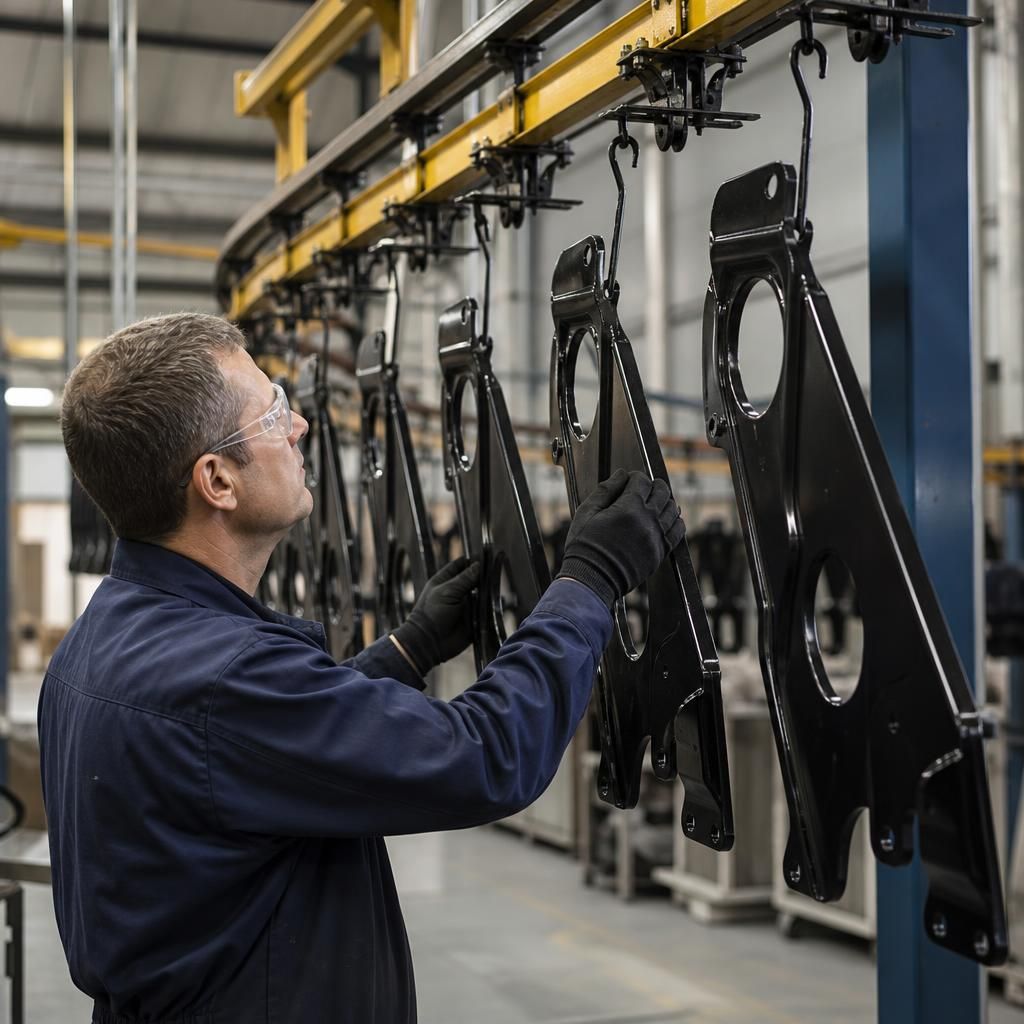
Nylon and Rilsan powder coatings are particularly relevant to industries that manufacture or maintain engineered components used inside larger assemblies. In these settings, the finish is specified as part of the component’s function rather than selected solely for appearance. A coated surface may need to tolerate repeated contact, protect adjoining parts, limit friction or provide a non-metallic barrier while remaining compatible with the component’s dimensions and operating conditions.
This makes the coating relevant to manufacturers, fabricators and equipment suppliers producing repeat components for industrial customers. The specification should be agreed before production so that coating thickness, masking, edge treatment and any required testing are considered alongside the component’s design. That approach helps establish whether Nylon or Rilsan is suitable for the part’s role, rather than assuming that the same coating is appropriate for every metal component within an industry.