

What preparation is necessary for metal surfaces before applying epoxy polyester hybrid coatings?
Metal surfaces must be clean, dry and free from oil, grease, rust, mill scale, moisture and unsound existing coatings before applying an epoxy polyester hybrid powder coating. Preparation typically includes degreasing, suitable abrasive blasting or mechanical preparation to create a consistent key, followed by thorough inspection and masking of areas that must remain uncoated.
Preparation for an epoxy polyester hybrid powder coating is a controlled pre-treatment process that gives the powder a sound, chemically compatible and uniformly accessible metal substrate. In addition to removing visible contamination, the work should address the metal grade, surface condition, fabrication defects, corrosion risk, coating history, part geometry and the requirements of the finished component.
Begin with a substrate assessment. Identify whether the component is mild steel, galvanised steel, aluminium or another suitable metal, and check for conditions that could affect adhesion or curing. Castings may contain porosity or residues that cause pinholes during oven curing, while galvanised surfaces can have uneven zinc layers. Aluminium may carry oxide deposits that need specific treatment. The coating specification should therefore be agreed with the applicator before preparation begins, particularly where different metals are joined in one assembly.
Resolve fabrication defects before coating. Weld spatter, sharp burrs, laminations, deep tool marks and loosely attached scale can remain visible through the finished powder film or create weak points. Welds should be continuous where the design requires it, and weld areas should be checked for flux, smoke residue and other by-products. Sharp external edges may need suitable treatment because powder tends to pull away from acute edges during application, leaving reduced coverage. Conversely, excessive grinding can create depressions or an uneven surface that remains visible after coating.
Hollow sections and fabricated assemblies need particular attention. Drainage and venting points allow pre-treatment solutions, rinse water and trapped air to leave the component. Without adequate drainage, liquid can remain inside a section, later causing staining, corrosion or blistering through joints and apertures. Enclosed areas should also be reviewed for trapped shot, abrasive or process residue before the part is sent for coating.
Choose the pre-treatment to suit the metal and service conditions. Abrasive preparation is commonly selected where a controlled anchor pattern is needed, but the abrasive, pressure and technique must be appropriate for the substrate. Aluminium and thin-gauge components can be distorted or excessively roughened by an unsuitable process. Chemical pre-treatment may be used to improve adhesion and corrosion resistance, with the chemistry selected according to the metal and the intended environment. The process must be properly rinsed and controlled so that residues do not remain beneath the powder.
Where corrosion protection is important, the prepared surface should not be allowed to deteriorate between pre-treatment and powder application. Handling should use suitable gloves and clean contact points to avoid transferring salts or oils back onto the component. Storage and transport arrangements should also prevent condensation, contact corrosion and recontamination. If flash corrosion, staining or residue appears after preparation, the affected area should be reassessed rather than coated over.
Existing coatings require a separate decision. A sound coating may sometimes be retained if it is compatible, firmly bonded and permitted by the specification, but it should not be treated as an automatic foundation for a new hybrid powder layer. Peeling, chalking, cracking or unknown coatings normally require removal or a confirmed remedial process. The edges of any retained coating need particular scrutiny because a poor transition can show through the new finish or allow lifting to begin at the boundary.
Parts should be designed and presented so that all required faces are accessible to the preparation and application equipment. Areas that must remain uncoated, such as precision threads, bearing seats, electrical contact points and mating faces, need clearly defined protection. Masking decisions should account for coating thickness, oven temperature and the need to remove masking without damaging the finish. Hanging points should be placed on non-critical areas where possible, since contact marks or small uncoated points may remain after the part is removed from its rack.
Final checks should take place before powder application. Confirm that:
- the selected pre-treatment matches the substrate and service environment;
- welds, edges, joints and apertures have been properly prepared;
- hollow sections are vented and drained;
- the surface has not been recontaminated during handling;
- protected areas, threads and contact faces are correctly identified;
- the component can be safely racked without obstructing important surfaces; and
- the agreed powder specification and curing schedule are available to the coating operator.
For assemblies with mixed metals, repaired areas, castings or demanding dimensional tolerances, a trial preparation or written process review can identify problems before the full batch is processed. Providing accurate drawings, substrate information and details of the intended operating environment helps the powder-coating specialist select a preparation route that is appropriate for the component rather than relying on a generic treatment.
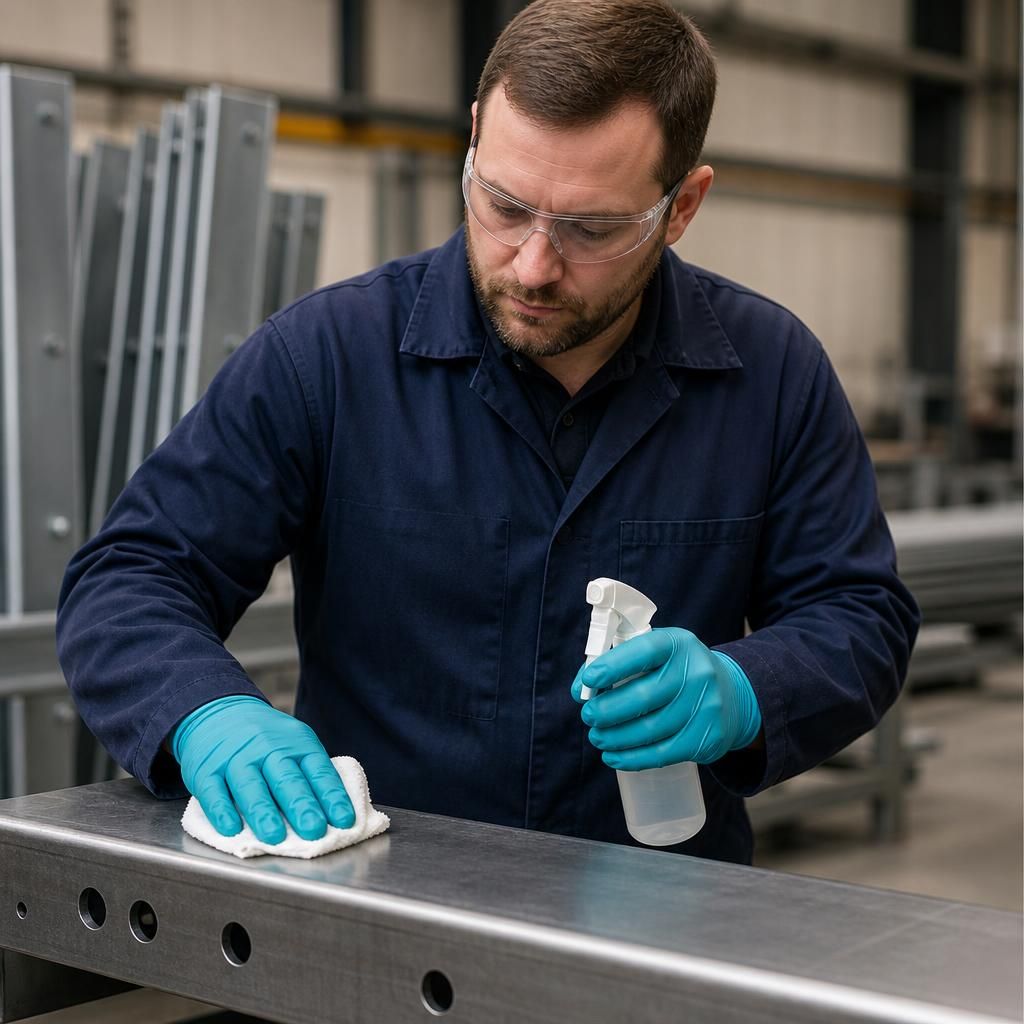
Visual cleanliness alone does not confirm that a metal surface is ready for an epoxy polyester hybrid coating. Soluble salts, fine dust and residues from handling may be invisible but can interfere with adhesion or promote corrosion beneath the cured film.
For components that have been stored outdoors, exposed to process chemicals or previously used in corrosive conditions, preparation should include a suitable cleanliness check. This may involve assessing surface dust, checking for oil residues and testing for soluble salts where the service environment makes them a concern. Any unacceptable result should lead to further cleaning or re-preparation rather than coating over the contamination. The inspection and test method should be agreed with the coating specification and matched to the metal substrate.