

What environmental conditions are best suited for using UV and high-performance powder coatings?
UV and high-performance powder coatings are best suited to metal components exposed to strong sunlight, changing temperatures, moisture, weathering and, where specified, corrosive or chemically demanding conditions. The coating should be selected according to the expected exposure, with proper surface preparation and application helping it perform consistently in outdoor and industrial environments.
The most suitable applications are those where a metal component must retain its appearance and protective performance despite a defined level of solar radiation, wetting, temperature variation, atmospheric pollution, salt exposure, abrasion or chemical contact. UV and high-performance powder coatings are not a single universal formulation, so the correct choice depends on the actual service environment rather than whether a component is simply described as being for indoor or outdoor use.
High solar exposure
Locations with sustained direct sunlight place particular demands on a coating. Ultraviolet radiation can gradually alter colour, gloss and resin structure, especially on south-facing elevations, exposed roofs, balconies, vehicle components and outdoor equipment. A UV-resistant system is appropriate where maintaining colour and surface appearance is important, while a higher-performance specification may also be needed where the coating must tolerate repeated heating and cooling.
Orientation matters. A sheltered vertical panel may receive less severe exposure than a horizontal surface, canopy, railing or roof-mounted component. Dark colours can also absorb more solar heat, increasing the temperature of the metal beneath the coating. Where different materials are joined, the specification should account for movement caused by unequal thermal expansion.
Wet, humid and condensation-prone locations
Powder-coated metal can be suitable for humid environments, but persistent moisture makes design and preparation especially important. Areas where water collects, joints remain damp or condensation forms repeatedly can challenge the coating system and create opportunities for corrosion at cut edges, fixings and defects.
Components for wash-down areas, plant rooms, covered external structures and damp industrial settings should therefore be assessed for their drainage, joint design and exposure to cleaning chemicals as well as humidity itself. A coating specification should not be treated as suitable for continuous immersion unless that particular system has been selected and verified for immersion service.
Coastal and salt-laden atmospheres
Salt carried in sea air increases the corrosive burden on exposed steel and aluminium. Coastal sites, harbours, marine-adjacent buildings and roads treated with de-icing salts may require a more carefully controlled protective system than a sheltered inland location. The condition of the substrate, edge coverage, film build, curing and the treatment of drilled holes or cut sections all influence resistance.
For significant corrosion risk, the coating should be selected as part of a defined corrosion-protection system. Environmental classifications such as those used in ISO 12944 can help describe the exposure and support discussions between the specifier, applicator and component manufacturer. The classification should be based on the real site conditions, including salt, moisture, pollution and the likelihood of maintenance.
Industrial and chemically demanding atmospheres
High-performance coatings are often considered for manufacturing sites, infrastructure, transport facilities and plant enclosures where airborne contaminants, oils, detergents or process chemicals may be present. The important question is not simply whether a coating is labelled “chemical resistant”; it is which substances will contact the surface, at what concentration, temperature and frequency, and whether contact will be brief or prolonged.
Potential exposure should include acidic or alkaline cleaners, solvents, fuels, hydraulic fluids, fertilisers and industrial emissions where relevant. The coating supplier or applicator should be given the chemical names and operating conditions so that compatibility can be checked. A coating that performs well against occasional splashes may not be appropriate for continuous contact or repeated aggressive cleaning.
Areas subject to impact, rubbing or particulate contamination
Some components experience mechanical conditions that are more influential than the climate. Agricultural equipment, guards, frames, handling systems, automotive parts and construction components may be struck, scraped or exposed to dust and grit. In these cases, hardness, flexibility, adhesion and resistance to abrasion should be considered alongside UV stability.
Sharp edges, exposed corners and interfaces between parts are common weak points. Sound design, suitable preparation and correct application help reduce premature damage, but a powder coating should not be expected to compensate for severe mechanical impact or poorly protected edges. Where wear is concentrated in particular zones, those areas may need a different material specification or replaceable protection.
Cold, heat and repeated temperature cycling
Outdoor components may experience frost, hot surfaces, rapid weather changes and repeated expansion and contraction. Equipment near ovens, exhausts, heaters or other heat sources has a different requirement from a component exposed only to ambient conditions. The maximum service temperature, the speed of temperature change and the temperature of the substrate should all be established before choosing a coating.
Low-temperature flexibility can matter where coated parts are handled or impacted in cold conditions. At the other extreme, excessive heat can affect colour stability, gloss and the performance of the resin system. The coating’s technical data should be checked against the actual operating range rather than relying on a general “outdoor” description.
Conditions that need additional caution
- Permanent immersion, buried components and areas with trapped moisture may require a specialised system rather than a standard high-performance exterior coating.
- Surfaces exposed to concentrated chemicals, severe abrasion or continuous high heat need confirmation that the selected formulation is suitable for that exact duty.
- Mixed-metal assemblies should be reviewed for galvanic corrosion, water traps and movement between different substrates.
- Interior components may still need UV or chemical resistance if they are close to glazing, lighting, production processes or frequent cleaning.
Before specifying the finish, record the component’s location, orientation, expected service temperature, moisture pattern, pollutants, chemicals, cleaning regime and mechanical loading. The intended appearance should also be defined, including acceptable changes in colour or gloss over time. This information allows the coating system and preparation method to be matched to the environment, rather than selecting a finish based only on colour or a broad outdoor-use label.
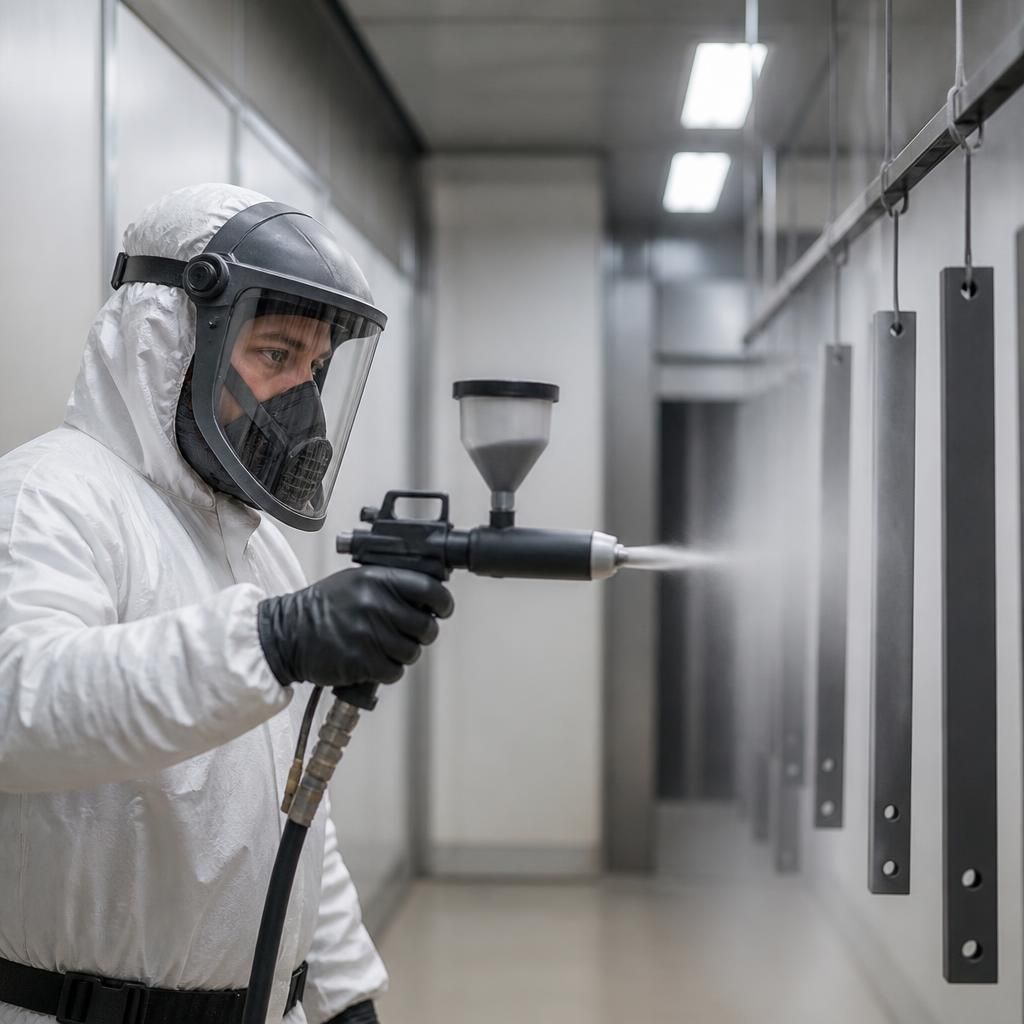
The conditions during application are as important as the conditions the finished component will face. Powder coating should be applied to a clean, dry substrate in an environment where moisture, condensation and airborne dust can be controlled. The metal temperature must remain suitable for preparation and coating, with the surface kept above its dew point to prevent invisible moisture from being trapped beneath the finish. Correct oven curing, based on the coating system and the component’s actual metal temperature, is also essential. A coating selected for demanding outdoor or industrial exposure may underperform if it is applied to damp, contaminated or inadequately cured metal.