

What equipment is essential for setting up a comprehensive industrial powder coating system?
A comprehensive industrial powder coating system requires equipment for every stage of the process: metal preparation and cleaning, drying, powder application, overspray extraction, curing and part handling. The core installation typically includes a preparation system, drying equipment, spray booth with electrostatic guns, powder recovery and filtration, a curing oven, and suitable conveyor or handling equipment, supported by process controls and inspection tools.
The essential requirement for a comprehensive industrial powder coating system is a properly integrated process line in which parts can be prepared, coated, cured, inspected and moved safely without disrupting the next stage. Equipment must be selected as a matched system: the part dimensions, material, throughput, coating specification, powder type and available utilities all affect the correct capacity and configuration.
Part loading, racking and handling
Parts need suitable loading equipment before any coating process begins. This may include loading tables, lifting aids, hanging rails, stillages, pallets or a conveyor loading station. Racks and hooks must support the component without masking important surfaces and must provide a reliable electrical contact where electrostatic application is used. Contact points should be positioned in areas that can tolerate a small uncoated mark or be touched up afterwards.
Jigs should hold parts securely while allowing powder to reach recesses, edges and internal faces. Their design also needs to prevent parts swinging, colliding or shielding one another as they pass through the system. For a line handling different component sizes, interchangeable fixtures and defined loading patterns help maintain repeatable spacing and coating access.
Pre-treatment and water management
Metal preparation equipment normally consists of a sequence of cleaning, rinsing and conditioning stages appropriate to the substrate and the required corrosion performance. Depending on the process, this can involve spray tunnels, immersion tanks, dosing equipment, pumps, filters, chemical storage and controls for concentration, temperature and flow.
Rinse quality is particularly important because residues can cause poor adhesion, blistering or contamination of subsequent stages. A comprehensive installation may therefore require conductivity monitoring, demineralised or treated water, sludge removal and equipment for managing spent chemicals and wastewater. The pre-treatment system should be specified around the metal types being processed; steel, galvanised steel and aluminium may require different chemistry or process settings.
After washing, parts require controlled drying. Air knives, blow-off stations and a dry-off oven remove water from seams, cavities and folded sections. Drainage holes may be needed in hollow components so that liquid cannot remain trapped and later emerge during curing. The drying stage should be long and hot enough for the component geometry, while avoiding unnecessary heat exposure that could affect the substrate or previously applied treatments.
Powder application hardware
The application area requires powder spray guns, powder pumps, hoses, gun controls and a powder feed system. The equipment should allow adjustment of voltage, current, powder output and atomising air so that settings can be matched to the component, powder formulation and required film build. Manual guns may suit varied batches and complex parts, whereas automatic guns and reciprocators are more appropriate where component geometry and production volume are consistent.
Powder containers, sieves and fluidising equipment help maintain a stable powder supply. Sieving can remove agglomerated material or foreign particles before they reach the gun. Powder hoses should be routed to avoid sharp bends, excessive length and build-up, since inconsistent transport can affect application uniformity.
Booth dimensions must provide enough clearance for the largest workpiece and for safe operator access. Booth construction, airflow and extraction should prevent powder escaping into the surrounding workplace while avoiding excessive air movement that could disturb the spray pattern. Lighting should make surface coverage and defects visible without creating an unsuitable environment for the powder application equipment.
Overspray recovery and filtration
Recovery equipment captures powder that does not reach the component. This commonly involves extraction ducting, cartridge or final filters, and, where reclaiming is appropriate, a cyclone or comparable separation arrangement. The choice depends on whether the system uses a single powder colour, frequent colour changes or multiple dedicated powder streams.
A reclaim system must prevent contamination between powders and allow the operator to decide whether recovered material is suitable for reuse. Quick-release booth components, accessible filters and straightforward cleaning arrangements are valuable where colour changes are frequent. Differential-pressure monitoring helps identify blocked filters or falling extraction performance before coating quality or workplace conditions are affected.
Curing and temperature control
The curing oven needs adequate internal circulation, insulation, temperature control and exhaust management for the largest and heaviest planned load. Its specification should be based on the metal temperature required by the powder manufacturer, not simply the air temperature displayed by the oven controller. Thick components and dense loads absorb heat more slowly than light sections.
Useful equipment includes calibrated temperature sensors, independent over-temperature protection, data logging and access for maintenance. Temperature profiling with probes attached to representative parts confirms whether the whole component reaches the required cure window. This is especially important for complex fabrications, hollow sections and mixed loads.
Oven doors, seals, burners or heating elements, circulation fans and exhaust systems should be selected to minimise heat loss while maintaining safe operation. Gas-fired and electrically heated designs have different utility and installation requirements, so the available power, fuel supply, ventilation and site layout must be assessed before selection.
Conveyor and transfer equipment
A conveyor links the stages and controls the time each part spends in preparation, drying, application and curing. Essential choices include load capacity, conveyor speed, track layout, hanger spacing, elevation changes and the ability to bypass or accumulate parts. The conveyor must be rated for the combined weight of components, fixtures and any retained liquid.
For batch or low-volume work, mobile racks, lifting equipment and transfer cars may be more practical than a permanently continuous line. A system handling mixed products may need removable hooks, adjustable loading positions or separate batch areas. Whatever arrangement is used, transfer points should protect the uncured coating from contact and provide sufficient cooling space before unloading or packing.
Utilities and control equipment
Industrial systems need correctly sized electrical distribution, compressed-air generation and treatment, extraction fans, lighting and, where applicable, gas services. Compressed air should be clean, dry and regulated because moisture or oil in the air supply can affect powder transport and the finished surface. Isolation points, pressure regulation and accessible maintenance connections should be incorporated into the design.
A central control panel or programmable control system coordinates conveyor movement, booth extraction, gun operation, oven heating and safety interlocks. Interlocks can prevent spraying when extraction is not operating, stop the conveyor during a critical fault and inhibit heating when required operating conditions are not met. Emergency stops, guarding and clear fault indication are essential rather than optional additions.
Powder is a combustible dust, so the installation needs a documented assessment of dust, ignition and ventilation risks. Equipment selection, earthing, electrical protection, extraction design, housekeeping arrangements and fire controls should follow the applicable UK requirements and the conclusions of the site risk assessment. Operators also need suitable personal protective equipment, safe access and clear procedures for cleaning powder deposits and handling coating chemicals.
Inspection and process verification
Quality equipment allows the coating process to be checked rather than judged only by appearance. A dry-film thickness gauge is used to verify film build on suitable substrates. Adhesion testing tools, gloss measurement equipment, colour comparison lighting and surface inspection lighting can support release checks where the specification requires them.
Oven data loggers and temperature probes confirm the cure experienced by the part. Records may also include pre-treatment parameters, powder batch details, booth settings, line speed and inspection results. These records are particularly useful when investigating defects such as poor adhesion, orange peel, pinholing, uneven coverage or colour variation.
How to size the installation
Equipment should be sized from the real production profile rather than the largest theoretical component alone. Important inputs include:
- maximum and typical part dimensions, weight and geometry;
- substrate types and pre-treatment requirements;
- powder chemistry, colour range and expected colour-change frequency;
- required film thickness and cure schedule;
- batch size, product mix and target production rate;
- available floor area, ceiling height and loading access;
- electrical, gas, compressed-air and extraction capacity; and
- cleaning, maintenance, waste handling and future expansion requirements.
A system that is too small creates bottlenecks at preparation, curing or loading. An oversized installation increases energy use, floor-space requirements and cleaning demands without necessarily improving results. The most suitable arrangement is therefore the one that balances process control, flexibility, safe operation and the actual mix of work the plant will handle.
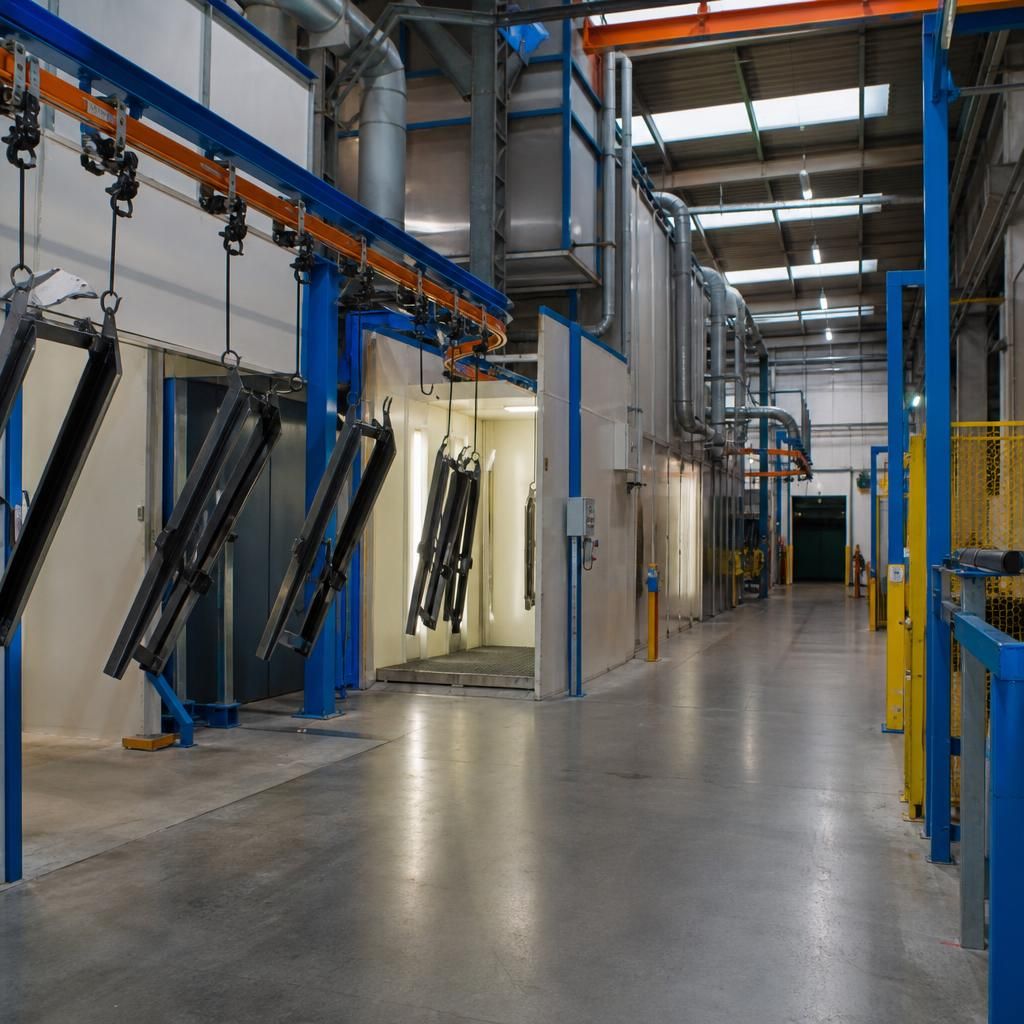
The layout around the equipment is an essential part of a comprehensive industrial powder coating system. Wet pre-treatment and drying areas should be separated from the dry powder application zone so that moisture, chemical residue and airborne contamination do not affect coating quality. The booth, oven and handling route should follow a logical sequence, with enough space for safe transfer between stages.
Planning should also include clearly defined areas for:
- incoming components awaiting preparation;
- clean, dried parts ready for coating;
- coated parts cooling before inspection or packing;
- powder, chemicals and consumables stored under suitable conditions; and
- cleaning, waste handling and maintenance activities.
This zoning helps prevent unfinished and finished work from being mixed, reduces unnecessary movement and gives operators safer access to the process equipment. It is particularly important where the system handles different substrates, powder colours or component sizes.
Discuss Your Industrial Powder Coating System Requirements
Discuss your industrial powder coating system requirements with Powder-coatings.co.uk and provide details of your components, substrates, batch profile and required finish. This will help establish a practical coating solution suited to your production needs.