

What types of abrasives are used in blast cleaning for powder coating preparation?
Blast cleaning for powder coating preparation uses abrasives such as aluminium oxide, glass bead, garnet, steel shot or grit, and plastic media. The correct choice depends on the metal substrate, contamination to be removed, and surface profile required for strong powder-coating adhesion.
The abrasives used for blast cleaning before powder coating are selected according to the metal substrate, the contamination present and the surface profile required. Common options include aluminium oxide, glass bead, garnet, steel shot, steel grit and plastic media. Each produces a different balance of cleaning power, surface texture and risk of damaging the component.
Aluminium oxide is a hard, angular abrasive used where substantial cleaning and a pronounced profile are needed. Its sharp edges cut into the surface to remove rust, mill scale, old coatings and other firmly bonded contamination. It is suitable for many steel components, but its aggressive action can be excessive for thin sheet, soft metals or parts with fine details. The resulting profile must be controlled so that it supports powder-coating adhesion without creating unnecessary roughness.
Glass bead is a rounded media that cleans and lightly refines the surface rather than cutting into it as sharply as an angular abrasive. It is often used where a smoother, more uniform appearance is required and where the underlying metal needs gentler treatment. Glass bead can remove light corrosion, dirt and surface residues, although it is generally less suitable for heavy scale or thick, strongly bonded coatings. Because it creates a relatively shallow profile, the specified finish should be checked against the powder coating system being applied.
Garnet is a naturally occurring mineral abrasive with angular particles and good cutting ability. It can remove corrosion and existing coatings while producing a useful anchor profile for powder coating. Garnet is used when a strong cleaning action is required but the operator wants an alternative to some harder manufactured abrasives. Its performance depends on particle size, blasting pressure and the condition of the workpiece.
Steel shot consists of rounded metal particles. Rather than cutting deeply into the substrate, the particles impact the surface and can remove contamination while producing a comparatively smooth, compacted finish. Steel shot is commonly associated with robust ferrous components that can tolerate repeated impact. It is not normally the first choice for delicate parts, soft metals or workpieces where a sharper mechanical key is required.
Steel grit has angular particles and therefore behaves differently from steel shot. It cuts more actively, making it useful for removing rust, mill scale and previous coatings from durable steel fabrications. The grade and condition of the grit influence the depth and character of the profile. If the abrasive is too coarse or the blasting is too forceful, the surface can become unnecessarily rough or edges can be rounded.
Plastic media provides a lower-impact option for components that could be distorted, marked or dimensionally affected by harder abrasives. It is used for removing selected coatings and contaminants from softer metals or sensitive parts while limiting substrate damage. Plastic media is not suitable for every type of heavy corrosion or scale, so it is normally chosen when preserving the base material is more important than achieving the most aggressive cleaning action.
Other media may also be considered for particular preparation requirements:
- Crushed glass is an angular abrasive that can remove coatings and corrosion while producing a relatively consistent profile.
- Silicon carbide is very hard and sharp, so it is reserved for applications requiring strong cutting action and careful process control.
- Organic media, such as walnut shell, is relatively soft and may be used for delicate cleaning where preserving the substrate is essential, although it is not intended for every powder-coating preparation task.
The size and condition of the particles matter as much as the material itself. Coarser particles generally deliver more impact and a deeper profile, while finer particles offer greater control and can produce a more even finish. Worn or contaminated media may clean less effectively and can affect the consistency of the prepared surface. Blast pressure, nozzle distance, angle and pass speed also alter the result, so the same abrasive can produce different finishes when the operating conditions change.
Steel and other durable ferrous substrates can often accept harder, angular media where corrosion or old coating is firmly attached. Aluminium and other softer metals require more careful selection because excessive impact can distort the surface, embed abrasive or create an unsuitable profile. Components with threads, machined faces, thin sections or close tolerances may need masking, reduced pressure or a less aggressive medium.
After blasting, the surface should be free from loose abrasive, dust, oil, grease and visible corrosion before powder is applied. The prepared profile needs to be compatible with the coating specification: too little texture may provide an inadequate mechanical key, while excessive roughness can affect coverage, appearance and the amount of powder needed on peaks and recesses. For this reason, abrasive choice is a preparation decision rather than a simple preference for one media type.
For industrial metal parts, the practical selection process is to identify the substrate, assess the contamination, define the required cleanliness and profile, then choose the least aggressive abrasive that can achieve those requirements consistently. A trial on a representative area is useful where the metal, existing finish or dimensional tolerances make the result uncertain.
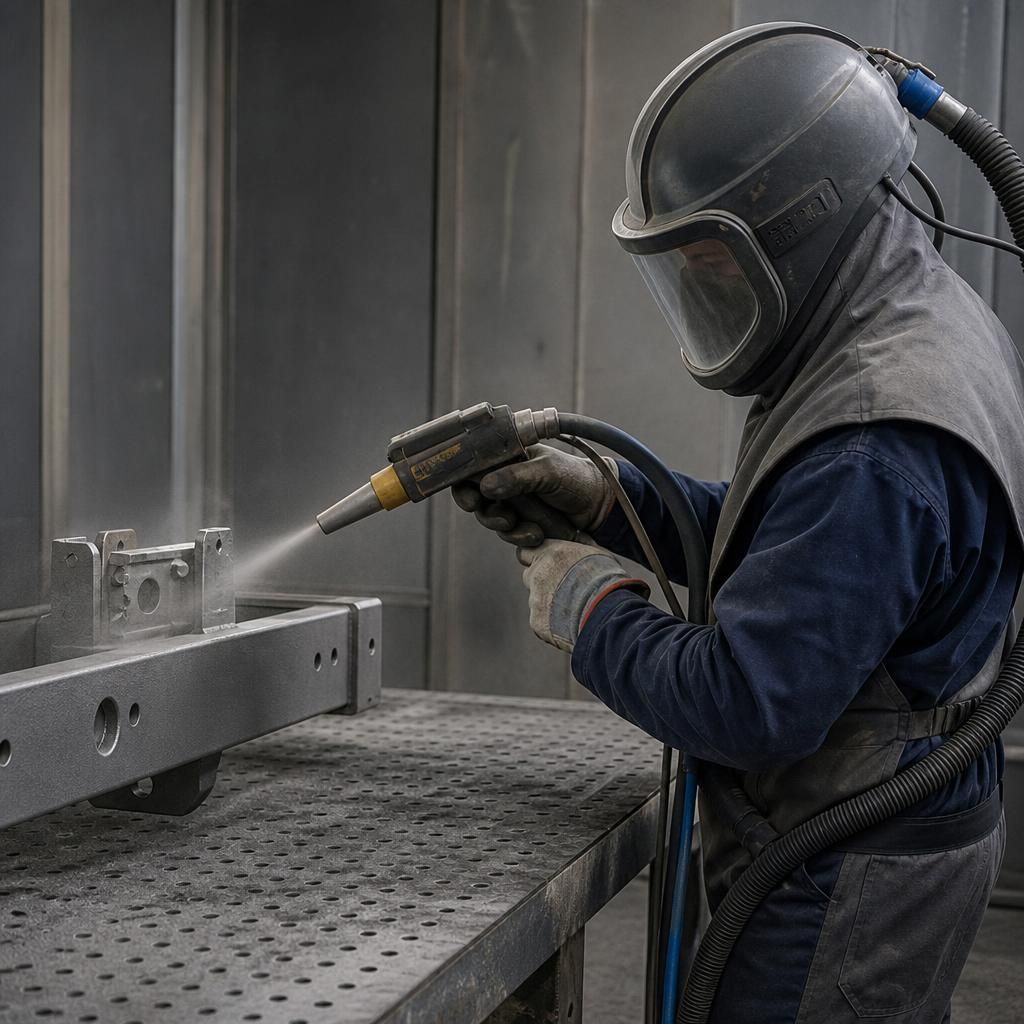
Abrasive cleanliness is an important part of media selection because the blast medium can transfer contamination to the prepared metal. Oil, moisture, salts, remnants of previous coatings or particles from another substrate may interfere with the powder-coating process, even when the surface appears uniformly blasted.
Media should therefore be kept dry, stored correctly and assessed for contamination before use. Where different metals or coatings are processed, separating abrasive streams can reduce cross-contamination. This is particularly relevant when preparing components that will receive a smooth or decorative powder finish, where embedded debris may contribute to visible surface defects. The abrasive type is only one part of the specification; its cleanliness and suitability for the particular workpiece must also be controlled.
Discuss Your Abrasive Selection Requirements
If you are unsure which abrasive is appropriate for your metal parts, discuss the substrate, existing finish and required powder-coating finish with our team before preparation begins. We can help assess the abrasive selection requirements for your components.