

How do mini powder coating machines enhance efficiency in industrial applications?
Mini powder coating machines enhance industrial efficiency by enabling controlled, repeatable application of powder to smaller batches, prototypes and individual components without occupying the space or using the resources of a full-scale coating line. Their precise spray control can help reduce overspray and rework while supporting consistent, durable finishes.
Mini powder coating machines enhance industrial efficiency by matching coating capacity to the job rather than requiring every component to pass through a full-scale production line. Their main advantages are shorter preparation routes, simpler handling of small production runs, lower space requirements and easier integration into work areas where a large automated system would be impractical.
They are particularly useful for variable production. Manufacturers and fabricators often need to coat prototypes, replacement parts, development samples, repair items or batches with different colours and specifications. A mini machine can be assigned to these jobs without disrupting the main production route. This helps separate low-volume work from high-volume processing, reducing the need to stop or reconfigure larger equipment for comparatively small orders.
Changeover efficiency is also important. Powder coating operations may involve removing residual powder, cleaning the application equipment, checking the booth and preparing a different powder type or colour. On a compact system, the working area and material path are generally easier to access, so operators can complete these tasks with less dismantling and handling than may be required on a larger line. The actual time and effort will depend on the machine design, powder specification and cleaning procedure, but the simpler layout can make frequent product changes more manageable.
Efficient use of labour comes from reducing unnecessary handling. A suitable mini system can allow an operator to carry out application, inspection and job changes within a defined work area. This may reduce movement between separate preparation and coating stations, particularly when components are small enough to be loaded and unloaded without specialised conveying equipment. Better organisation of racks, hooks, masking materials and finished parts is still essential; a compact machine does not remove the need for a properly planned workflow.
Space utilisation is another industrial consideration. Full-scale coating lines require room for booths, conveyors, curing equipment, extraction systems and material movement. A mini powder coating machine occupies a smaller operational footprint, which can allow a business to add coating capability within an existing workshop or reserve larger equipment for work that genuinely requires higher throughput. The available space must still accommodate safe loading, ventilation, electrical requirements, curing and the movement of personnel and components.
Energy efficiency depends on the complete process, not only the spray equipment. A small machine may use fewer resources when it is processing a small workload because the operator does not need to run a larger line for a limited number of parts. However, the oven, extraction, compressed air and ancillary equipment all contribute to consumption. Efficiency should therefore be assessed by considering the energy used per completed job, the loading of the curing oven and whether the equipment can be switched or adjusted appropriately between production tasks.
Curing can have a significant effect on output. Powder must reach the specified metal temperature for the required cure, rather than simply being exposed to a particular oven air temperature. A well-planned mini setup should provide sufficient space and temperature control for the components being processed. Parts should be arranged so that air can circulate around them and so that the oven is neither overloaded nor operated inefficiently for a very small load. Temperature verification and adherence to the powder manufacturer’s technical data remain necessary to avoid under-cured or over-cured finishes.
Efficiency also includes first-time quality. Defects can create additional inspection, stripping, preparation and recoating work. Suitable preparation of the metal, correct grounding, appropriate hanging, controlled application and accurate curing all contribute to a more efficient process. Operators should check for contamination, oil, moisture, sharp edges and unsuitable masking before coating begins. A brief pre-coating inspection can prevent a finished component from becoming a rework item.
Powder handling affects both productivity and material control. Powder should be stored in suitable conditions, identified by job and protected from contamination. Operators should use the correct feed settings and keep the equipment clean so that powder flows consistently. Where a machine is designed with powder recovery or reclaim capability, that feature can support material utilisation, provided recovered powder is managed in accordance with the coating supplier’s guidance. Reclaim is not automatically suitable for every colour, finish or performance requirement, particularly where contamination or mixing could affect the final specification.
Mini systems can support a more flexible production schedule because jobs can be grouped by component size, coating type or colour. A practical schedule may place similar jobs together, complete compatible preparation tasks in one sequence and reserve more involved cleaning for planned changeovers. This avoids treating every small order as a separate start-to-finish setup. Job records should identify the powder, substrate, preparation method, cure requirements and inspection criteria so that repeat work does not depend solely on operator memory.
Integration with the wider production line should be assessed before selecting equipment. Relevant questions include:
- Can the machine accept the dimensions and weight of the components being produced?
- Is there sufficient room for loading, unloading, extraction and safe operator access?
- Can the curing equipment accommodate the part size and required temperature profile?
- Will the system work with the powder types and finish specifications used by the business?
- Can coated parts move easily to assembly, inspection or packing without damage?
- Are electrical, ventilation, compressed-air and housekeeping requirements compatible with the workshop?
A mini powder coating machine is not automatically the most efficient choice for every application. Large, uniform volumes may be better suited to an automated line with continuous conveying and dedicated curing capacity. Conversely, a mini system may be more appropriate where production is mixed, batch sizes vary, available space is limited or coating forms one stage of a broader fabrication process. The correct comparison is between the machine’s capacity and the actual production profile, not simply between the purchase size of different systems.
For Midlands manufacturers, fabricators, construction businesses and automotive suppliers, this type of equipment can form part of a flexible in-house coating arrangement or support specialist batch work alongside existing production facilities. Collection and delivery options may also be relevant when coating is handled by an external specialist rather than on the customer’s premises. In either case, efficiency should be judged across preparation, application, curing, inspection, handling and rework, because improvements in one stage can be cancelled out by bottlenecks elsewhere.
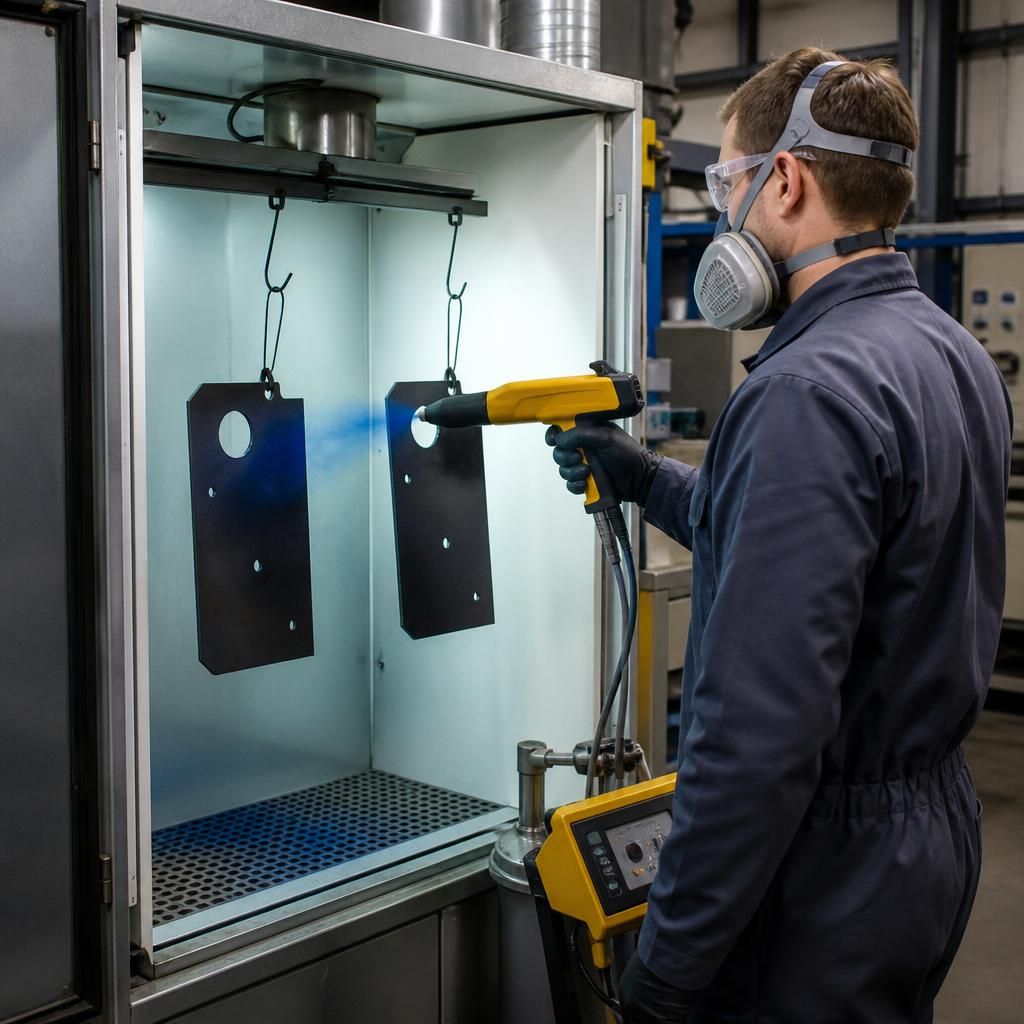
A mini powder coating machine can improve industrial efficiency during process development by allowing prototypes, first-off parts and coating trials to be assessed before a larger production run begins. Operators can check powder coverage, appearance, adhesion and curing requirements on representative components without interrupting a full-scale coating line.
This supports a controlled validation process. The trial should use the intended substrate preparation, powder specification, application settings and cure profile. Any issues with masking, edge coverage, contamination or oven loading can then be identified before the main batch is processed, limiting avoidable rework and helping establish repeatable instructions for subsequent jobs.
For businesses handling varied components, retaining records of the approved settings and inspection results can make future repeat work more consistent. The mini system therefore serves not only as a production tool, but also as a practical way to test and refine coating parameters before they are introduced into a higher-volume process.