

How do small powder coating machines compare to larger systems in terms of efficiency and cost?
Small powder coating machines generally require less capital and can be efficient for low-volume, varied or occasional work, while larger systems offer higher throughput for sustained production. The more cost-effective option depends on batch size, utilisation, labour, changeover requirements and whether the additional capacity of a larger system will be used consistently.
The efficiency and cost difference between a small powder coating machine and a larger system is determined by how well each installation matches the parts, coating changes and production pattern involved. A small machine can avoid the fixed costs and operating complexity of a full-scale line, while a larger system can process more work with less handling when its capacity is used consistently. The right comparison therefore includes total operating cost, usable output and finish quality, not purchase price alone.
Efficiency is more than spray speed
Small equipment may appear less efficient because an operator often loads, unloads and handles components manually. However, that arrangement can be efficient where parts differ in size, shape or colour and do not justify a dedicated conveyor process. The operator can adapt the sequence to the work rather than waiting for a fixed line arrangement.
A larger system normally improves material flow through a defined sequence of preparation, application, curing and unloading. This can reduce handling per component and make output more predictable. Its advantage is greatest when parts are sufficiently consistent to move through the same settings and process stages without frequent interruption.
When comparing systems, assess the complete cycle rather than the spray application alone:
- loading and unloading time;
- masking, racking and component positioning;
- booth or enclosure preparation;
- oven loading, curing and unloading;
- colour or powder changes;
- inspection, touch-up and rework; and
- cleaning between different materials or finishes.
A machine with a faster application stage may not deliver a lower cost per finished component if preparation, curing or changeover creates a bottleneck.
Energy and space costs
Large systems commonly require more floor space and supporting infrastructure. This may include a larger curing oven, extraction, compressed air capacity, electrical supply, ventilation and dedicated areas for preparation and finished parts. These requirements affect installation cost and can reduce the space available for other production activities.
Small equipment generally gives the operator more control over which parts are processed and when the oven is used. That can prevent an oversized curing system from being heated for a small load. The comparison should consider the energy used per acceptable finished part, rather than the nominal power of the equipment. An under-filled large oven may be less economical than a smaller oven operated with suitable loads, whereas a small oven can become inefficient if many partial cycles are needed.
Energy performance also depends on insulation, curing temperature, oven loading, recovery of heated air and the time required to reach operating conditions. Ask suppliers for the information needed to estimate running costs under the intended process conditions, rather than relying on general equipment classifications.
Powder usage and recovery
Material efficiency depends on transfer efficiency, component geometry, operator technique and the extent to which overspray can be recovered and reused. Larger systems may incorporate more formal powder recovery arrangements, which can reduce waste where the same powder is used repeatedly. Those arrangements can be less useful when colours or materials change frequently, because recovered powder may need careful segregation or may not be suitable for another finish.
Small systems can be practical where different powders are applied in separate runs, but the cleaning required between runs must be included in the cost assessment. A comparison should record powder purchased, powder applied, recoverable overspray, disposal and any material rejected because of contamination. This gives a more useful measure of coating efficiency than the amount placed in the gun.
Labour, skills and process control
Manual equipment can place more responsibility on the operator. Consistent results depend on correct gun settings, gun-to-part distance, grounding, film build, racking and curing. This does not automatically make a small system inefficient, but it means training and process checks have a direct effect on output and rework.
A larger installation may reduce some manual handling while introducing more settings and control points. Operators may need to manage conveyor speed, booth conditions, powder recovery, oven profiles and line coordination. If the system is not loaded effectively, the available automation does not necessarily translate into lower costs.
Quality should be included as an efficiency measure. A coating that requires stripping, reapplication or additional inspection has consumed labour and materials without producing saleable output. Compare systems using the cost per conforming component, taking account of coating thickness, appearance, adhesion and cure requirements for the specified finish.
Changeovers and product mix
Changeover time can have a major effect on the economics of either system. A small setup may be easier to clean and reconfigure, particularly when components vary between runs. A larger line may offer greater productive capacity but involve more extensive cleaning, booth preparation and powder-system management when changing colour or coating type.
For a fair assessment, list the likely sequence of work rather than considering each run in isolation. Include the time and material involved in purging equipment, cleaning recovery equipment, replacing filters, masking different areas and confirming that the new powder will not be contaminated. A system that appears cheaper at maximum output may be less efficient when its normal workload involves frequent changes.
Maintenance and whole-life cost
Purchase price is only one part of the financial comparison. Allow for installation, extraction, electrical work, compressed air, ventilation, commissioning, training, routine cleaning, replacement filters, gun wear parts, oven servicing and eventual disposal. Larger systems can have more components to inspect and maintain, while small equipment can still incur significant costs if a heavily used part needs frequent replacement.
Downtime also has a financial effect. Consider whether a failed component stops only one operation or prevents the rest of the process from continuing. The availability of replacement parts, the ease of cleaning and the clarity of maintenance instructions can matter as much as the initial specification.
How to make a practical comparison
- Describe the component range, including dimensions, weight, material, geometry and masking requirements.
- Record the expected production pattern, coating types, colour changes and required finish standards.
- Map every stage from preparation to inspection and identify where work is likely to queue.
- Estimate labour, powder, energy, extraction, maintenance, waste and rework costs for each option.
- Calculate the cost per conforming finished component under normal operating conditions, not only at maximum rated capacity.
- Test whether the system can accommodate foreseeable changes without creating excessive unused capacity or repeated manual work.
For manufacturers and fabricators, a small machine may be the more efficient option when flexibility, controlled setup and modest infrastructure are important. A larger system becomes more economically compelling when the workflow is repeatable, equipment capacity can be kept productively occupied and reduced handling offsets its additional infrastructure and maintenance requirements. Reviewing these factors against actual production data provides a sounder decision than comparing machine prices or quoted application speeds alone.
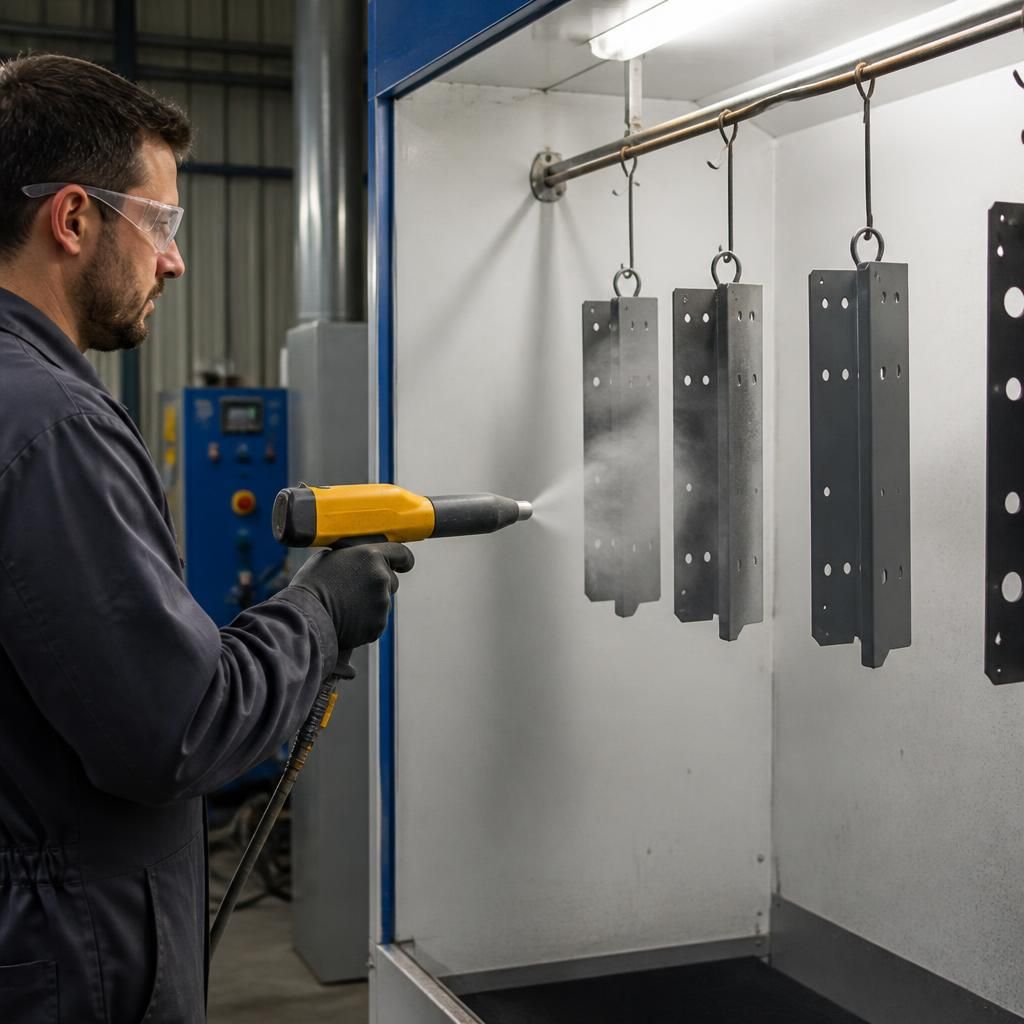
A small powder coating system can be a lower-risk starting point when future demand is uncertain, provided its capacity can be expanded or supported later. Before choosing this approach, check whether the booth, curing equipment, extraction and electrical supply can accommodate additional capacity. A low initial purchase cost may become poor value if the first installation has to be replaced rather than extended.
Where modular expansion is practical, a business can match investment to proven workload instead of paying for unused capacity from the outset. The comparison should therefore include not only today’s operating cost, but also the cost and disruption of adding capacity if production volumes, component sizes or coating requirements change.