

How does powder coating preparation affect the longevity and performance of the finish?
Powder coating preparation directly affects finish longevity and performance by removing contamination, corrosion and existing coatings so the powder can bond consistently to the metal substrate. Effective preparation helps reduce adhesion failure, premature corrosion and surface defects, while correct curing completes the coating’s required durability and protective properties.
Powder coating preparation affects longevity and performance by controlling the condition, texture and geometry of the metal before application. A well-prepared substrate gives the coating a consistent foundation, allowing it to withstand handling, weathering, abrasion and normal service stresses more effectively. Preparation cannot compensate for an unsuitable powder, incorrect application or inadequate curing, but poor preparation can limit the performance of an otherwise suitable coating system.
Surface condition determines coating consistency. Metal parts rarely present a perfectly uniform surface. They may contain mill scale, weld discolouration, sharp edges, pores, machining marks or residues from fabrication. If these features are not addressed appropriately, the finished coating may vary in thickness and appearance across the same component. Localised thin areas, pinholes or uneven coverage can become weak points during service, particularly on edges, corners and recessed areas.
The preparation method also affects the physical key available to the powder coating. Abrasive preparation can create a controlled surface profile that helps the applied film remain securely attached to the substrate. However, excessive blasting can roughen the surface unnecessarily, alter dimensions or leave abrasive media embedded in the metal. Insufficient preparation may leave an unsuitable surface profile. The correct balance depends on the metal, the condition of the component and the coating specification.
Different metals require different preparation decisions. Steel, galvanised steel, aluminium and other substrates do not respond identically to blasting, cleaning or chemical pre-treatment. A process suitable for one material may be too aggressive or chemically inappropriate for another. For example, aluminium components may require careful handling to avoid distortion or an excessively coarse finish, while galvanised surfaces may need treatment that accommodates the existing zinc layer. Matching the preparation process to the substrate helps maintain the material’s integrity and supports predictable coating results.
Fabrication details can have a disproportionate effect on service performance. Welds should be assessed for spatter, sharp transitions and residues, while drilled holes, folded sections and enclosed profiles need consideration for access and drainage. Sharp external edges can receive less coating than broad faces, and narrow gaps can retain process residues or moisture. Smoothing unsuitable edges, correcting fabrication irregularities and designing effective drainage paths can therefore improve coverage in areas that are especially vulnerable to early deterioration.
Preparation also protects dimensional and functional accuracy. Powder coating adds a measurable film to the component, so preparation and masking must account for threads, bearing faces, bores, mating surfaces and close-tolerance interfaces. If these areas are not protected or specified correctly, the finished part may require additional machining, fail to assemble correctly or operate with unwanted friction. Suitable masking and handling preserve the features that must remain free of coating without compromising the surrounding finish.
Pre-treatment selection influences more than visual appearance. Where a chemical conversion process is appropriate, it can improve the interface between the metal and the powder system and provide an additional barrier against environmental attack. Its effectiveness depends on correct chemical control, thorough rinsing and complete drying. Residues left on the part can interfere with the coating system, while an unsuitable treatment may reduce rather than improve long-term performance. The process should therefore be selected according to the substrate, intended environment and powder specification.
Consistent preparation supports consistent film performance. Components intended for outdoor, industrial, automotive or construction use may face different combinations of ultraviolet exposure, moisture, pollutants, impact and abrasion. The preparation standard should reflect those conditions. A decorative indoor component may not need the same substrate treatment as a structural or externally exposed part. Where parts are produced in batches, repeatable preparation is particularly important because variation between components can lead to differences in appearance, coverage and service life.
Inspection between preparation and coating is an important control point. The substrate should be checked for remaining fabrication defects, trapped residues, visible oxidation, excessive roughness, damaged areas and masking errors. Components also need to be handled in a way that avoids reintroducing grease, moisture or dirt after preparation. This stage allows unsuitable parts to be corrected before powder is applied, rather than relying on later finishing work to conceal a problem that originated at the substrate.
The practical result is that preparation influences several performance characteristics at once:
- Durability: a stable, uniform foundation helps the coating tolerate impacts, handling and general wear.
- Appearance: consistent preparation reduces visible variation caused by substrate marks, uneven texture or inconsistent coverage.
- Environmental resistance: correctly selected substrate treatment helps the coating system withstand the conditions for which it was specified.
- Dimensional performance: accurate masking and attention to interfaces help preserve assembly and operating tolerances.
- Batch consistency: repeatable preparation produces more uniform results across multiple components.
For these reasons, preparation should be treated as part of the coating specification rather than as a preliminary cleaning task. A suitable service provider should be able to assess the metal, fabrication quality, required finish, component geometry and intended use before selecting the process. For Midlands manufacturers, fabricators, construction firms and automotive businesses, discussing those requirements before components are processed helps ensure that the preparation method supports the required long-term performance.
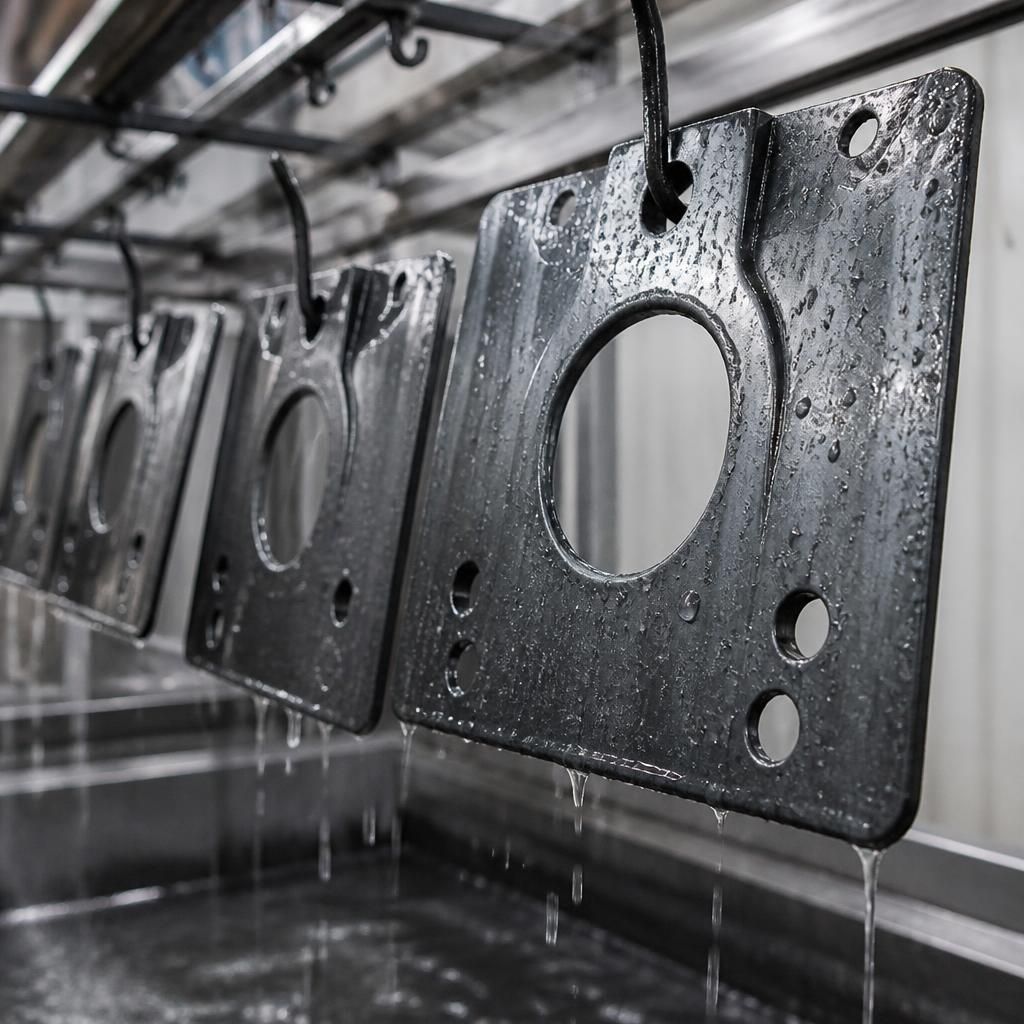
Drying and moisture control during powder coating preparation affect finish longevity because trapped moisture or volatile residues can be released during oven curing. Porous castings, folded sections and enclosed components may retain process liquid even when their external surfaces appear dry. If that material escapes through the coating, it can form pinholes, blisters or localised adhesion defects, interrupting the protective barrier and creating points where deterioration may begin.
Effective preparation therefore includes allowing parts to drain, dry and reach a suitable condition before powder application. Components should be assessed for cavities, overlaps and porous areas that could retain contamination, while the handling process should prevent reintroduction of moisture after cleaning. This is particularly important where the finished part will face outdoor exposure, wash-down, condensation or other conditions that could exploit a small coating discontinuity.