

How can incorrect curing times impact coating performance?
Incorrect curing times can leave powder coating under-cured or over-cured, affecting cross-linking and reducing adhesion, hardness, flexibility, chemical resistance and long-term durability. The result may be visible defects, premature failure or inconsistent performance across coated components.
Incorrect curing time means that the powder film has not spent the required period at the specified metal temperature. The oven’s set temperature and the conveyor’s dwell time do not, by themselves, confirm that the coating has received the correct cure. Actual performance depends on the powder formulation, the component’s material and thickness, the load arrangement and the time taken for the metal itself to reach the required temperature.
Powder coating cures through a chemical cross-linking reaction. During heating, the powder melts, flows across the substrate and develops its final film structure. If the component leaves the oven before this reaction is sufficiently advanced, the film can appear acceptable while remaining chemically immature. This is why visual inspection alone cannot reliably confirm that curing time is correct.
- Insufficient dwell time: Parts may pass through the oven too quickly, or sections of a dense component may take longer to heat than expected. The surface can then be less resistant to handling, solvents and service conditions than the specification requires.
- Excessive dwell time: Keeping the coating at curing temperature for longer than intended can alter its appearance and film characteristics. Depending on the powder chemistry and temperature, this may contribute to colour change, loss of gloss, brittleness or reduced flexibility.
- Uneven dwell time: Parts positioned in different areas of a load may not experience the same thermal history. Some pieces can be adequately cured while others remain outside the intended process window.
A common source of error is treating oven air temperature as the curing time reference. The relevant period normally begins when the metal reaches the powder manufacturer’s specified part-metal temperature, not when the component enters the oven. A thin bracket may reach that temperature quickly, whereas a heavy welded assembly, folded section or thick casting may need considerably longer. If both are processed using one unverified conveyor setting, the coating may not receive equivalent treatment.
Incorrect timing can also create variation within one component. Areas close to thin edges may heat rapidly, while joints, overlapping sections and shielded faces can heat more slowly. Racking can affect airflow and radiant heat, and a heavily loaded oven may recover temperature less effectively after the doors are opened. These factors can produce differences between exposed and sheltered surfaces even when the displayed oven temperature appears stable.
Signs that curing time may be unsuitable include inconsistent gloss or colour, a finish that marks during handling, poor resistance during solvent testing, and differences between parts processed in separate loads. These observations are indicators rather than a complete diagnosis. Contamination, poor preparation, incorrect film thickness, unsuitable powder storage or inadequate temperature control can cause similar symptoms, so the curing schedule should be assessed alongside the rest of the coating process.
A reliable investigation should establish the actual thermal profile of representative components. Temperature probes attached to the metal can show:
- how long the part takes to reach the specified curing temperature;
- how long it remains within the required curing range;
- whether different faces, thicknesses or positions receive different exposure; and
- whether the process remains consistent when the load or racking arrangement changes.
The measured profile should then be compared with the powder supplier’s technical data sheet. The cure requirement may be expressed as a particular time at a particular metal temperature, or as an equivalent time and temperature relationship. It should not be replaced with a general oven setting. When a powder specification changes, the cure schedule must be reviewed rather than assumed to remain suitable.
Corrective action may involve reducing conveyor speed, adjusting the oven profile, changing component spacing or separating parts by mass and geometry. If the process has produced suspect work, samples should be assessed using appropriate checks before the batch is released or reprocessed. Re-curing is not automatically suitable: additional heat may affect appearance or material properties, and a coating that has been overheated may not be restored by another oven pass.
For repeat production, operators should record the powder specification, component type, film thickness where relevant, oven settings, conveyor speed, load arrangement and profiling results. Establishing a validated schedule for each significant component family makes it easier to identify drift and prevents a change in production conditions from silently changing the coating’s cure. This process control is particularly important for assemblies with substantial differences in metal thickness or complex geometry.
In practice, curing time should therefore be treated as a measured process variable, not simply a timer setting. Confirming the time at temperature on the metal, checking representative parts and retaining clear process records gives a more dependable basis for judging coating performance than relying on oven display values or appearance alone.
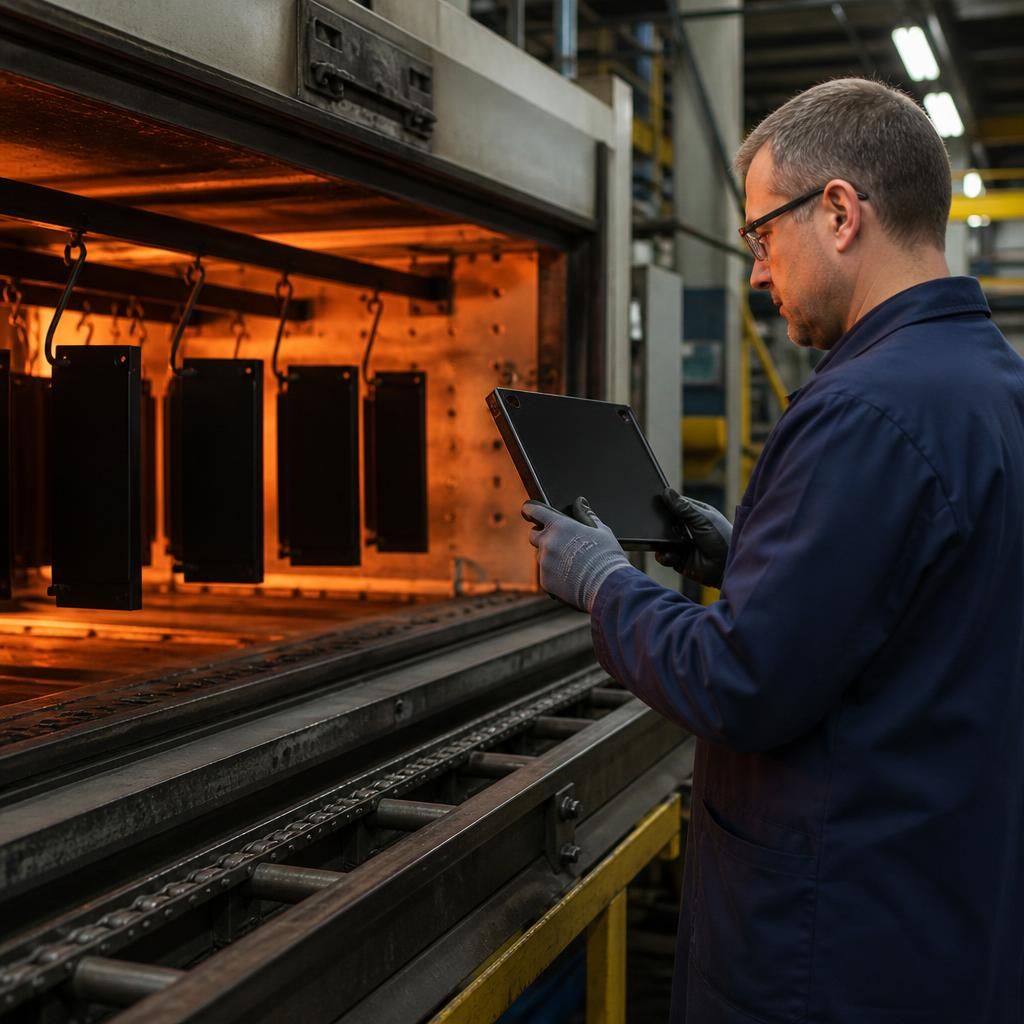
Incorrect curing time can affect a coating’s performance even when the finished surface looks uniform. The polymer network may not have developed sufficiently throughout the film, so the part can behave differently under handling, assembly or service loads than its appearance suggests.
This is particularly important where coated components will be exposed to chemicals, repeated contact or movement. A finish that has not reached its intended cure may deteriorate earlier in use, while excessive heat exposure can reduce the balance of hardness and flexibility required by the component. Cure assessment should therefore consider the coating’s intended service conditions, not appearance alone, and any change to the powder or component design should prompt a review of the established process.