

How does the surface cleaning process enhance the quality and durability of powder coating?
Surface cleaning removes oil, grease, dirt, rust and other residues that can interfere with powder adhesion. By creating a suitably clean, active metal surface, it supports a more consistent finish and helps the coating resist premature peeling, corrosion and wear.
Surface cleaning is a controlled preparation stage that makes metal chemically and physically suitable for powder coating. Its effect goes beyond removing visible dirt: it establishes a consistent surface condition so the powder can wet, form an even film and remain securely bonded throughout the component’s service life.
A clean surface provides more predictable coating behaviour during application. Powder particles need to melt and flow across the metal without being disrupted by residues, moisture or localised changes in surface condition. Where preparation is inconsistent, the same coating material may produce different results on one component, including variations in gloss, texture, coverage and film formation. Thorough cleaning reduces these local differences and supports a more uniform appearance across individual parts and production batches.
The process also affects the way the coating behaves at detailed areas. Holes, corners, folds, welds and recesses can retain contaminants or cleaning residues if they are not properly treated, rinsed and dried. These areas are often more vulnerable to coating defects because powder may be applied unevenly or because trapped material can interfere with the coating as it cures. Effective preparation ensures that the whole component, rather than only its broad flat faces, is ready for coating.
Surface condition influences wetting, which is the ability of the molten powder to spread across the metal. A suitably prepared surface allows the coating to flow into a continuous film rather than pulling away from isolated areas. This helps reduce defects such as cratering, fisheyes, pinholes and local areas of poor coverage. The result is not simply a better visual finish; a continuous film gives the component a more stable protective barrier during use.
Cleaning can also improve the consistency of subsequent pretreatment stages. Depending on the metal and the required finish, a prepared component may receive a conversion or other chemical treatment before powder is applied. Such treatments work more consistently when the metal surface is free from interfering material. If residues remain, the treatment may be uneven, which can create differences in surface reactivity between adjacent areas. Controlled cleaning therefore helps create a reliable foundation for the complete finishing system.
The method used must be suitable for both the substrate and the type of contamination present. Steel, galvanised steel, aluminium and other metals do not respond identically to chemicals, abrasion, heat or moisture. A process that is appropriate for one substrate may dull, etch or otherwise alter another. The cleaning specification should therefore consider the metal grade, existing surface condition, component geometry and the performance requirements of the finished part.
Preparation is not complete when the cleaning agent has been applied. A robust process normally includes appropriate rinsing, drainage and drying controls. Remaining chemicals, salts or moisture can become trapped beneath the powder and cause defects during heating or later service. Drying is particularly important around joints, folded sections and drilled holes, where retained moisture may not be obvious during a visual inspection.
Good process control links cleaning to the later coating stages. Relevant checks may include:
- confirming that the selected cleaning method is compatible with the substrate;
- checking that components are fully wetted and treated, including edges and recessed areas;
- monitoring the condition and concentration of process solutions where chemical cleaning is used;
- ensuring rinsing removes process residues rather than transferring them across the component;
- verifying that parts are dry before powder application; and
- inspecting the prepared surface for remaining marks, residues, moisture or damage.
These controls help prevent preparation-related defects from being mistaken for problems with the powder or curing schedule. If a coating fault appears, the cause may lie in the condition of the metal before application, the cleaning sequence, drying, application or oven curing. Treating cleaning as a defined process makes it easier to identify and correct the actual cause.
For manufacturers and fabricators, consistent cleaning is especially important when components are produced in batches or assembled from different fabrication operations. Cutting fluids, forming lubricants, weld residues and handling marks can leave different surface conditions on parts made from the same material. A controlled preparation stage reduces this variation and gives the coating process a more repeatable starting point.
In practical terms, surface cleaning enhances powder coating quality by improving consistency at every stage: the metal is presented in a controlled condition, pretreatment can perform more evenly, the powder can form a continuous film, and the finished component is less likely to develop preparation-related defects. The most durable result comes from treating cleaning, rinsing, drying, powder application and curing as one connected finishing system rather than as separate operations.
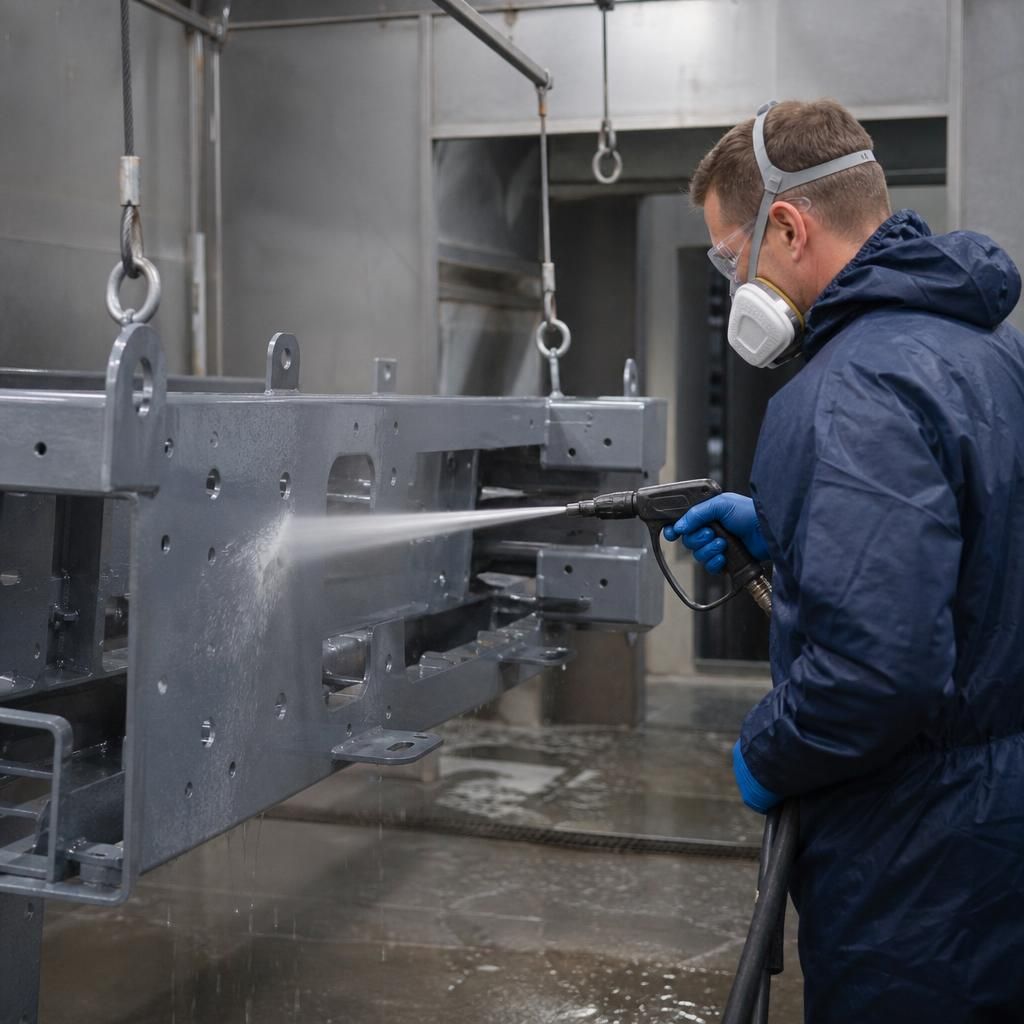
Surface cleaning improves durability by removing the weak boundary layer between the metal and the powder coating. Oils, soluble salts and fine fabrication residues can remain beneath an apparently sound finish, preventing reliable contact at the interface. When moisture reaches these areas, the coating may lose adhesion locally and corrosion can develop beneath the film.
Preparing the surface thoroughly before coating helps the finish remain bonded when components are exposed to handling, condensation, outdoor conditions or industrial use. This is particularly important at welds, joints, edges and other areas where residues can concentrate. The quality of the metal-to-coating interface therefore has a direct influence on how well the finished part retains its protective function over time.
Discuss Your Powder Coating Surface Preparation Requirements
Discuss your component’s substrate, geometry, existing contamination and required service conditions with our powder coating specialists to establish a suitable surface cleaning specification. Share your preparation requirements for informed advice on the next stage of the finishing process.