

How do pretreatment chemicals improve the adhesion and longevity of powder coatings?
Pretreatment chemicals clean metal surfaces and create a chemically suitable conversion layer, helping powder coating bond consistently rather than adhering to oil, scale or other contaminants. This stronger interface reduces the risk of peeling and under-film corrosion, extending the service life of the finished coating.
Pretreatment chemicals improve powder coating performance by modifying the metal surface at the interface where the coating must remain attached. They promote chemical compatibility between the substrate and the cured powder film, inhibit corrosion beneath the coating and make the result less sensitive to normal variations in handling and exposure.
They improve interfacial bonding. A powder coating does not bond to metal through one mechanism alone. During curing, the resin flows across the prepared surface and forms an interface with it. A suitable pretreatment can increase the surface’s chemical receptiveness, allowing stronger interaction between the conversion layer and the coating system. This is more dependable than relying solely on the physical grip of the coating film.
The conversion layer is also designed to remain sufficiently thin and uniform. If it is poorly formed, excessively heavy or damaged during subsequent handling, it may become a weak boundary between the metal and the powder coating. Correct chemical concentration, contact time, temperature and rinsing are therefore important to the final bond, not just to the cleaning stage.
They help control the way corrosion develops. A coated component can be exposed to moisture, salts, pollutants and changes in temperature. If corrosion begins at a cut edge, scratch, drilled hole or area of incomplete coverage, it can spread beneath the surrounding film. Pretreatment provides an additional barrier and, depending on the chemistry, can reduce the electrochemical activity of the metal surface. This slows the movement of corrosion from local damage into otherwise sound coating.
This matters particularly for fabricated components, where joints, recesses, edges and areas affected by forming or machining can behave differently from broad, flat faces. A consistent pretreatment helps give these areas a more uniform basis for coating, although it cannot compensate for poor design, trapped contamination or inadequate powder coverage.
They support longer-term film stability. Adhesion is not only assessed immediately after curing. A coating may remain attached during repeated wetting and drying, temperature changes, impact, abrasion or outdoor exposure only if the substrate interface stays stable. Pretreatment reduces the likelihood that moisture will exploit microscopic weaknesses between the metal and the cured film. By limiting under-film reactions, it helps preserve the film’s protective and decorative function over its service life.
Different metals require different chemical approaches because aluminium, galvanised steel, mild steel and other alloys do not form the same surface oxides or react in the same way. A treatment suitable for one substrate may produce an ineffective, excessively reactive or visually inconsistent surface on another. The chosen process should therefore reflect the alloy, the condition of the incoming material and the expected exposure of the finished part.
The process must be controlled as a complete sequence. Chemical pretreatment is normally part of a series of stages rather than a single application. A typical sequence may include:
- degreasing or alkaline cleaning to remove oils, workshop residues and handling contamination;
- rinsing to prevent residues from carrying into later stages;
- acidic treatment where required to remove oxides, scale or other inorganic contamination;
- application of a suitable conversion treatment;
- further rinsing or conditioning as specified by the process; and
- drying without recontaminating the prepared surface before powder application.
Each stage affects the next. Incomplete cleaning can prevent the treatment from contacting the metal evenly. Excessive cleaning or etching can alter dimensions or surface appearance. Insufficient rinsing can leave residues that interfere with adhesion, while poor drying can introduce water into the coating process. These interactions explain why chemical selection alone does not determine performance.
They reduce common coating failures at the interface. Inadequate or unsuitable pretreatment can contribute to blistering, flaking, edge corrosion, filiform corrosion on susceptible substrates, poor resistance after scratching and inconsistent results between batches. The visible defect may appear in the powder film, but the underlying cause can be a contaminated, over-etched or chemically unstable metal surface.
Good preparation also helps distinguish coating defects from substrate-related problems. If panels or components are tested after pretreatment and curing, checks such as cross-cut adhesion, impact resistance, water exposure and corrosion testing can show whether the failure occurs within the powder film, at the interface or in the metal itself. The appropriate test depends on the substrate, coating specification and intended service conditions; no single test represents every real-world exposure.
They make the coating result more repeatable. Powder coating involves several variables, including part geometry, substrate condition, film thickness, curing temperature and handling. A controlled pretreatment reduces the influence of surface variability before powder is applied. This is especially useful for batches containing parts from different fabrication stages, provided the chemical process is monitored and the components enter it in a consistent condition.
In practical terms, pretreatment should be selected by considering the metal type, contamination present, required corrosion performance, coating system, part geometry and operating environment. The process supplier’s technical instructions should define working concentration, temperature, contact time, rinsing requirements and permissible bath variation. Monitoring these parameters and recording changes helps identify whether a deterioration in adhesion results from chemistry, application or curing.
Pretreatment is not a substitute for sound powder coating practice. The coating still needs correct application, adequate coverage and a cure appropriate to the powder system and component mass. Likewise, pretreatment cannot correct oil trapped in seams, inaccessible corrosion, unsuitable joint design or contamination introduced after treatment. Its value is greatest when it forms part of a controlled preparation and coating process.
For Midlands manufacturers, fabricators and other businesses coating metal components, the practical conclusion is that pretreatment should be specified as part of the coating system rather than treated as a preliminary wash. The right chemistry creates a stable interface, limits corrosion activity and improves repeatability, giving the powder film a sounder basis for maintaining adhesion and protective performance in service.
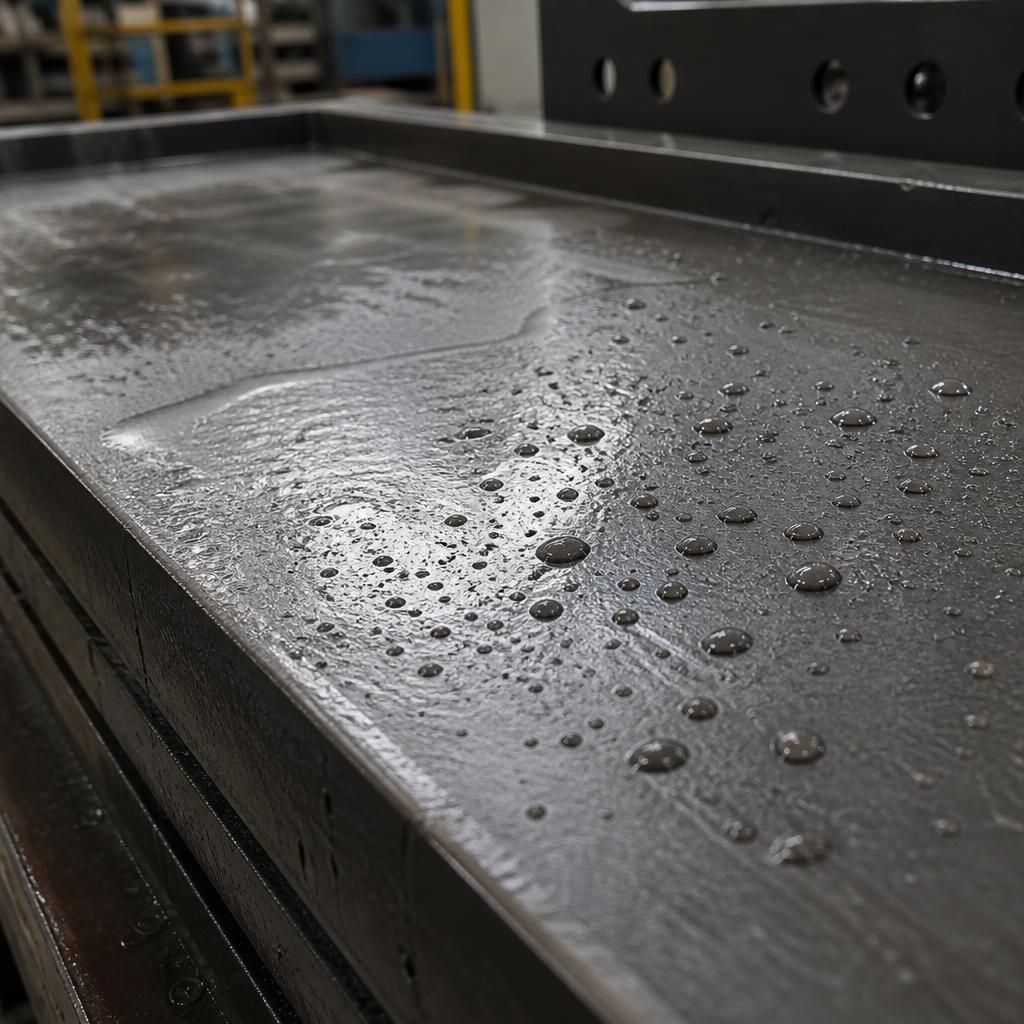
A useful check after cleaning is whether water forms a continuous film across the metal rather than retracting into beads. Beading can indicate residual oil, grease or other hydrophobic contamination, showing that the surface may not be ready for a conversion treatment or powder application. This check is an indication of surface cleanliness, not a replacement for controlled chemical parameters or substrate-specific testing.
Checking the surface at this stage helps prevent a preparation fault from being mistaken for a powder or curing fault. It is particularly relevant when components have passed through machining, fabrication or handling, as contamination can be reintroduced after the main cleaning stage. The result should be considered alongside process records and the coating specification before the parts proceed.