

How does shot blasting improve the durability of powder-coated surfaces?
Shot blasting improves powder-coated surface durability by removing rust, mill scale and other contaminants while creating a keyed surface for the powder coating to bond to. This stronger mechanical adhesion helps reduce peeling, flaking and premature coating failure during service.
Shot blasting improves the durability of a powder-coated surface by making the preparation stage more consistent and giving the coating a sound, uniform foundation. This helps the finished system withstand handling, impact, abrasion, moisture and general industrial service more reliably than powder coating applied to an inadequately prepared component.
Durability depends on the complete coating system rather than the powder alone. A properly controlled blast can produce an even surface condition across the component, including areas where residues, oxidation or uneven texture might otherwise lead to localised coating weakness. Consistent preparation supports more uniform powder coverage and reduces the risk of isolated defects developing into larger areas of coating failure.
The blasting process also affects how the coating performs at vulnerable features. Corners, welds, apertures and transitions between different sections of a fabrication can experience greater mechanical stress or collect moisture during service. Careful preparation of these areas helps the powder coating form a more continuous protective layer, provided the part is designed, blasted, coated and cured appropriately.
Several process controls determine whether shot blasting contributes positively to long-term performance:
- Media selection: the type and size of abrasive should suit the substrate, component thickness and required surface condition. An unsuitable medium can leave an inconsistent finish, embed particles or damage a delicate part.
- Blast intensity and angle: pressure, stand-off distance and nozzle movement must be controlled. Excessive treatment may distort thin sections or create an unnecessarily coarse surface, while insufficient coverage can leave areas with a different preparation standard.
- Complete and even coverage: complex fabrications need particular attention around joints, recesses and internal edges so that the coating system does not rely on untreated or poorly prepared areas.
- Clean handling after blasting: prepared metal should be protected from new contamination and unnecessary contact before powder application. Damage or contamination introduced between the two stages can reduce the benefit of the preparation work.
- Powder application and curing: correct film build and the specified cure schedule remain essential. Shot blasting cannot compensate for under-cured powder, excessive thickness, inadequate coverage or a powder formulation unsuited to the service environment.
The practical benefit is greatest where components face repeated handling, contact, vibration, outdoor exposure or abrasive conditions. For example, a fabricated steel part used in an industrial setting may need a coating system that remains intact around edges and high-contact areas rather than one that simply looks uniform when first inspected.
Inspection should therefore consider the whole process. A coating specialist may assess the blasted condition, check that the powder has been applied evenly, and verify that curing and handling have not introduced defects. The required standard will vary with the metal, component geometry, operating environment and expected exposure. Shot blasting is an important contributor to durability, but reliable results come from matching the preparation method with the powder system and the component’s intended use.
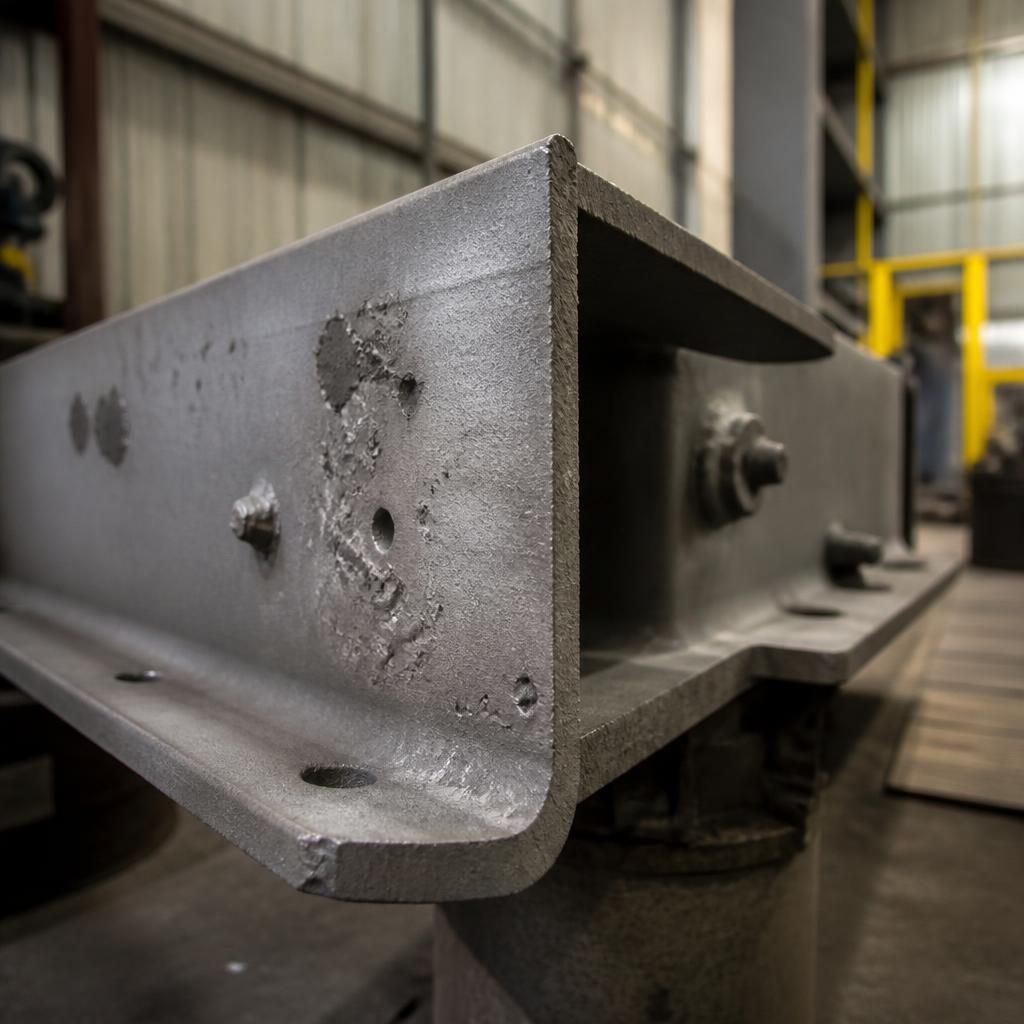
Shot blasting can also improve durability by revealing substrate defects before powder is applied. Pitting, weld spatter, sharp edges and surface laminations may be hidden beneath rust, scale or old coatings, but become easier to identify after blasting. These issues can then be corrected or assessed before coating, reducing the risk of weak spots, premature edge failure or visible imperfections being sealed beneath the finished surface.
Ask About Shot Blasting for More Durable Powder-Coated Surfaces
If you are assessing a metal component for powder coating, discuss its substrate, geometry and service environment with a shot blasting and powder coating specialist. This helps establish whether the proposed preparation and coating system are suitable for the durability required.