

How do I choose the right shot blasting media for different types of metal components?
Choose shot blasting media according to the metal’s hardness, component geometry, existing coating and the surface profile required before finishing. Use a sufficiently aggressive medium for robust steel components, but a finer or softer option for aluminium, thin sections and detailed parts to avoid distortion, excessive roughening or embedding abrasive in the surface.
The right shot blasting media is selected by matching the abrasive’s shape, hardness and size to the component’s material, thickness, geometry and required surface finish. Heavy steel fabrications may tolerate an angular, high-cutting abrasive, whereas aluminium, stainless steel, thin sections and precision parts generally need a less aggressive medium and tighter process control.
Start with the component material
- Carbon and mild steel: Steel shot, steel grit or aluminium oxide can be suitable, depending on whether the priority is efficient scale removal, a pronounced anchor profile or a cleaner cosmetic finish. Angular grit cuts into the surface and is useful for firmly attached mill scale and corrosion. Steel shot produces a more controlled, rounded impact and can be preferable where excessive cutting is undesirable.
- Cast iron: Castings can contain sand, mould residue and irregular surface contamination. A durable angular abrasive is often appropriate, but the grade should be chosen carefully around thin walls, sharp edges and machined faces. Excessive blasting can expose casting defects or alter dimensions at vulnerable areas.
- Aluminium: Aluminium is relatively soft and can become distorted, peened or embedded with unsuitable media. Fine aluminium oxide, glass bead or another non-ferrous-compatible abrasive may be more appropriate than conventional steel grit. Lower impact energy and careful nozzle control help preserve the component’s shape and avoid an unnecessarily coarse finish.
- Stainless steel: Use media and equipment that will not introduce free iron or other contaminants onto the surface. Dedicated non-ferrous or stainless-compatible media can reduce the risk of later staining and preserve the intended appearance. Glass bead may be selected where a more uniform satin finish is required rather than a deeply cut profile.
- Zinc-coated or other sensitive metals: Abrasive selection must account for the coating’s thickness and purpose. A harsh medium can remove protective layers unevenly, particularly at edges and welds. If the coating is to remain, a controlled low-aggression process may be needed; if it is being removed, the abrasive and operating conditions should be agreed around the underlying metal.
Choose the media form as well as the material
Angular media, such as grit or aluminium oxide, cuts and creates a more pronounced mechanical key. This is useful where tenacious contamination must be removed or where the subsequent coating specification calls for a defined profile. Spherical shot impacts the surface rather than cutting deeply, giving a more uniform treatment and generally producing less sharp surface texture. Bead media can provide a relatively even cosmetic finish, but it may be unsuitable where a strongly keyed surface is required.
Media size affects both coverage and profile. Coarse particles can remove robust contamination efficiently but may leave an excessively deep or uneven texture on small parts. Fine particles reach recesses and give greater control on detailed components, although they may be less effective against heavy scale. A mixed or staged approach can sometimes be appropriate, but the grades should not be combined without considering separation, reclaim and the consistency of the resulting finish.
Consider geometry and vulnerable features
Component shape is as important as the base metal. Deep corners, drilled holes, threads, slots and folded sections can receive more concentrated impact than broad faces. For these areas, consider a smaller or less aggressive medium, altered nozzle distance and an application method that avoids directing the blast repeatedly at one edge. Masking or protecting machined faces, bearing seats, threads and sealing surfaces may be necessary where dimensional accuracy matters.
Thin sheet, narrow bars and lightly supported assemblies are particularly susceptible to distortion. Large flat panels can flex under blast pressure, while unsupported sections may vibrate and receive an uneven treatment. Components should be supported so that the media can reach the required faces without creating localised over-blasting. Welds and heat-affected areas may also respond differently from the parent metal, so the specification should cover the whole assembly rather than only its largest surface.
Match the profile to the planned powder coating
The blasted surface should be sufficiently clean and keyed for the powder coating system, but not so rough that the coating has difficulty covering peaks and recesses. An overly deep profile can increase coating consumption, create sharp high points and leave valleys that are difficult to inspect. A weak or inconsistent profile can reduce mechanical adhesion, particularly where the component will face impact, abrasion or outdoor exposure.
Where a coating specification gives a target surface profile or preparation grade, that requirement should take priority over a general preference for a particular abrasive. Profile should be checked on representative parts, especially when the batch contains different thicknesses or complex shapes. The blasting process may need separate settings or media grades for different component families rather than one universal choice.
Account for contamination and media transfer
Media must be compatible with the intended finish and must not leave residues that interfere with powder coating. Reclaimed abrasive can accumulate paint fragments, oil, corrosion products or particles from a different metal. This can affect surface cleanliness and may transfer unwanted material between jobs. Segregating media by type and substrate, maintaining suitable filtration and replacing contaminated abrasive are important parts of process control.
Silica-containing products also require particular attention to workplace control and material selection. The choice should be based not only on cutting performance but also on the applicable risk assessment, extraction arrangements and handling requirements. A less hazardous alternative may be preferable where it provides the necessary preparation result.
Use a controlled trial before committing to a full batch
- Identify the substrate, thicknesses, critical dimensions and areas that must be protected.
- Record the contamination or coating to be removed and the surface condition required before powder coating.
- Select a short list of media based on hardness, shape, size, compatibility and cleanliness.
- Blast representative components using controlled pressure, stand-off distance, travel speed and exposure time.
- Inspect the result for profile consistency, distortion, embedded media, edge rounding and contamination.
- Confirm that the prepared surface remains suitable for the specified powder coating and any required inspection standard.
A trial is especially valuable when a component combines heavy and thin sections, includes dissimilar metals or has critical machined areas. The most aggressive abrasive is not automatically the most effective: the best choice removes the unwanted material while preserving geometry, achieving a consistent profile and avoiding contamination that could compromise the following coating stage.
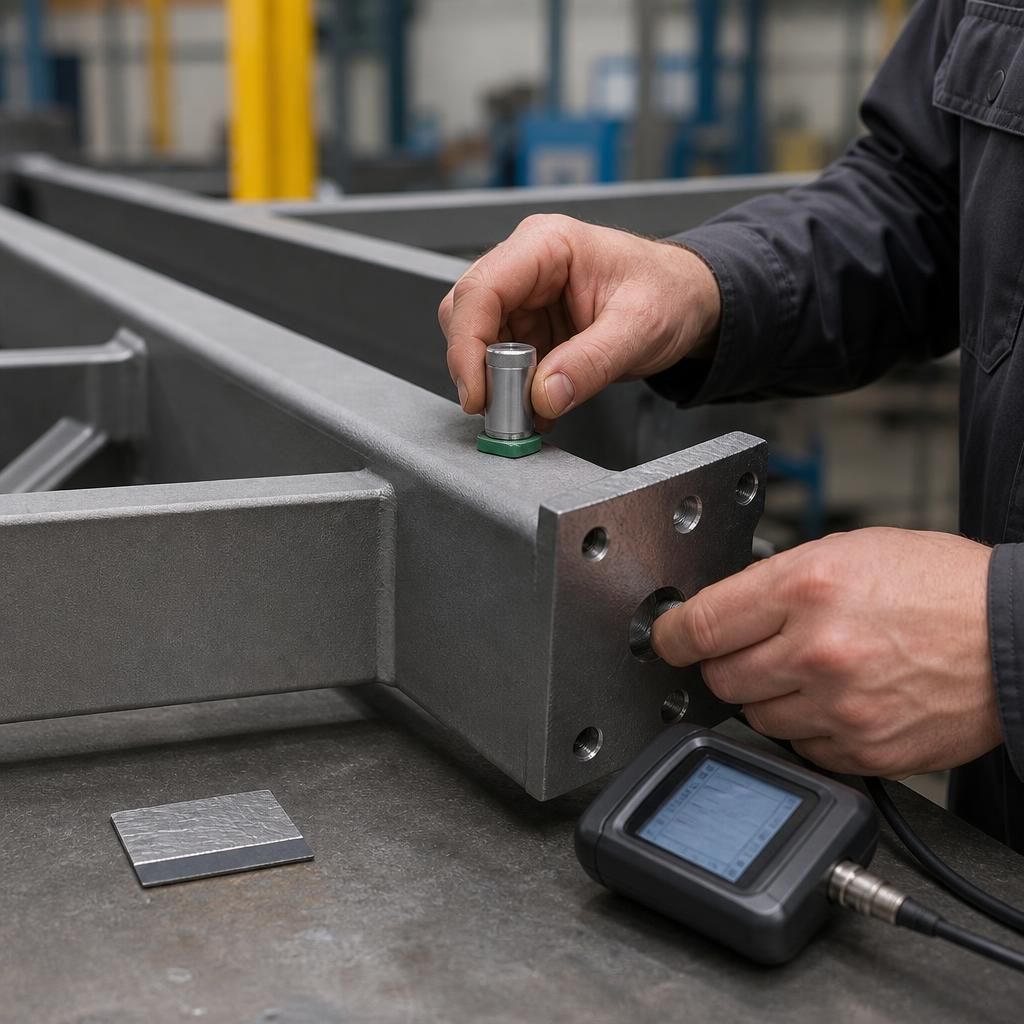
Surface profile should be measured rather than judged by appearance alone when the component has a defined powder-coating specification. Replica tape, a stylus instrument or an appropriate optical method can show whether the selected media is producing a consistent profile across different areas of the part.
Take readings from representative faces, edges and less accessible areas, then compare the results with the coating specification. If the profile varies significantly, adjust the media grade or blasting conditions before processing the full batch. This confirms that the abrasive is creating a suitable key without introducing unnecessary roughness.