

How does the type of shot blasting media affect the powder coating process?
The type of shot blasting media affects how aggressively the metal is prepared, the surface profile created and the cleanliness of the substrate before powder coating. Choosing the right media helps produce a surface that supports consistent coating adhesion, appearance and durability without unnecessarily damaging the component.
The blasting media changes the way energy is transferred to the metal, so it influences how quickly contamination is removed, how much the substrate is altered and what preparation is needed before powder is applied. Its effect depends not only on the media material, but also on particle shape, size, hardness, condition and the blasting settings used with it.
Particle shape is one of the main variables. Spherical shot tends to strike and peen the surface, while angular grit cuts into it. This makes angular media useful where firmly attached scale, corrosion or an existing coating must be removed. Spherical media is generally less cutting and can be more appropriate where the component needs gentler treatment or where a less sharply textured surface is required. Using the wrong shape can either leave contamination behind or remove more base material than necessary.
- Steel shot is rounded and is commonly used on robust ferrous components. It can remove loose scale and contamination efficiently while peening the surface. Because it is ferrous, it is not normally the first choice where iron contamination must be avoided, such as with aluminium, stainless steel or other non-ferrous substrates.
- Steel grit has angular particles that cut rather than simply impact. It is suited to tougher residues and coatings, but its greater cutting action requires care around thin sections, sharp edges, machined features and softer metals.
- Aluminium oxide is a hard, angular abrasive that provides strong cutting action without introducing steel shot into the process. It can be useful for non-ferrous work, although excessive pressure or repeated blasting can alter fine details and edges.
- Glass bead is rounded and generally produces a gentler peening effect. It is often selected where the visual character of the metal matters or where heavy cutting is unnecessary. It is less suitable for removing substantial corrosion or firmly bonded mill scale.
- Mineral or garnet-type abrasives offer angular cutting with low ferrous contamination. They can be considered where the substrate or specification rules out steel media, subject to equipment compatibility and suitable recovery arrangements.
- Plastic media is softer than most mineral and metallic abrasives. It can be appropriate for removing paint or contamination from substrates that could be damaged by harder particles, but it may not provide sufficient cutting action for heavy scale or corrosion.
Particle size affects control as well as removal rate. Larger particles deliver a more substantial individual impact and can deal with stubborn deposits, but they may be unsuitable for narrow recesses, delicate edges or small threaded features. Smaller particles can give more even access to complex profiles and are easier to control on finer components, although they may take longer to remove heavy contamination. A mixture containing worn or inconsistent particle sizes can produce variable results across one batch.
Media hardness must be matched to the substrate. A hard abrasive can cut effectively into steel, but may mark aluminium, distort a thin panel or soften a precisely machined edge. Softer media reduces that risk but may not remove the existing surface condition adequately. The choice should therefore consider the metal grade, thickness, hardness, geometry and any tolerances that must be retained after preparation.
Media can also affect features that are easy to overlook. Threads, holes, mating faces and masked areas may collect abrasive particles or dust. Sharp edges may receive more direct impact than recessed faces, while corners can become visually different from broad flat areas if the nozzle angle and dwell time are not controlled. Components with several materials or inserts may require more than one preparation method, or careful masking before blasting.
The condition of the media matters as much as its original specification. Reusable metallic and mineral media gradually break down into smaller particles and dust. Worn media can alter the treatment from one batch to the next, while contaminated or poorly separated media can transfer oil, paint residue, rust or unwanted metal particles to the workpiece. Regular inspection, screening and replenishment help maintain consistent blasting conditions. Media that is suitable for one material should not automatically be reclaimed for another where cross-contamination could be a concern.
Blasting pressure, nozzle distance, angle, traverse speed and exposure time change the result produced by the same media. Increasing pressure does not simply improve preparation: it can increase substrate removal, embedment or distortion. A slower pass gives the particles longer to act on one area, whereas an uneven pass may leave differences that become visible after powder application. For repeat production, these settings should be recorded alongside the media type and size rather than treated as separate variables.
The subsequent powder coating stages also influence the practical choice. After blasting, the component needs to be free from loose abrasive, dust, moisture and residues that could interfere with spraying or curing. Media that leaves embedded particles or a high level of fines may require more thorough cleaning. Masking may be needed to protect contact points, precision faces and threaded areas, particularly where the coating must not affect assembly or electrical continuity.
A sensible selection process usually follows these steps:
- Identify the substrate and any materials that must not be introduced to it.
- Define what must be removed, such as mill scale, corrosion, old paint, welding residue or general contamination.
- Consider the component’s thickness, edges, recesses, threads, tolerances and cosmetic requirements.
- Choose the least aggressive media that can complete the preparation reliably.
- Set pressure, angle, distance and travel speed through a controlled trial rather than relying on media type alone.
- Inspect the prepared surface and check that no abrasive, dust or contamination remains before powder application.
For uncertain or mixed batches, a trial on a representative component or test panel is preferable to selecting media solely from its name. The result should be assessed for removal of the original contamination, preservation of critical dimensions, uniformity across different features and compatibility with the planned powder coating system. This separates the effect of the abrasive itself from problems caused by worn media, unsuitable blasting settings or inadequate post-blast cleaning.
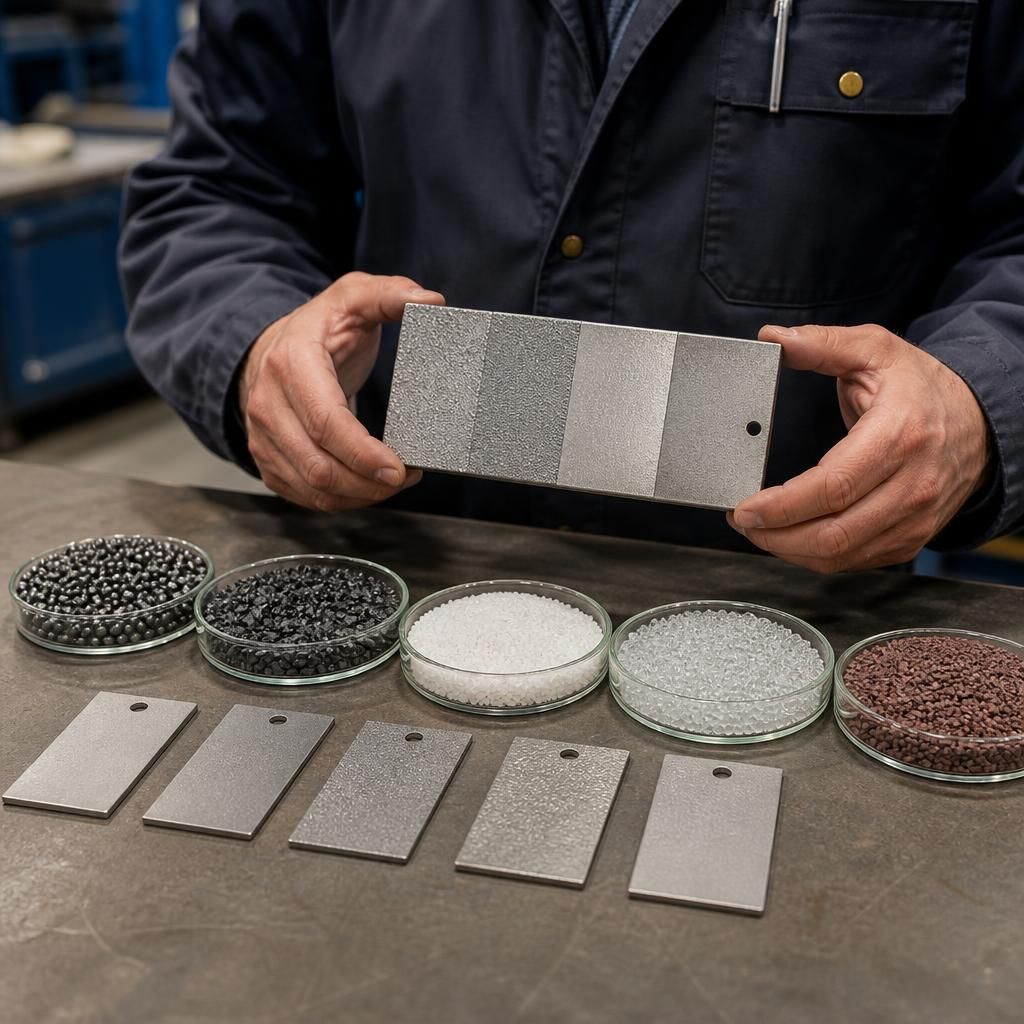
Shot blasting media affects the anchor profile available for the powder coating. Angular abrasives tend to create a sharper, more pronounced profile, while rounded media generally produces a smoother peened surface. The profile should be sufficient for the coating to key to the substrate, but not so pronounced that the powder has difficulty covering peaks and valleys evenly. Selection should therefore take account of the planned coating thickness, the component’s service conditions and the finish required. A suitable test panel can confirm that the chosen media and blasting settings produce a surface profile compatible with the powder coating system.