

What are the key differences between sandblasting and shot blasting when preparing surfaces for powder coating?
Sandblasting propels fine abrasive through compressed air, allowing controlled cleaning and surface profiling, while shot blasting uses spherical metal or mineral shot to remove heavier scale, rust and existing coatings more aggressively. For powder coating preparation, the choice depends on the substrate, contamination, required surface profile and component geometry: sandblasting suits detailed or sensitive parts, whereas shot blasting is often better for robust steel components and high-volume preparation.
The main difference is the way each process delivers abrasive energy to the component. Sandblasting, more accurately described in many industrial settings as abrasive blast cleaning, uses compressed air to project a fine or angular abrasive. Shot blasting uses a wheel or compressed-air system to propel reusable metallic or mineral particles, commonly in a controlled cabinet or automated line. This difference affects the surface profile, cleaning intensity, production method and suitability for the part before powder coating.
Abrasive media and impact
- Sandblasting uses a relatively fine, often angular medium. The particles can reach recesses and provide a controlled etched surface for powder to key into. The abrasive can be selected to suit the substrate and the required finish, although the term “sandblasting” is often used generally even when a different abrasive is specified.
- Shot blasting uses rounded shot or similarly shaped particles. These strike the surface repeatedly and are particularly effective at dislodging mill scale, firmly attached rust, old coatings and other heavy contamination from robust metalwork.
- Angular grit cuts into contamination and the surface, while rounded shot tends to peen and work-harden the outer layer. This can produce a different anchor profile, so the blasting method should be matched to the powder coating system and the metal being treated.
Equipment and production method
Sandblasting is generally suited to manual or semi-automated work where the operator needs to control nozzle position, pressure and exposure around a complex component. It can be used for localised treatment, intricate shapes and parts that need selective cleaning.
Shot blasting is commonly associated with enclosed blast cabinets, tumble systems, wheel-blast equipment or automated lines. These arrangements can process repeat batches efficiently and provide consistent exposure on suitable components. They are less flexible for very large, delicate or awkwardly shaped items unless the equipment is specifically designed for them.
Effect on the metal surface
The correct process must remove contamination without creating a surface condition that compromises the coating. Excessive blasting can alter sharp edges, expose defects, increase roughness beyond the powder manufacturer’s recommended range or affect thin sections. Shot blasting can also be unsuitable for light-gauge metal or parts with vulnerable features if the impact energy is not carefully controlled.
Sandblasting offers more direct control over pressure, stand-off distance and the area being treated. That makes it useful where the operator must protect machined faces, threads, apertures, weld details or other critical features. It is not automatically gentler, however: abrasive type, nozzle pressure, dwell time and operator technique all influence the result.
Suitability by component
- Heavy steel fabrications: shot blasting is often considered where substantial scale, rust or existing coating must be removed from durable steelwork and the component can tolerate the impact.
- Complex fabrications: sandblasting can provide better access and control around corners, welds, brackets, recesses and mixed profiles.
- Thin or sensitive parts: a lower-energy abrasive blasting approach may reduce the risk of distortion or excessive surface change, subject to assessment of the material and part design.
- Repeatable batch components: shot blasting equipment can be advantageous where parts have similar dimensions and can be presented consistently to the blast stream.
- Parts with critical tolerances: the preparation specification should identify surfaces that must be masked, protected or treated separately.
Surface cleanliness is only part of the preparation
Neither process replaces inspection and suitable pre-treatment. After blasting, the component should be checked for remaining rust, scale, paint residues, embedded abrasive, sharp edges and contamination from handling. Dust and loose blast media must be removed before powder application, and the prepared surface should not be allowed to become contaminated by oil, moisture or fingerprints.
Timing also matters. Clean, freshly blasted steel can be vulnerable to flash rust or other surface changes if exposed to unsuitable conditions before coating. The preparation and powder coating stages should therefore be planned as one controlled sequence, with storage and handling arrangements that protect the surface.
How to choose between the two
- Identify the substrate, thickness, hardness and condition of the component.
- Record the contamination to be removed, such as mill scale, corrosion, weld residue or an existing coating.
- Specify the areas that require full preparation and those that have to remain dimensionally or cosmetically protected.
- Define the required surface profile and cleanliness level for the selected powder coating system.
- Consider the component’s size, geometry, batch quantity and ability to fit available blasting equipment.
- Agree how the part will be inspected, cleaned, handled and transferred for coating after blasting.
In practice, the better choice is not determined by the name of the process alone. Media specification, impact energy, operator control, equipment access and post-blast handling all affect the final powder-coated result. A coating provider should be able to assess the metal component and explain why a particular blasting method and abrasive are appropriate for its condition, design and intended use.
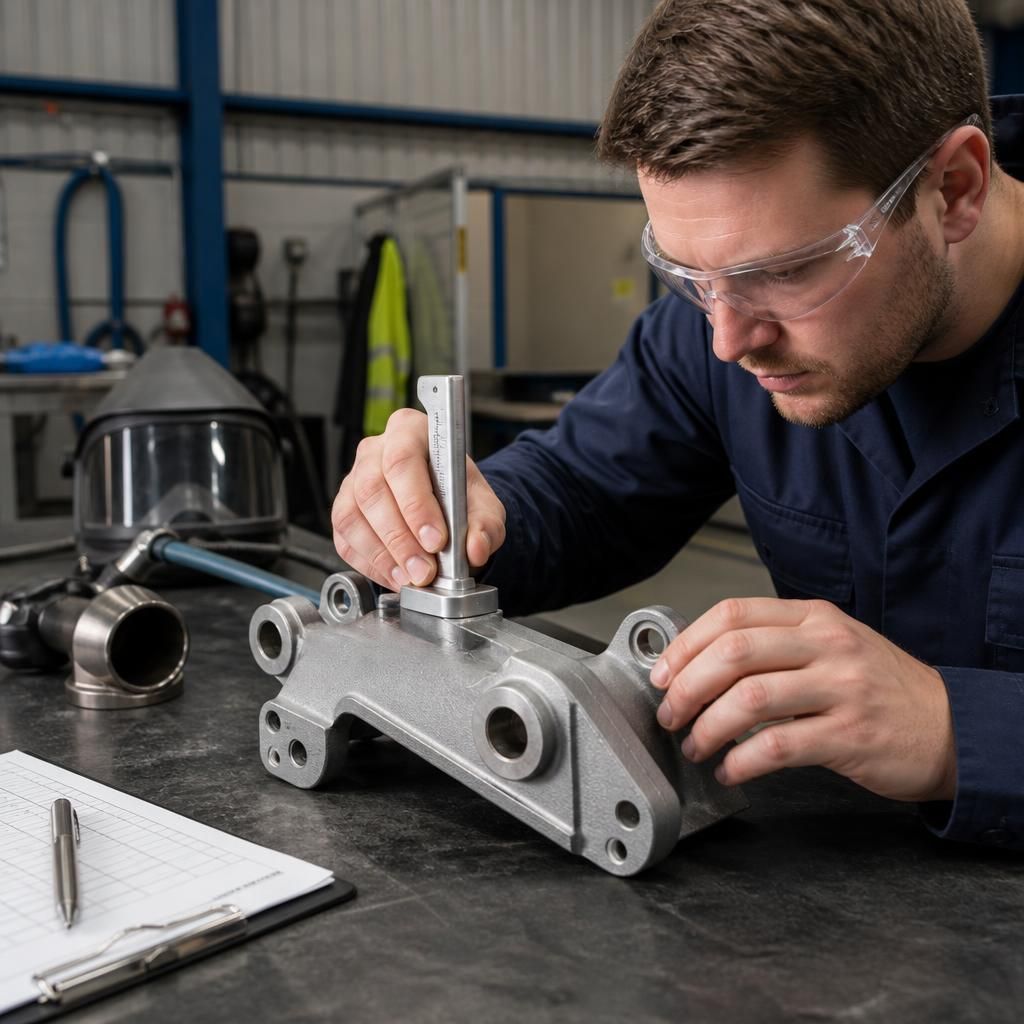
The most reliable comparison is based on the surface each process produces, rather than on the process name alone. Before production work begins, the required cleanliness and surface profile should be agreed with the powder coating specification and checked on a representative area or test piece. Profile measurements can confirm that the blast has created sufficient texture for coating adhesion without producing excessive roughness.
Inspection should also consider embedded abrasive, residual dust, flash rust and areas shielded from the blast stream. These checks are particularly useful when comparing sandblasting and shot blasting on the same type of component, as they show whether the chosen method is delivering consistent preparation across edges, recesses and broad faces. The results can then inform the final blasting settings, masking arrangements and handling procedure before powder is applied.
Discuss Your Sandblasting and Shot Blasting Requirements
Discuss your component’s condition, geometry and required powder coating finish with the team to determine whether sandblasting or shot blasting is the more suitable preparation method. Share drawings, photographs or sample parts where appropriate so the preparation requirements can be assessed accurately.