

How does powder coating thickness affect resistance to corrosion and wear on steel surfaces?
Powder coating thickness affects steel by determining how consistently the finish forms a protective barrier against moisture, chemicals and abrasion. A coating that is too thin may leave weak points vulnerable to corrosion and wear, while excessive thickness can impair adhesion, curing and impact performance; the correct, uniform thickness must therefore match the coating system and service conditions.
Powder coating thickness affects corrosion and wear resistance by controlling the amount of cured material available to shield steel from its service environment and absorb surface damage. However, the relationship is not simply linear: increasing thickness can improve protection where the film is sound, but it cannot compensate for contamination, poor pretreatment, incomplete curing or defects at edges and joints.
For corrosion resistance, the most important benefit of an adequate film is the reduction of pathways through which water, oxygen, salts and chemicals can reach the steel. A very thin or uneven coating is more likely to contain weak spots, particularly over sharp edges, welds, corners, recesses and complex fabrications. Once corrosion starts at one of these points, moisture can spread beneath the coating. This underfilm corrosion may cause blistering, lifting and progressive loss of adhesion, even where the surrounding surface still appears intact.
A thicker film can provide greater tolerance to minor surface irregularities and local damage, but only when the coating has been specified and applied as a suitable system. Corrosion performance also depends on the steel preparation, removal of oil and oxides, conversion treatment or primer where required, environmental exposure and the chemical resistance of the powder formulation. A coating intended for an internal dry environment should not automatically be treated as suitable for persistent condensation, salt exposure or aggressive industrial chemicals simply because it has been applied more heavily.
Thickness has a similar but distinct effect on wear. During abrasion, contact and handling, the coating is gradually removed or damaged. A sound film with sufficient build provides more material before the substrate is exposed, so it can extend the useful life of components subject to rubbing, impact or repeated contact. This is relevant to guards, fabricated equipment, brackets, housings and other steel parts that may be handled during manufacture, installation or service.
Wear resistance is not determined by thickness alone. A softer, thicker film may wear faster than a thinner film formulated for greater hardness or chemical resistance. The type of contact matters as well: sliding abrasion, sharp-particle erosion, repeated impact and scuffing place different demands on the finish. If a component is likely to experience severe abrasion, the coating specification should identify the relevant exposure rather than relying on thickness as a general substitute for material selection.
Excessive build can introduce its own problems. Powder trapped in corners or recesses may produce an uneven surface, while over-application can affect appearance, edge definition and the way the film cures. A heavy or poorly cured film may be more susceptible to cracking, chipping or loss of adhesion when the steel flexes or receives an impact. These defects can expose the substrate and create local corrosion sites, meaning that additional thickness does not necessarily deliver additional protection.
Thickness should therefore be considered alongside the following factors:
- Exposure: moisture, condensation, salt, chemicals, ultraviolet light and temperature changes influence the required coating system.
- Component geometry: edges, holes, welds, internal corners and inaccessible areas can receive a different film build from broad flat faces.
- Substrate condition: rust, mill scale, grease, weld spatter and embedded contamination can undermine the coating regardless of its measured thickness.
- Mechanical duty: abrasion, impact, flexing and assembly contact determine whether hardness, toughness or additional sacrificial material is most important.
- Curing: the powder must reach the specified cure throughout the part; thickness readings alone cannot confirm that the film has developed its intended properties.
For industrial steelwork, the target thickness should be set from the powder manufacturer’s technical information, the pretreatment and primer arrangement, the component design and the expected environment. A single nominal value is not always appropriate for every surface. Thin areas can reduce corrosion protection, whereas isolated heavy areas may affect curing and mechanical performance. The practical objective is a controlled film within the agreed specification, with particular attention to edges and other areas likely to initiate failure.
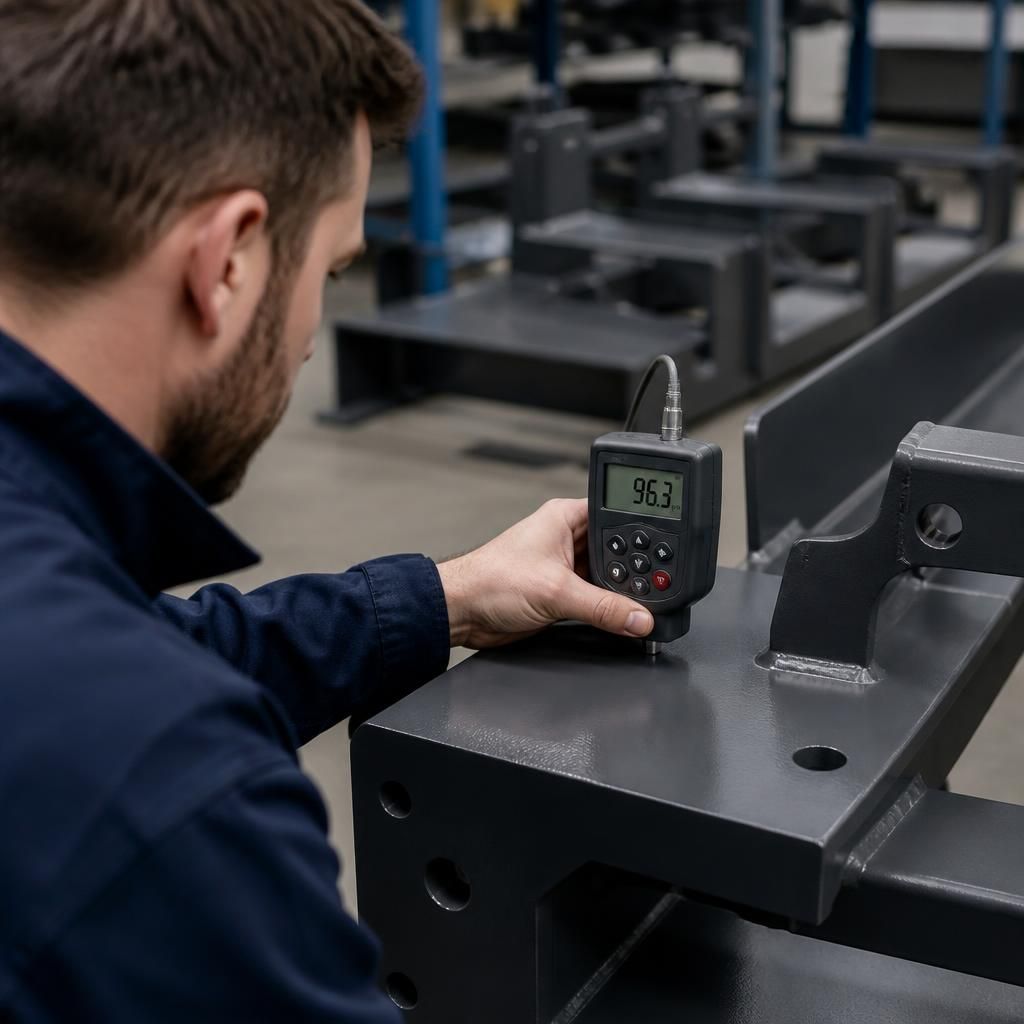
Verification normally involves measuring the dry film thickness after curing with a suitable gauge. Readings should be taken at representative points rather than from one convenient flat area, and results should be assessed against the agreed specification or project requirement. Where corrosion or wear performance is critical, visual inspection should accompany measurement to identify pinholes, inclusions, runs, exposed edges, blistering, poor coverage and impact damage. If a result is outside specification, the cause should be established before adding another coat, since overcoating may create adhesion or curing problems.
In practical terms, the best corrosion and wear performance comes from a compatible coating system applied to properly prepared steel, cured correctly and distributed consistently across the component. Thickness provides the necessary protective build and wear allowance, but its value depends on film continuity, adhesion, formulation and the conditions the steel will face in service.
Steel surface profile can affect how effectively a given powder coating thickness protects against corrosion and wear. After abrasive preparation, the surface contains microscopic peaks and valleys. The coating must cover the peaks continuously; if the applied film is too slight in relation to the profile, these high points may have less protective material and can become vulnerable to early wear or corrosion.
For this reason, coating thickness should be assessed in relation to the prepared surface rather than treated as an isolated number. The preparation method, surface roughness and coating system should be considered when setting the target build, particularly for steel components exposed to moisture, handling or abrasion.