

How does the drying and curing process affect the quality of the final electrostatic coating?
Drying removes moisture and residual chemicals before powder application, while curing melts and cross-links the powder to form its final film. Correct control of both stages is essential for consistent adhesion, appearance, hardness and corrosion resistance; insufficient or excessive heat can cause defects and reduce coating performance.
Drying and curing influence the final electrostatic coating by controlling how cleanly the prepared surface receives the powder and how completely the deposited film develops its intended properties. Drying takes place after pre-treatment and before powder application; curing follows application and establishes the structure of the finished coating. A sound result therefore depends on controlling both stages as separate, measurable operations.
Drying before powder application
After cleaning, rinsing, conversion coating or priming, the component must be sufficiently dry before it enters the spray area. Water retained in seams, folds, threaded holes, boxed sections and other recesses can be released during oven heating. This may produce pinholes, blistering, bubbling or local loss of adhesion. Residual treatment chemicals can create similar problems, particularly where drainage is poor or the component has been handled before it is fully dry.
Drying quality is affected by the component’s geometry, material thickness and position during the drying stage. Parts should be arranged so that liquid can drain rather than collect, with particular attention to enclosed sections and overlapping faces. The drying process must also avoid introducing contamination: contact points, handling equipment and air movement should not transfer oil, dust or other substances back onto the prepared metal.
Where a primer or other pre-treatment has been used, its own drying requirements must be respected. Applying powder over a layer that has not formed correctly can trap volatiles or weaken the interface between the substrate, primer and topcoat. Conversely, excessive heating at this stage may alter the pre-treatment or cause unnecessary oxidation, so the selected process should follow the relevant technical specification.
How curing develops the finished film
In the curing oven, the powder first softens and flows across the component before its resin system reacts to form a continuous film. The coating’s final performance depends on the metal reaching the required curing condition for the required period, not simply on the oven air reaching a stated setting. The component’s actual metal temperature is therefore more relevant than the displayed air temperature.
Heavy fabrications, thick brackets and assemblies with substantial thermal mass take longer to heat than thin sheet or small components. Recesses and shaded areas may also warm more slowly than exposed faces. If the oven cycle is judged only from its air temperature or conveyor setting, different sections of the same load may receive different curing histories. Profiling representative parts helps establish whether the coldest or slowest-heating areas achieve the specified cure.
Effects of insufficient curing
Under-cured powder may look acceptable initially but remain below its intended level of chemical and mechanical resistance. It can show reduced resistance to impact, abrasion, solvents or weathering, depending on the coating system. The film may also be softer or more easily marked, and the bond between coating layers may be weaker. These issues are especially important for components exposed to handling, moisture, industrial contamination or repeated use.
Insufficient curing can result from a low metal temperature, inadequate time at temperature, excessive conveyor speed, poor oven circulation or loading patterns that restrict heat transfer. A cold spot in a complex fabrication may therefore be more significant than a satisfactory reading taken in an exposed area.
Effects of excessive curing
Over-curing can change the colour, gloss or texture of some powders and may make a finish appear dull or uneven. Prolonged or excessive heat can also reduce the coating’s flexibility and affect its long-term appearance. Heat-sensitive substrates, pre-treatments and primers require particular care because their limits may differ from those of the powder itself.
Excessive heat is not a reliable way to compensate for an unsuitable process. The correct approach is to match the oven profile to the powder system, substrate and component design, then verify the result through inspection and process records.
Process controls that support consistent quality
- Confirm that parts are clean and dry before they reach the spray area, including joints, cavities, recesses and drainage points.
- Use the powder manufacturer’s specified curing window as the starting point, while considering the actual metal temperature rather than relying only on oven-air readings.
- Check the effect of component size, thickness, load arrangement and conveyor position on heat-up time.
- Use temperature profiling equipment where component geometry or thermal mass makes the curing cycle uncertain.
- Keep oven airflow, temperature control and conveyor settings consistent, and investigate changes rather than treating them as harmless variations.
- Inspect representative parts for film continuity, colour and gloss consistency, surface defects and the appropriate mechanical or chemical resistance.
For industrial batches, recording drying conditions, oven settings, load configuration and temperature-profile results makes it easier to identify whether a defect originated before powder application or during curing. This distinction matters: pinholes and bubbling may point to retained moisture or volatiles, whereas poor resistance or a soft film may indicate inadequate curing. Treating drying and curing as controlled stages, rather than as simple waiting periods, gives the electrostatic coating a more predictable and durable finish.
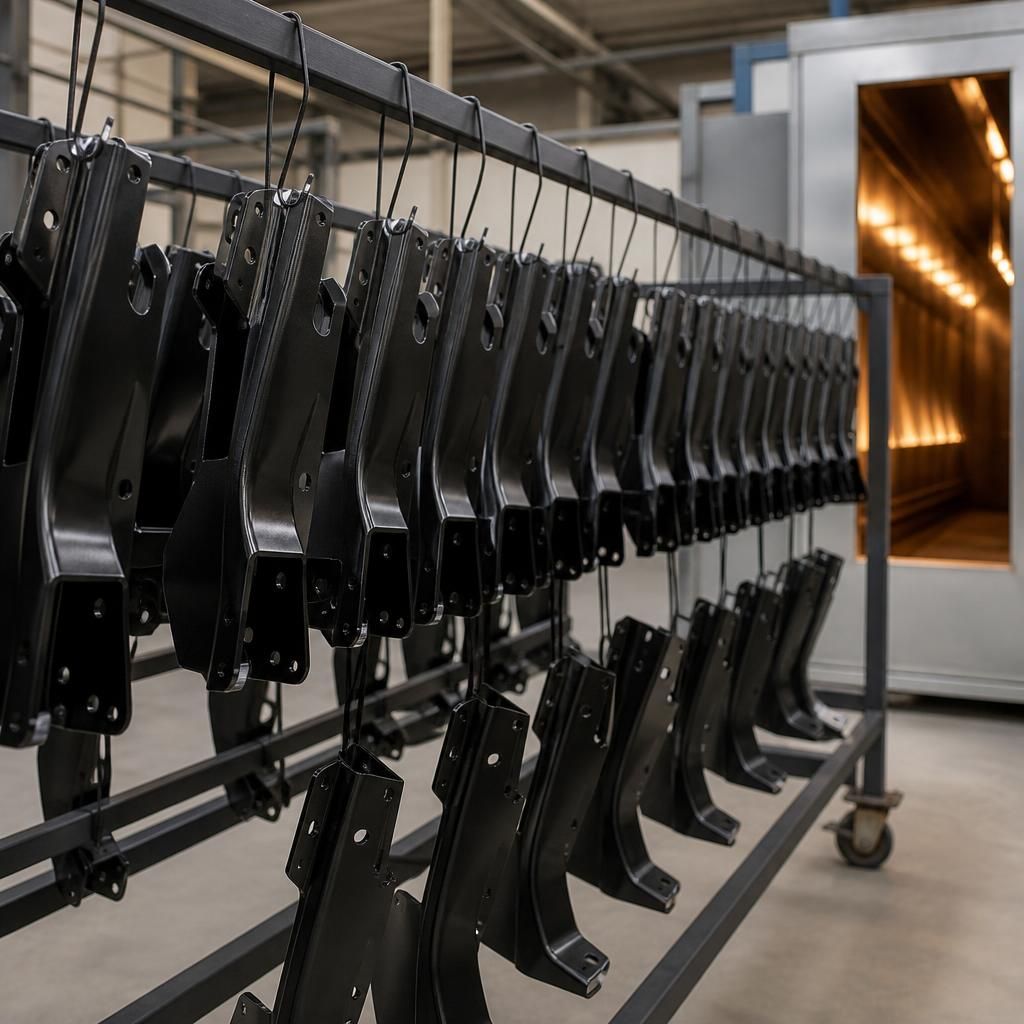
Cooling after the curing stage also affects the final quality of an electrostatic coating. Although the powder has formed its cured film, the coating may still be vulnerable to pressure, abrasion and contamination while it remains hot. Placing components against unsuitable supports or stacking them too soon can create imprints, surface marks or local gloss variation.
Components should therefore be handled in a way that avoids concentrated contact and allows air to circulate around coated faces. Inspection is more reliable once the parts have cooled sufficiently for the finish to stabilise. This final handling stage helps preserve the appearance and surface integrity developed during curing, particularly on large fabrications and parts with visible faces.