

How does the powder coating process ensure long-lasting durability for steel panels?
Powder coating gives steel panels long-lasting durability by preparing the surface properly, applying charged powder evenly and curing it into a bonded protective layer. This continuous finish helps resist corrosion, impact, abrasion and weathering, protecting the steel in demanding industrial environments.
Powder coating gives steel panels long-term durability by forming a chemically cross-linked film that is firmly bonded to a correctly prepared surface. The service life of that finish depends on controlling each stage of the process: panel condition, surface preparation, powder selection, application, curing, inspection and subsequent handling.
Unlike a liquid coating that primarily dries through solvent evaporation, thermosetting powder melts during oven curing and undergoes a chemical reaction. The particles flow together to create a continuous film, then cross-link into a hard, stable coating. This structure helps the finish retain its protective and decorative properties when the panel is exposed to routine handling, moisture, industrial contaminants and changing temperatures.
Durability begins with the steel itself. Oil, grease, mill scale, rust, dust and fabrication residues can prevent the powder from bonding consistently. These contaminants are removed before coating, and the surface is conditioned so that the powder has a clean, receptive base. Welds, cut edges, drilled areas and other fabricated features require particular attention because residues or roughness in these locations can become points of early coating failure.
The powder formulation is selected according to the panel’s intended environment and use. Different coating chemistries provide different balances of hardness, flexibility, chemical resistance, colour stability and exterior performance. A panel used indoors may have different requirements from one exposed to rain, sunlight, condensation or industrial pollutants. Choosing a suitable system is therefore as important as applying it correctly; a coating cannot compensate for a specification that does not match the service conditions.
During application, the powder is attracted to the earthed steel panel, helping it reach faces, recesses and profiles that may be difficult to coat by conventional methods. Application is controlled to produce an even film rather than relying on excessive build to conceal variations. Consistent coverage reduces weak areas while avoiding problems associated with an unnecessarily heavy coating, such as poor flow, trapped defects or incomplete curing.
Curing is a critical control point. The panel must reach the required metal temperature for the specified time so that the powder fully cross-links throughout its film thickness. If the cure is insufficient, the coating may have reduced hardness, adhesion or chemical resistance. Excessive heat or an unsuitable cycle can also affect appearance and performance. For this reason, the curing schedule is matched to the powder system, panel mass and geometry rather than treating every steel component identically.
Several features help a correctly cured coating withstand service conditions:
- Continuous film formation: the fused coating creates a barrier that limits direct contact between the steel and surrounding moisture or contaminants.
- Mechanical resilience: the cured film can tolerate normal handling and service-related contact when the correct formulation and film build have been used.
- Resistance to surface wear: the coating’s hardness and adhesion help it remain intact where panels are subject to rubbing or repeated handling.
- Dimensional coverage: controlled application helps protect broad faces as well as edges, folds and other panel features.
- Colour and appearance retention: a suitable exterior-grade system can help the finish remain stable when exposed to light and weathering.
Quality checks provide evidence that the process has produced a sound finish. These can include visual examination for missed areas, contamination, runs, pinholes, craters and other surface defects, together with checks that the coating is continuous and appropriately built for its specification. Adhesion and cure-related checks may also be used where the project requirements call for them. Inspection is particularly valuable for panels with complex profiles, narrow returns or areas that are difficult to view after coating.
Long-term performance also depends on design and handling after coating. Sharp edges, poorly sealed joints, trapped moisture and direct contact with incompatible materials can expose the finish to stresses that are unrelated to the powder itself. Panels should therefore be stored, packed and installed in a way that avoids abrasion, impact and contamination. Damage caused during fabrication, transport or installation should be dealt with promptly, because a break in the film can provide a route for corrosion beneath the surrounding coating.
In practice, a durable result is achieved by treating powder coating as a controlled system rather than a single spray operation. Correct preparation establishes the bond, the selected powder provides properties suited to the environment, even application creates consistent protection, and the correct cure converts the powder into its final protective film. These controls are what allow coated steel panels to remain serviceable in demanding industrial applications.
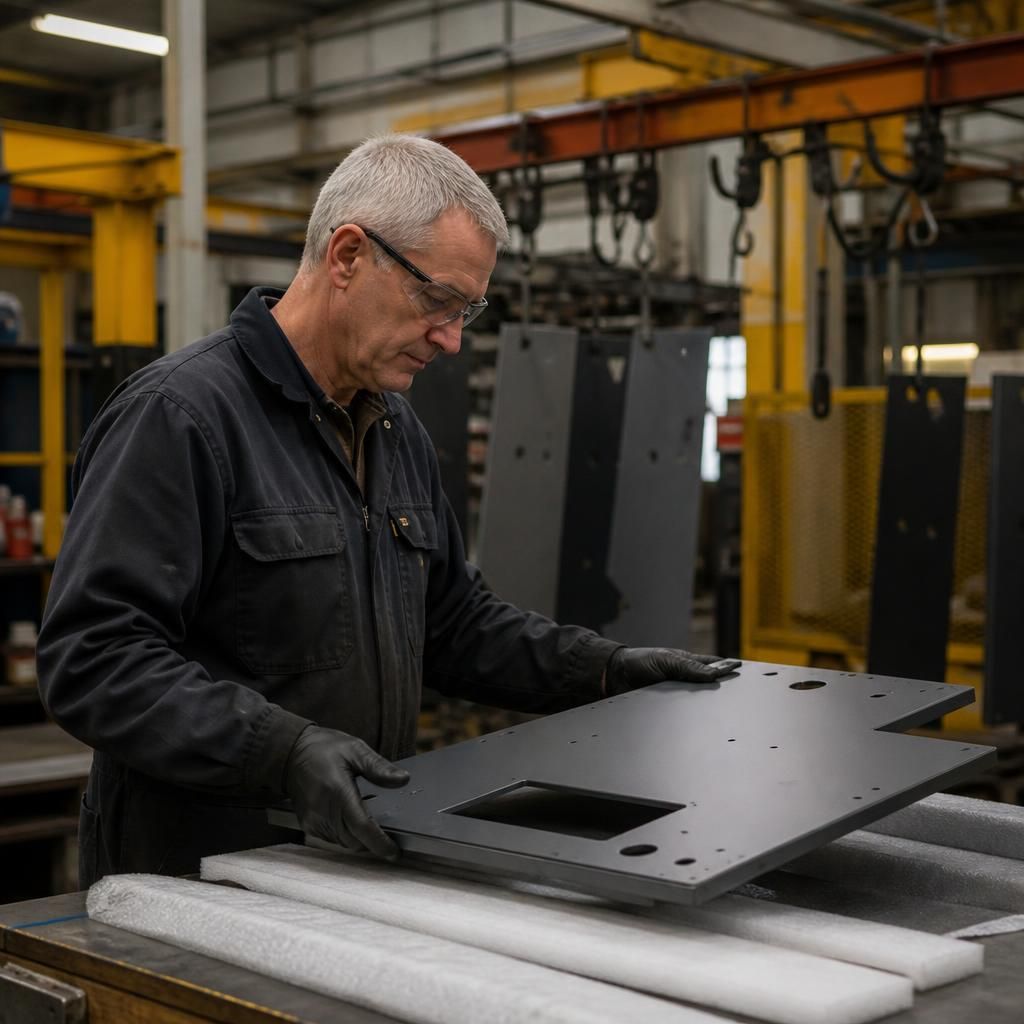
One important factor in the long-term durability of powder coated steel panels is completing fabrication before coating wherever possible. Cutting, drilling, welding or grinding after coating can remove the protective film and expose bare steel, creating a local route for corrosion that the surrounding coating cannot prevent.
For this reason, panel dimensions, apertures, fixings and welded details should be confirmed before the coating stage. If a post-coating modification is unavoidable, the exposed area should be cleaned and repaired using a treatment compatible with the original coating specification. This maintains continuity of protection rather than relying on the powder coating to cover newly created damage.