

How does abrasive blasting enhance powder coating adhesion?
Abrasive blasting enhances powder coating adhesion by removing rust, mill scale, old coatings and other contaminants while creating a controlled surface profile. This textured, clean substrate gives the powder coating a stronger mechanical key, helping the cured finish remain securely bonded to the metal.
Abrasive blasting enhances powder coating adhesion by creating a consistent, chemically clean and suitably keyed surface for the coating system. Its effectiveness depends not only on removing unwanted material, but also on controlling the condition of the substrate afterwards: the profile must suit the powder system, embedded abrasive must be avoided and the prepared metal must remain free from renewed contamination before coating.
It improves adhesion in several ways:
- It exposes sound substrate beneath corrosion, weak surface layers or failing finishes.
- It increases the available surface area at a microscopic level, giving the powder film more area with which to bond.
- It removes loosely attached particles that could otherwise form a weak boundary between the metal and the cured coating.
- It produces a uniform surface condition across complex components, provided the blasting process reaches corners, recesses and other difficult areas.
Mechanical adhesion is only one part of the result. Blasting can also improve the consistency of the metal surface by removing localised oxidation and irregular residues. This is particularly important for fabricated parts, where weld areas, heat-affected zones, handling marks and previously exposed steel may all respond differently to coating if they are not prepared to a comparable standard.
Preparation before blasting is important. Oil, grease and heavy contamination should be removed first. Otherwise, blasting may spread contamination across the surface or drive it into surface depressions rather than eliminate it. A suitable cleaning stage also prevents the abrasive from becoming contaminated and transferring residue to later components. Once blasting is complete, the surface should be handled carefully so that fingerprints, workshop dust and other contaminants do not compromise the prepared metal.
Process control determines whether blasting helps or harms adhesion. Abrasive type, particle size, blasting pressure, nozzle distance, angle and operator technique all affect the resulting surface. Excessive aggression can distort thin sections, round sharp edges or create a profile that is too deep for the powder film to cover properly. Insufficient treatment may leave weak material or uneven areas behind. The correct balance is therefore a controlled, even finish rather than the roughest possible surface.
The abrasive must also be compatible with the substrate and the required finish. Harder media may be appropriate for robust steelwork, whereas softer or less aggressive media can be preferable for aluminium, thin sheet or components where dimensional accuracy matters. Media selection should take account of the risk of embedded particles, galvanic contamination and unwanted changes to the appearance of the metal. Where a specialist coating or corrosion-resistant system is specified, the preparation standard should be agreed with the coating specification rather than selected in isolation.
After blasting, the component should be checked for remaining rust, scale, old coating, abrasive residue and visible contamination. Surface profile can be assessed using an appropriate comparator, gauge or replica method, depending on the specification and component. The surface should also be dry and free from compressed-air oil or moisture. If prepared metal is left exposed for too long, particularly in damp conditions, flash rust or other contamination can develop and reduce the benefit of blasting.
Blasting is not a substitute for correct powder application or curing. The powder must be applied at the specified film thickness, and the coating must reach the required cure schedule for the particular product and substrate. Poor curing, trapped moisture, outgassing from cast or porous components and contamination introduced after blasting can all cause adhesion failure even when the blast preparation itself was satisfactory.
For batch work, repeatability is a central advantage of a controlled blasting process. Components should be assessed for material, previous condition, geometry and intended coating before treatment. A documented preparation approach helps keep the surface condition consistent from one batch to the next and makes it easier to investigate defects such as flaking, blistering or early corrosion. The most reliable outcome comes from treating blasting as one stage in a complete preparation and coating system, not as an isolated cleaning operation.
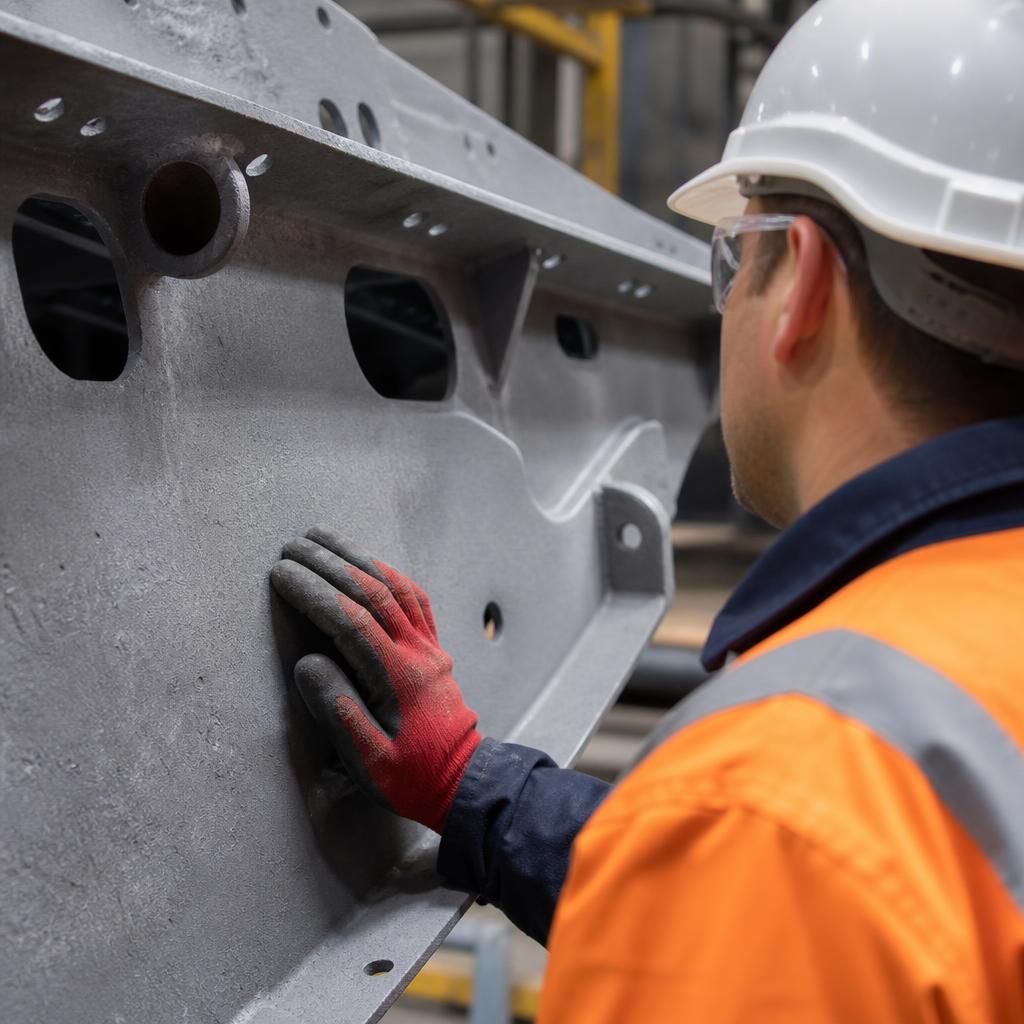
Abrasive blasting can reveal defects in the metal that were hidden beneath rust, scale or an old coating. It does not repair pits, cracks, weld spatter, laminations or sharp burrs, so these issues should be assessed and corrected before powder coating. Leaving them untreated can create thinly covered edges, trapped contamination or small voids where the coating is more vulnerable to damage.
This is why inspection after blasting is important as well as inspection of the blast finish itself. Any required grinding, filling or weld treatment should be completed without introducing fresh oil, moisture or dust. The component can then be prepared again where necessary, ensuring that the surface presented to the powder coating is both suitably profiled and physically sound.