

What factors should be considered when choosing a conveyor powder coating system for specific industrial applications?
Choose a conveyor powder coating system by matching its load capacity, part dimensions, required throughput, material type, coating specification and curing requirements to the application. Also assess pretreatment, powder recovery, line layout, finish consistency, operator safety, future production needs and the total cost of ownership.
Choosing a conveyor powder coating system requires more than comparing conveyor speed or oven size. The system should be assessed as a complete production process, including how parts are loaded, presented, coated, cured, inspected, changed between batches and integrated with existing manufacturing controls. The right choice is the one that supports the required production method without creating avoidable handling, cleaning, quality or maintenance problems.
Part presentation and fixturing
How components are suspended is a central design consideration. Hooks, racks, jigs and purpose-made fixtures must hold each part securely while exposing the surfaces that need coating. They should also minimise shadowing, contact marks and areas where powder cannot reach. The fixture design needs to account for part geometry, drainage during pretreatment and the electrical connection required for powder application.
Consider how often fixtures will be changed, cleaned or replaced. A system designed around one product may be unsuitable where a manufacturer coats several component families. Quick and repeatable fixture changes can reduce handling variation, but only if the loading points and hanging method are compatible with the full product range.
Product mix and colour changeover
Manufacturers coating one powder type in long runs have different requirements from those changing colour, texture or chemistry between batches. The system should therefore be evaluated for cleaning access, separation between powder types and the time and labour involved in changeover. Areas such as guns, hoses, booths, hoppers and reclaim paths need to be accessible enough to prevent contamination between jobs.
If a line handles both light and dark colours, or smooth and textured finishes, the sequence of work may affect cleaning requirements and production planning. A system that makes changeovers difficult can reduce practical capacity even when its nominal conveyor specification appears suitable.
Control and repeatability
The control system should allow operators to set and monitor the process variables that matter for the selected powder and component range. Useful functions may include recipe management, conveyor control, gun settings, oven monitoring, fault indication and production records. Recipes can help standardise repeat jobs, provided they are protected from unauthorised changes and reviewed when materials or components change.
Data capture is particularly valuable where customers require traceability. The business should decide whether it needs records linking a batch to an operator, powder reference, process settings, oven conditions and inspection results. This requirement can influence the choice of controls and whether the system needs to communicate with existing manufacturing or quality software.
Integration with the existing operation
A new conveyor line must work with the stages before and after coating. Assess how parts arrive from fabrication, welding or machining, and how finished components are unloaded, packed or transferred to assembly. Interfaces between processes should not introduce manual lifting, waiting areas or repeated handling that undermines the benefit of mechanisation.
Check the available electrical supply, compressed air, extraction, ventilation and floor loading before selecting equipment. The building may also impose restrictions on access for installation, service or future replacement. These practical constraints should be identified during specification rather than after the equipment has been ordered.
Powder and substrate compatibility
Although the coating specification is a primary selection factor, the system must also accommodate the behaviour of the powder and the substrate during processing. Different powders can vary in application characteristics, curing window, storage requirements and sensitivity to contamination. Likewise, steel, aluminium, galvanised components and mixed-metal assemblies may require different process controls or handling precautions.
Where components include welds, seams, recesses or areas with different thermal mass, trials may be needed to confirm that the selected arrangement gives an acceptable result across the whole part. A trial should examine not only the visible faces but also edges, internal corners, threaded areas and masking points.
Inspection and quality assurance
Define how the finished coating will be assessed before choosing the system. Depending on the application, checks may include appearance, film thickness, adhesion, coverage, cure and resistance to the intended service environment. The inspection method should be practical for the production volume and should identify defects early enough to prevent a large batch from progressing unnecessarily.
It is also sensible to consider calibration, test equipment, sample retention and non-conformance handling. A system may produce technically acceptable parts, but the surrounding quality process determines whether problems can be traced to a powder batch, fixture, process setting or component preparation issue.
Operator access and everyday usability
Controls, loading points, inspection stations and cleaning areas should be positioned so that normal tasks can be completed without awkward access or unnecessary manual movement. Operators need clear information about alarms, process status and changeover steps. Usability matters because complicated procedures are more likely to be applied inconsistently.
Assess access to guns, filters, booth surfaces, conveyors and oven components as part of the selection process. Maintenance access should not require extensive dismantling, and routine cleaning points should be reachable with the equipment isolated in accordance with the site’s procedures.
Future operating requirements
The system should be judged against the likely product mix and process changes, not only the first job it will handle. Possible changes include different component families, new powder types, greater use of automation, additional inspection or connection to production monitoring systems. Expansion may be easier if the initial controls, booth arrangement and conveyor design allow sensible modification.
Finally, compare proposals on a like-for-like basis. Include installation requirements, commissioning, operator training, spare parts, cleaning equipment, inspection provisions, service access and expected consumables, rather than considering only the purchase price. For businesses that outsource specialist or batch work, discussing part geometry, coating requirements and handling methods with an experienced powder coating provider can also help establish whether a conveyor-based process is appropriate for the intended application.
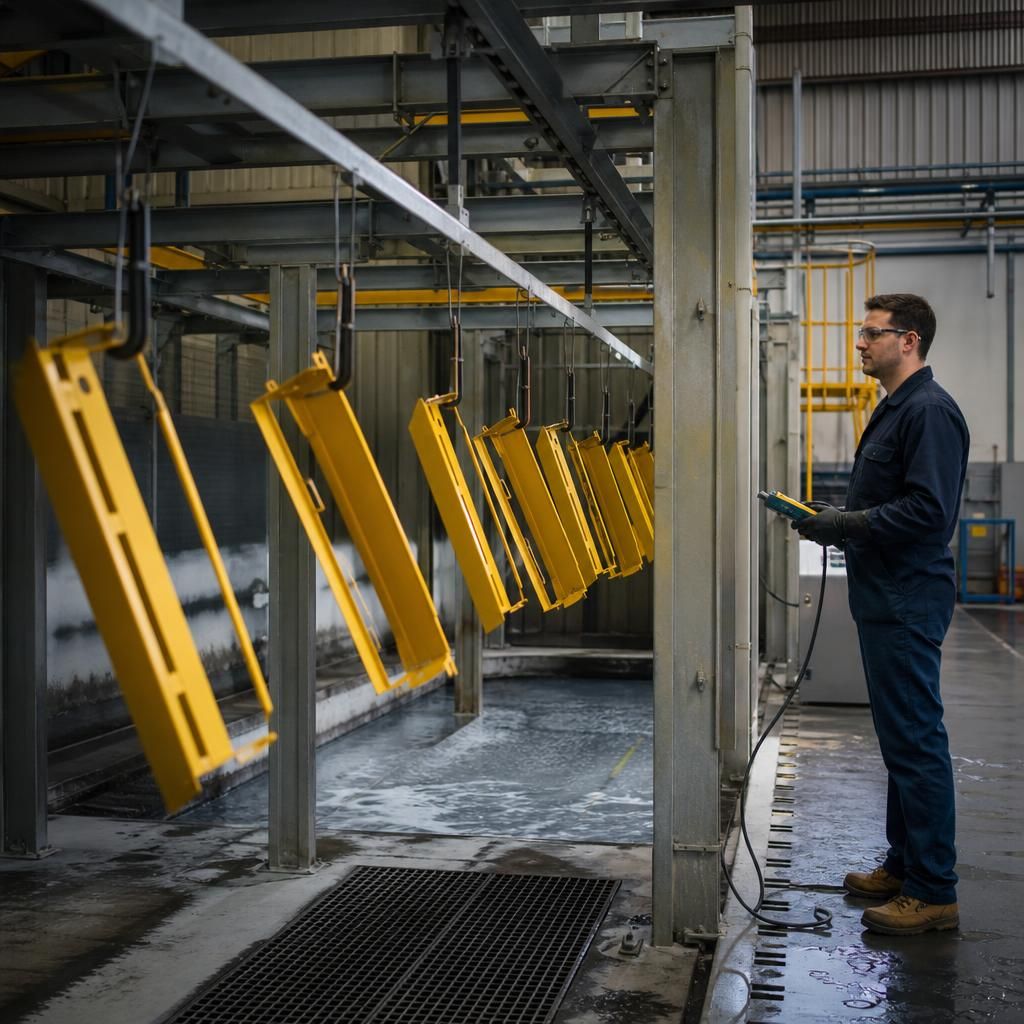
The operating environment should determine the coating specification, not appearance alone. Components exposed to moisture, road salt, chemicals, abrasion, impact, ultraviolet light or elevated temperatures may need a different powder chemistry, film build or pretreatment process from parts used indoors in a controlled environment.
When comparing conveyor powder coating systems, confirm that the line can apply and cure the selected coating consistently across the required component range. Consider whether masking, additional coats or specific surface preparation are needed, and assess exposed edges, joints and recessed areas where corrosion or incomplete coverage may begin. The finished part should then be evaluated against the service conditions it will encounter, using appropriate checks for adhesion, film thickness, cure and resistance.
Discuss the Right Conveyor Powder Coating Approach
Discuss your component range, production requirements and coating specification with an experienced powder coating provider to establish whether a conveyor-based approach is suitable. Sharing drawings, sample parts and handling requirements can support a more informed system assessment.