

How does the electrostatic charging process ensure a uniform coating on stainless steel components?
Electrostatic charging gives powder particles an electrical charge while the stainless steel component is grounded, creating an attraction that draws the powder evenly onto its surface. Controlled spray settings, correct grounding and suitable gun movement help maintain consistent deposition, including across edges and less accessible areas.
Electrostatic charging promotes a uniform powder coating by controlling how much electrical charge each particle carries and how that charge interacts with the stainless steel component. The resulting electric field guides powder towards the available metal surface, while carefully controlled charge levels help limit excessive build-up and variations in film thickness.
Inside the spray gun, powder is conveyed through an ionising field, commonly produced by a corona electrode. The particles acquire a charge-to-mass ratio that allows them to respond to the field around the component. This is important because the powder does not rely solely on the direction of the spray stream. Electrical forces influence the particle path, helping the powder follow the shape of the component and reach surfaces that are not directly in line with the nozzle.
Uniformity depends on maintaining a suitable balance between electrical charge, powder flow and the characteristics of the component. If the charge is too low, particles may not be guided effectively and transfer efficiency can fall. If it is too high, the deposited layer can resist further powder, producing roughness, uneven build or back-ionisation. Back-ionisation occurs when excess electrical charge accumulates in the coating and disrupts the normal deposition of incoming particles.
- Charge level: The gun must apply enough charge for stable deposition without creating excessive surface charge.
- Powder flow: A consistent supply helps prevent local areas from receiving too much or too little material.
- Particle properties: Powder formulation, particle-size distribution and electrical behaviour affect how readily the material charges and deposits.
- Component geometry: Corners, recesses, holes and closely spaced features alter the electric field and can create shielding effects.
- Contact and conductivity: Stainless steel is electrically conductive, but contamination, oxide layers or poor contact at the rack can interfere with charge dissipation.
One limitation is the Faraday cage effect. Electric field lines tend to concentrate around exposed edges and outer faces, while deep recesses or internal corners can receive less powder. A controlled charging programme reduces this imbalance by using settings suited to the component’s geometry rather than applying the same conditions to every part. Lower electrical intensity may help powder enter recessed areas, while the total powder feed and deposition sequence are adjusted to avoid overloading exposed edges.
The coating also becomes progressively less receptive as powder accumulates. This natural self-limiting effect is useful because it discourages unlimited build-up on easily reached faces. However, it does not guarantee equal thickness by itself. The operator must consider the surface area, profile and orientation of each component and establish a repeatable application sequence for the batch.
Stainless steel components can vary considerably in shape, from flat fabricated panels to tubular sections, brackets and machined parts. Their different edges and recesses produce different electrical field patterns. For this reason, uniform coating is best assessed across representative points rather than judged only by the appearance of the broadest face. Dry film thickness checks, visual inspection for missed areas and examination of corners can identify whether charging and deposition settings are properly matched to the component.
Consistent results also depend on keeping the equipment and powder conditions stable. A clean charging electrode, steady air supply and correctly conditioned powder support repeatable charge transfer. Changes in humidity, powder reclaim content or material handling can alter flow and charging behaviour, so these variables need to be controlled when producing repeat batches.
In practice, electrostatic charging is therefore one part of a controlled coating system. It provides the electrical forces that guide and distribute powder, while component conductivity, powder formulation, gun settings, geometry and quality checks determine whether the final film is genuinely even across the stainless steel surface.
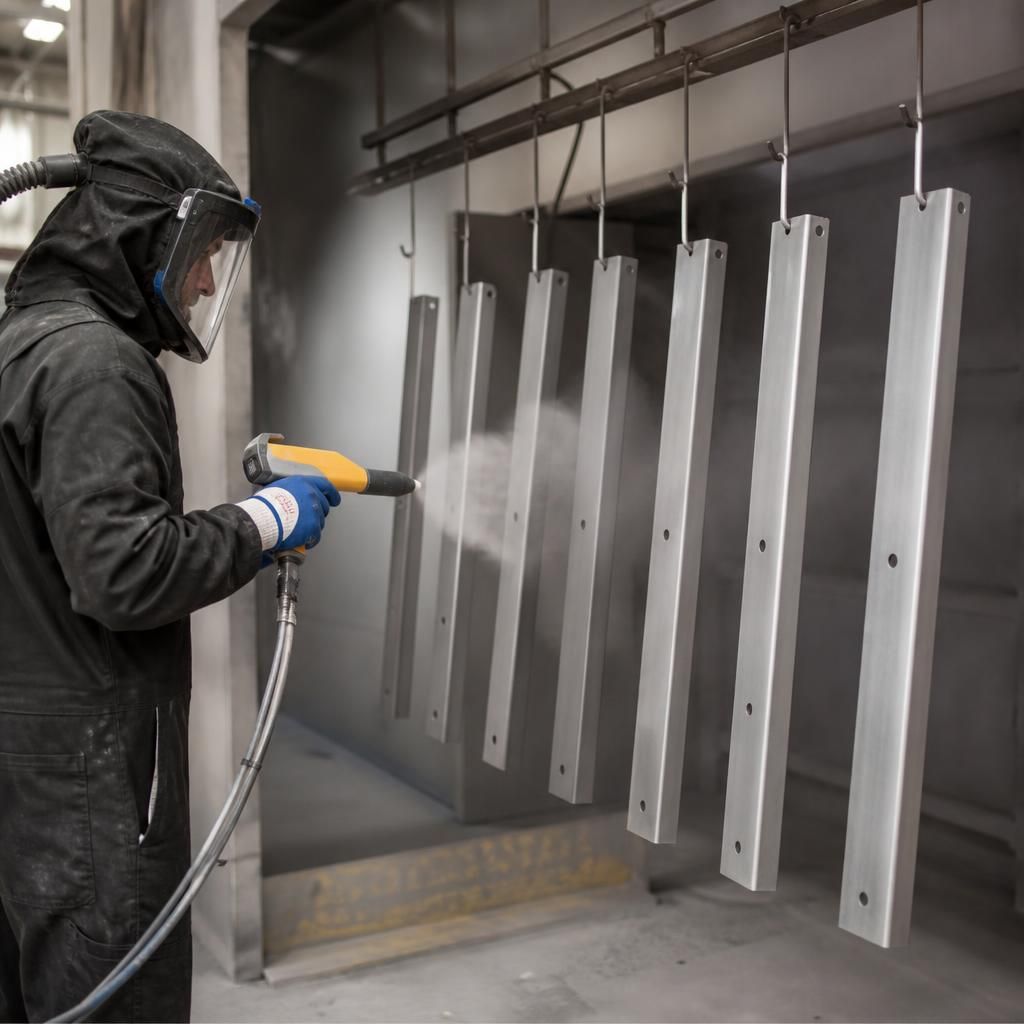
Grounding is essential because it gives charged powder a controlled destination. The stainless steel component must remain electrically connected through its hanging points and support rack so that deposited particles can discharge and remain attached to the metal. If the suspension point is poorly positioned or the contact is interrupted, the affected area may attract powder less effectively, even when the spray gun settings are correct. For repeatable coverage, the racking arrangement should provide a secure conductive path while leaving the key coating surfaces exposed.